The world’s most populous country seems to be adopting AI the most at work.
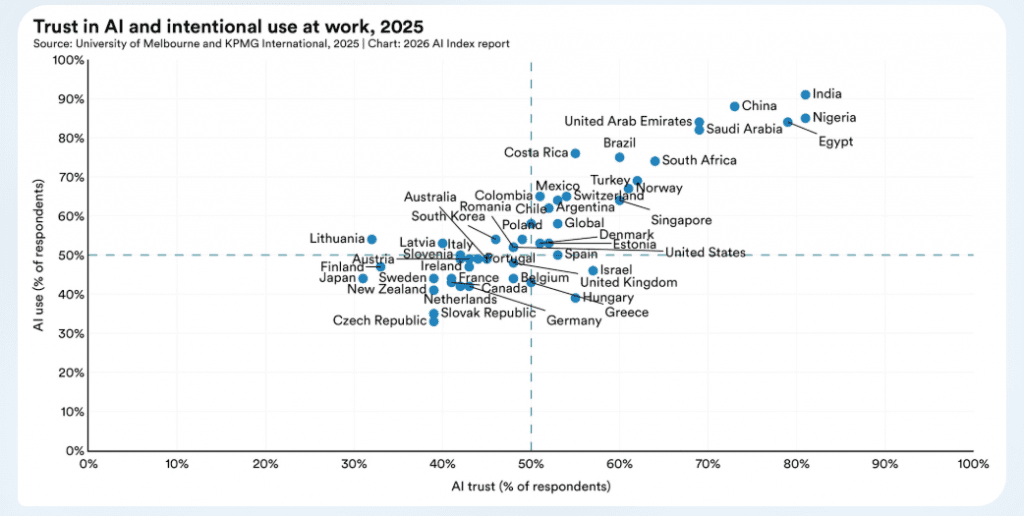
According to the newly released 2026 AI Index Report from Stanford University’s Institute for Human-Centered Artificial Intelligence, India tops the global chart on two critical dimensions: trust in AI and intentional use of AI at work. Based on survey data from the University of Melbourne and KPMG International, India recorded the highest percentage of respondents both trusting AI (~80%) and actively using it in their jobs (~90%) — placing it in a league of its own, far ahead of any Western nation.
The Chart That Says It All
The Stanford report’s scatter plot — mapping AI trust against AI use across dozens of countries — tells a stark story. India sits alone in the top-right corner: highest on the x-axis (trust), highest on the y-axis (use). Nigeria, Egypt, Saudi Arabia, and China cluster nearby, all showing strong trust and adoption. In sharp contrast, European nations and Japan huddle in the lower-left quadrant — low trust, low use. Germany, Czech Republic, and the Slovak Republic rank among the most reluctant AI adopters globally.
The United States lands squarely at the 50% trust mark with around 50% use — right at the global average, a modest position for a country that leads the world in AI investment.
Not A New Story — But Now It’s Official
India’s enthusiasm for AI at work has been building for years. This Stanford data now gives it the most authoritative stamp yet. OpenAI CEO Sam Altman had declared India its fastest-growing ChatGPT market in early 2025, saying the country was “outpacing the world” in AI adoption. That wasn’t just hype. India is OpenAI’s second-largest market globally, which prompted the company to open its first India office in New Delhi and launch its Go plan in India first before any other country.
The EY 2025 Work Reimagined Survey had separately found that India leads globally with an “AI Advantage” score of 53, compared to a global average of 34 — with 86% of Indian employees reporting a positive productivity impact from AI, and around 62% using it at work regularly.
Why India? A Few Factors
India’s high AI trust likely stems from a convergence of factors: a young, tech-hungry workforce, a culture of rapid digital adoption (the UPI payments revolution being a precedent), and a lack of the regulatory anxiety that makes European workers more sceptical. Unlike in the US, where only 31% of respondents trust their government to regulate AI — the lowest among all surveyed countries per the Stanford report — Indians appear broadly comfortable with both the technology and its oversight.
There’s also a demographic logic. India’s workforce skews young. Younger workers globally are more likely to view AI not as a threat but as a tool — even an operating system for their work life. The country’s large IT and services sector has also given millions of workers early, hands-on exposure to AI tools.
Big industry bets are reinforcing this. Reliance Industries launched its dedicated AI unit “Reliance Intelligence” in partnership with Google and Meta, with ambitions to build gigawatt-scale AI infrastructure and deliver AI services across healthcare, education, and agriculture. Meanwhile, global AI companies have been racing to deepen their India footprint — from OpenAI’s planned 1GW datacenter to Google offering free Gemini Pro access to Indian college students.
The Gap With The West
The Stanford chart lays bare a deepening divide. While India, China, the UAE, Saudi Arabia, Nigeria, and Egypt show both high trust and high use, most of Western Europe is stuck in a low-trust, low-use rut. France, Germany, Japan, and the Netherlands all sit well below the 50% mark on both dimensions.
This isn’t purely cultural. European AI regulation — particularly the EU AI Act — has created a climate of caution. Workers in these markets are more likely to perceive AI as a compliance risk or a job threat than an everyday ally. The United States, caught between high investment and high public anxiety, lands somewhere in the middle — using AI at around the global average, trusting it at around the same rate.
A Caveat Worth Noting
High trust and high use don’t automatically translate to high outcomes. Separate research has pointed to gaps in structured AI skilling in India — most workers globally spend fewer than 40 hours a year on AI-related learning — and some studies have flagged a trust gap specifically around AI-driven decisions (such as AI-managed performance reviews), even among enthusiastic adopters.
Still, on the broadest measure of workplace AI sentiment, the Stanford data is unambiguous: India is the most willing country on earth to bring AI into its working life. For AI companies looking for their next major market, that’s a signal that’s hard to ignore.