Meta’s personal AI agent Muse had, by most measures, one of the strongest launches of any consumer app in recent memory. It topped the US App Store within 48 hours of its September 8 debut, crossed 10 million US downloads in 40 days — a pace only a dozen apps in history have matched — and briefly out-downloaded ChatGPT’s own early run. Seven weeks later, the picture looks very different. Downloads are sliding, net new daily active users have fallen off a cliff, and a growing list of retailers and platforms are shutting Muse out entirely.
Here’s what the numbers actually say about Muse’s usage trajectory, and why the agent is struggling to turn a loud launch into a lasting habit.

The Launch Spike Was Real
There’s no disputing that Muse’s opening weeks were genuinely strong. The agent, built on Meta’s Muse Spark model and designed to take real-world actions — booking travel, sending emails, filling out forms, completing purchases through Stripe’s Link — launched in the US on iOS, Android, WhatsApp and muse.ai, and immediately benefited from Meta’s built-in distribution across Instagram, Facebook and WhatsApp’s combined 3.6 billion daily users.
Early Apptopia data showed Muse’s US and Canada mobile daily users beating ChatGPT’s at the same point after launch: 642,000 versus 231,000. By September 30, Muse had crossed 5 million downloads, helped by Meta sharply increasing ad spend around September 16, when daily downloads jumped 73% day over day. Google search interest for “Muse” spiked accordingly, briefly rivaling search volume for “ChatGPT” before settling back down to a fraction of it within weeks — a pattern visible in Google Trends data for the September–October window.
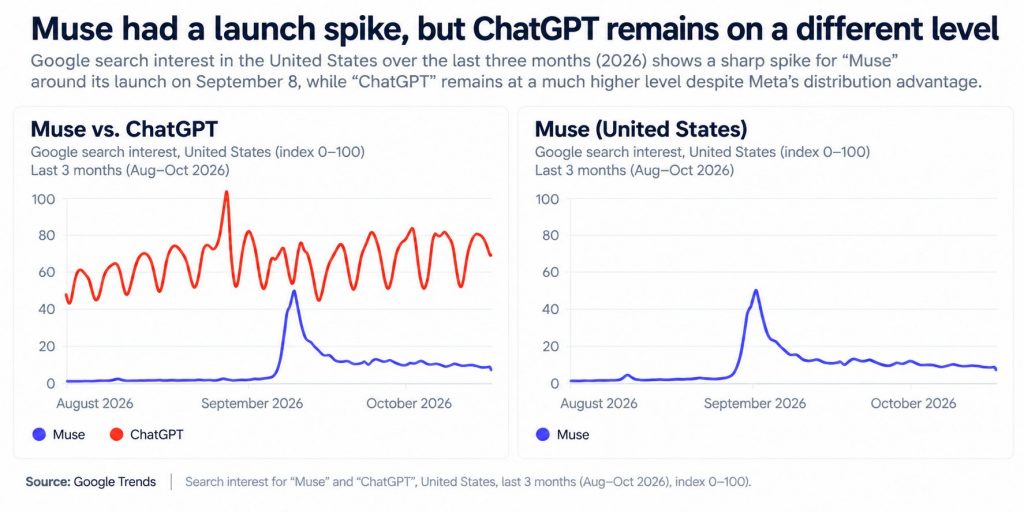
By October 20, Sensor Tower estimated Muse had reached 10.9 million downloads globally and 2.5 million US daily active users, putting it alongside only 11 other apps that have ever cleared 10 million US downloads in 40 days.
Then The Numbers Started Rolling Over
The deceleration shows up most clearly in the gap between downloads and actual usage. According to Hunterbrook Capital’s analysis, average daily downloads fell to roughly 165,000 through October 7, an 8.1% decline from the week before, and remained below the post-Connect-conference peak of 214,900 for 12 consecutive days.
The sharper drop is in net new daily active users — the number of people who actually stick around. In mid-September, Muse was adding approximately 198,000 new daily users per day. By early October, that had shrunk to about 74,000 — a 62.4% collapse in net additions. Total DAU reached roughly 2.73 million on October 6, a figure that, notably, trailed where Threads stood at the same point in its own early life.
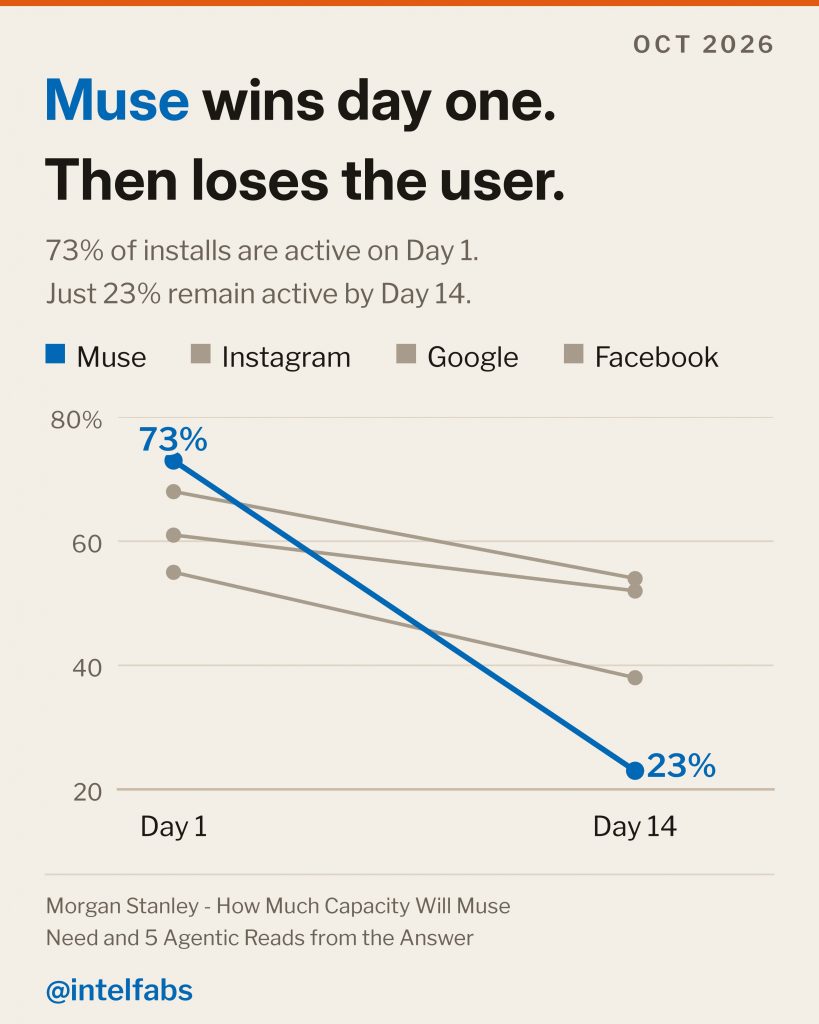
Retention data tells the same story from a different angle. Sensor Tower pegged Muse’s US retention at 73% on Day 1, falling to 23% by Day 14 — steeper than rivals in absolute terms, but still ahead of the 19%/16% averages Sensor Tower attributed to ChatGPT, Claude and Grok at seven and 14 days. A chart credited to a Morgan Stanley note put Muse’s 14-day retention at a similar 20–23%, with the bank flagging that Muse’s daily active users weren’t scaling anywhere near as fast as its download count, even as the firm’s AI capacity models were effectively built for an eventual 1 billion daily users. On actual engagement, Similarweb’s late-October breakdown found US Muse users spending just 7.5 minutes a day in the app, against 23 minutes for ChatGPT — a gap that suggests many of the people who do return aren’t using Muse for much once they’re there.
The slowdown hasn’t gone unnoticed by investors. Hunterbrook Capital disclosed a short position in Meta on October 9, explicitly citing Muse’s cooling momentum, the download dip, and a decline in app store reviews over the same window.
Why Agents Keep Getting Blocked
A significant part of Muse’s engagement problem isn’t about the product itself — it’s about how much of the open web is actively closing its doors to it. Muse’s core pitch is that it can act on a user’s behalf across the internet: shop, book, negotiate, check out. That only works if the sites on the other end let it in, and a growing number don’t.
Amazon blocked Muse from shopping on Amazon.com on September 20, just 12 days after launch, serving users a popup citing its Conditions of Use. Amazon’s stated reasoning was that Meta hadn’t disclosed Muse would be accessing its store, and that the agent wasn’t identifying itself as AI while browsing — Amazon has taken a similarly hard line against other AI shopping agents, alongside JPMorgan Chase and Charles Schwab blocking agents from touching customer accounts, Yelp paywalling its data from agents, and Delta blocking agents from booking flights outright.
Walmart, despite being a Muse partner, has had its own friction — users have reported anti-bot checks interrupting the agent mid-task, though that’s being described as a technical glitch rather than a deliberate ban. Users have also reported Muse getting shut out of sites including Cars.com, Amtrak, Adidas and Pizza Hut, along with eBay account suspensions tied to agent activity. Because platforms rarely announce these blocks publicly, the true scope of how much of the commercial web is now off-limits to Muse is likely larger than what’s been confirmed on the record.
This matters directly for the usage numbers above. If a meaningful share of what people download Muse to do — shop, book travel, manage subscriptions — gets interrupted by a block or a rejected checkout, the natural result is exactly what the retention curve shows: strong initial curiosity, followed by users not finding a reason to come back on Day 7 or Day 14. An agent that can’t reliably complete the tasks it was built for has a structural ceiling on habit formation that no amount of ad spend can fully offset.
The Bigger Picture
None of this means Muse has failed. It’s still pulling in roughly 300,000 new US downloads a day by some estimates, still outperforming ChatGPT, Claude and Grok on raw 14-day retention percentages, and still benefiting from a distribution advantage — Meta’s own apps — that no rival AI agent has access to. Meta reports third-quarter earnings this week, and Muse adoption, retention and monetization will be among the most closely watched lines in that report.
But the gap between Muse’s download chart and its usage chart is exactly the gap investors and analysts are now pointing to. Getting someone to tap “install” turned out to be the easy part. Getting them to come back — and getting the rest of the internet to let the agent actually do its job once they do — is the much harder problem Meta now has to solve.