Even as frontier models from US keep getting better, Chinese open-source is more than keeping up.
Moonshot AI, the Beijing-based startup behind the Kimi series, has released Kimi K2.6 — its latest open-source model that claims state-of-the-art performance in agentic coding, long-horizon execution, and multi-agent orchestration. The model is available via Kimi.com, the Kimi App, the API, and Kimi Code.
Kimi K2.6: Benchmark Numbers
On several key benchmarks, K2.6 edges out or closely matches GPT-5.4 (xhigh) and Claude Opus 4.6 (max effort). It leads the pack on SWE-Bench Pro (58.6 vs. GPT-5.4’s 57.7 and Claude Opus 4.6’s 53.4), DeepSearchQA (92.5 vs. 91.3 for Claude), and Humanity’s Last Exam with tools (54.0 vs. 53.0 for Claude and 52.1 for GPT-5.4). On Toolathlon, an agentic tool-use benchmark, K2.6 scores 50.0 — ahead of Claude (47.2) and Gemini 3.1 Pro (48.8). It also ties Gemini 3.1 Pro on SWE-Bench Multilingual (76.7 vs. 76.9) and V* (96.9 vs. 96.9).
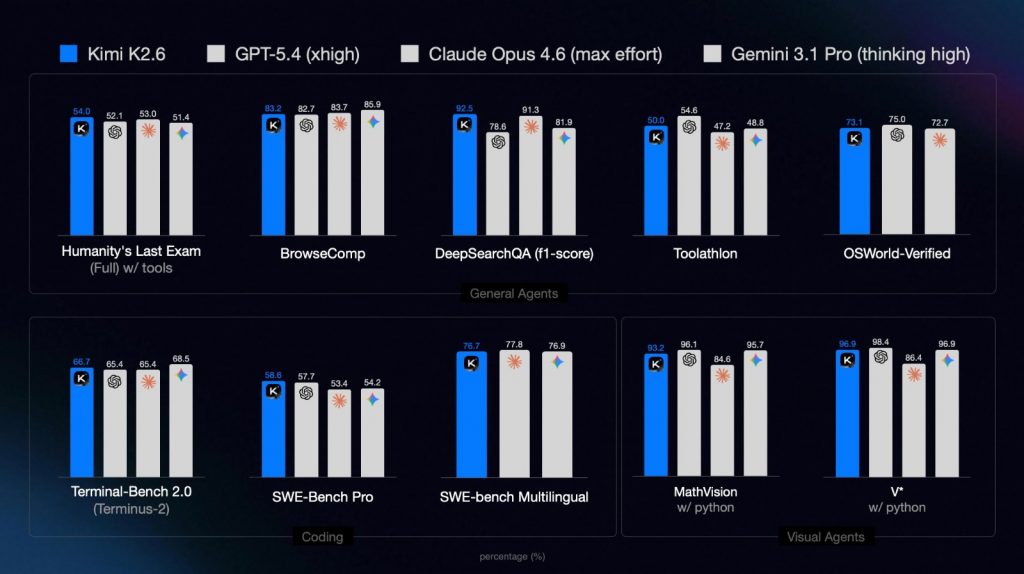
To be clear, K2.6 doesn’t dominate across the board. GPT-5.4 and Gemini 3.1 Pro maintain leads in pure reasoning benchmarks like AIME 2026, GPQA Diamond, and BrowseComp. But the fact that an open-source Chinese model is competitive on agentic and coding tasks — often the most commercially relevant benchmarks — is the story worth watching.
Moonshot AI’s Kimi series has been on a rapid ascent. Kimi K2.5 had already topped the Artificial Analysis Intelligence Index as the strongest open model, outperforming Claude 4.5 Sonnet. K2.6 builds on that trajectory with a specific focus on execution depth, not just benchmark scores.
Long-Horizon Coding: The Real Differentiator
The headline capability in K2.6 is not raw benchmark performance — it’s sustained, autonomous execution. Moonshot showcases two examples that are difficult to dismiss:
In one demonstration, K2.6 optimized local inference of the Qwen3.5-0.8B model on a Mac using Zig — a niche, low-level language — across 4,000+ tool calls and over 12 hours of continuous execution, ultimately improving throughput by roughly 20% beyond LM Studio’s performance.
In another, K2.6 autonomously refactored exchange-core, an 8-year-old open-source financial matching engine, over 13 hours and 12 optimization passes — delivering a 185% improvement in medium throughput and 133% gain in peak throughput. It made over 1,000 tool calls and modified more than 4,000 lines of code.
These are sustained engineering tasks of the kind that matter to real enterprises. Partners including Vercel, Baseten, Ollama, and Factory.ai have validated K2.6’s improvements over K2.5, with Vercel reporting more than 50% improvement on its Next.js benchmark.
Agent Swarms, Scaled Up
K2.6 also pushes Moonshot’s Agent Swarm architecture further. The new version supports 300 parallel sub-agents executing across 4,000 coordinated steps simultaneously — up from K2.5’s 100 sub-agents and 1,500 steps. The system can decompose complex tasks into heterogeneous subtasks and produce end-to-end deliverables including documents, websites, slides, and spreadsheets within a single run.
Chinese open-source models have already displaced US open models as the developer community’s preferred choice. OpenRouter data shows Chinese models triggered sustained usage spikes that held well beyond initial launch weeks — a sign of genuine production adoption, not curiosity. K2.6’s Agent Swarm capabilities, if they hold up at scale, give enterprises another reason to build on Kimi rather than wait for GPT or Claude to catch up on openness.
Claw Groups: Humans and Agents, Together
The most forward-looking feature in K2.6 is Claw Groups (research preview) — a framework where users can bring agents from any device, running any model, into a shared operational space. K2.6 acts as an adaptive coordinator, routing tasks to agents based on skill profiles and handling failures automatically. It’s a bet on heterogeneous, human-in-the-loop agent networks as the next frontier of AI deployment.
Moonshot’s own marketing team reportedly runs end-to-end content production using Claw Groups, with specialized agents for demo creation, benchmarking, social media, and video — all coordinated by K2.6.
The Bigger Picture
Chinese AI models have grown rapidly in adoption among startups, and it’s not hard to see why. Kimi K2 Thinking had already beaten Grok 4 and Gemini 2.5 Pro on the Artificial Analysis rankings. The pattern across the Kimi model family — K2, K2 Thinking, K2.5, and now K2.6 — shows consistent, rapid iteration with each release pushing further into territory previously held by closed US models.
K2.6 is open-source, competitively priced, and capable of sustained autonomous execution at a level that closed models from OpenAI and Anthropic are still working toward. For developers and enterprises evaluating their AI infrastructure, that combination is increasingly hard to ignore.