Moonshot AI’s Kimi K3 has had X abuzz all of yesterday with its high-quality 3D generations, and the model’s size and pricing are now out.
Kimi K3 comes in at 2.8 trillion total parameters, which Moonshot says makes it the largest open-source model released to date. That puts it well ahead of DeepSeek’s V4-Pro at 1.6 trillion and comfortably clear of every other open-weight release from a Chinese lab this year, including Xiaomi’s 1.02 trillion parameter model and Z.AI’s 744 billion parameter offering. Moonshot’s own chart, which tracks flagship open-source models going back to July 2025, shows just how sharply the line jumps with K3 after months of the field hovering in the 500 billion to 1 trillion parameter range. The model is available on Kimi’s website, though benchmarks are currently awaited.
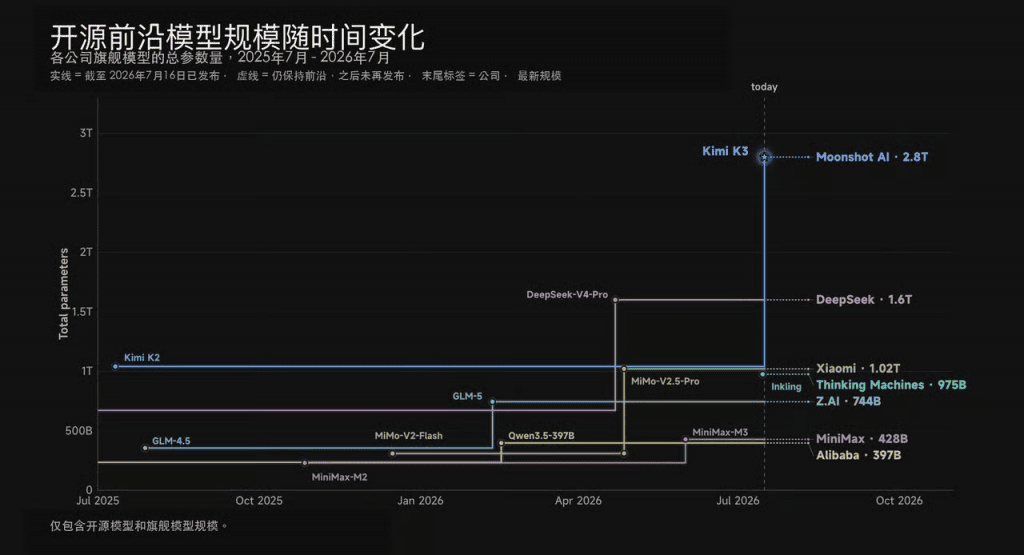
The company says this is the ninth time in the past year that a Kimi release has set a new record for open-source model scale, a run that started with Kimi K2 at 1 trillion parameters and has continued through the K2.5, K2.6 and K2.7 Code updates. Each of those releases chipped away at the gap between open and closed models rather than closing it in one move, and K3 appears to be the point where Moonshot decided to make a bigger jump instead of another incremental one.
Alongside the parameter count, Kimi K3 ships with a 1 million token context window, which Moonshot is pitching as suited for software engineering, knowledge work and what it calls deep reasoning. The model is built on what the company describes as a new architecture involving Attention Residuals, a technique Moonshot open-sourced earlier this year as a drop-in replacement for standard residual connections, along with native visual understanding baked directly into the model rather than bolted on as a separate module.
On benchmarks, Moonshot says K3 delivers frontier-level performance and that among the models it tested, its overall intelligence ranks second only to Claude Fable 5 and GPT-5.6 Sol. That would place it ahead of Gemini and other frontier releases on Moonshot’s internal evaluation set, though the company has pointed to its tech blog for the full breakdown rather than publishing every number on the model’s landing page. It’s a notably different framing from K2.6’s launch, where Moonshot leaned on benchmark tables showing it edging out GPT and Claude on specific tasks like SWE-Bench Pro and Toolathlon rather than claiming a straightforward overall ranking.
The pricing has also been published. Kimi K3 costs $0.30 per million tokens for cached input, $3 per million tokens for input that misses the cache, and $15 per million tokens for output, with the full 1,048,576 token context window included at that rate. That output price sits above what Moonshot charged for K2.7 Code, reflecting the jump in scale, though it remains well under what OpenAI and Anthropic charge for their top-tier models.
Kimi K3 also supports automatic context caching, tool calls, JSON mode, structured outputs through JSON Schema, and partial mode, along with two capabilities that are new to this generation: tool choice constraints and dynamically loaded tools. The model reasons by default, and its documentation currently lists only a single reasoning effort setting, max, with no lighter-weight option available yet. Moonshot has flagged that its web search functionality is being updated and has advised developers not to rely on it in the near term.
Kimi K3 Benchmarks
Moonshot is positioning K3 as its strongest coding model yet, built to hold up across long software engineering tasks rather than just single-shot prompts. That means reading through large codebases, working the terminal, chaining tool calls, checking how code actually behaves at runtime, and correcting course on its own when an attempt doesn’t pan out. The bigger jump, according to Moonshot, comes on tasks that blend coding with visual understanding and spatial reasoning, where the model can go back and forth between the source code it’s writing and what that code actually renders, using screenshots, logs and test results to figure out what to fix next. That’s the combination Moonshot is leaning on for use cases like game development, frontend work, CAD, and infrastructure tuning, and it lines up with what testers were seeing in those early 3D and frontend demos circulating on X.
On the knowledge work side, Moonshot is citing numbers from Artificial Analysis. K3 scored 1687 on GDPval-AA v2, a leaderboard that tests models against real tasks spanning 44 occupations across nine industries, putting it behind Claude Fable 5 Max and GPT-5.6 Sol Max but ahead of Claude Opus 4.8 Max, which scored 1600. On AA-Briefcase, a private benchmark Artificial Analysis built specifically to measure long-horizon agentic knowledge work, K3 scored 1527, again landing second behind Claude Fable 5 Max and just ahead of GPT-5.6 Sol Max at 1495.
The 1 million token context window shows up in K3’s BrowseComp result too. Moonshot says the model hit a state-of-the-art score of 91.2 on the benchmark running as a single agent, with no context compression or other workarounds needed to manage the window — a result the company is holding up as evidence of how K3 handles long, difficult information-seeking tasks.
The buzz around K3 actually started before any of this was official. Over the past two days, developers testing an anonymized checkpoint called Kivine on arenas and coding platforms began posting side-by-side comparisons with GPT-5.6 Sol and Claude Fable 5, with several calling its frontend and 3D generation output some of the best they’d seen from any model, open or closed. One widely shared thread showed the model building a fully animated, real-time Star Wars-style trench run from a prompt that was only meant to produce a static scene. The trade-off users flagged repeatedly was speed, with some generations taking over half an hour to complete, which lines up with Moonshot’s own description of K3 as a model built for deep reasoning rather than quick turnaround.
Full model weights are expected to be released soon, with a technical report covering the architecture, training process and evaluation details to follow alongside them. Moonshot has previously released its models under a modified MIT license, and K3 is expected to follow the same approach, though that hasn’t been formally confirmed yet.
The release lands at a moment when Moonshot is also reportedly closing a new funding round that would value the company at $31.5 billion, more than fifteen times what it was valued at just over a year ago. That trajectory mirrors what’s happened to Moonshot’s earlier releases: K2.5 briefly became the top-ranked open model on the Artificial Analysis Intelligence Index in January, before K2.6 pushed further up the board to land just three points behind Claude, Gemini and GPT-5.4 in April. Whether K3 can hold second place on independent benchmarks the way it has on Moonshot’s own testing will likely become clear over the next few days, once outside evaluators get their hands on the weights.