Kimi K3’s benchmarks are out on WeChat, and Moonshot has delivered an incredibly strong performance.
Moonshot’s own numbers put K3 behind Claude Fable 5 and GPT-5.6 Sol on overall intelligence, the company said as much itself, but the benchmark breakdown tells a messier and more interesting story than a straight third-place finish. Across coding, agentic work, visual reasoning and knowledge work, K3 beats one or both of the two frontier closed models on a majority of the individual tests Moonshot published, even if it can’t match them everywhere at once.
Kimi K3 Coding benchmarks
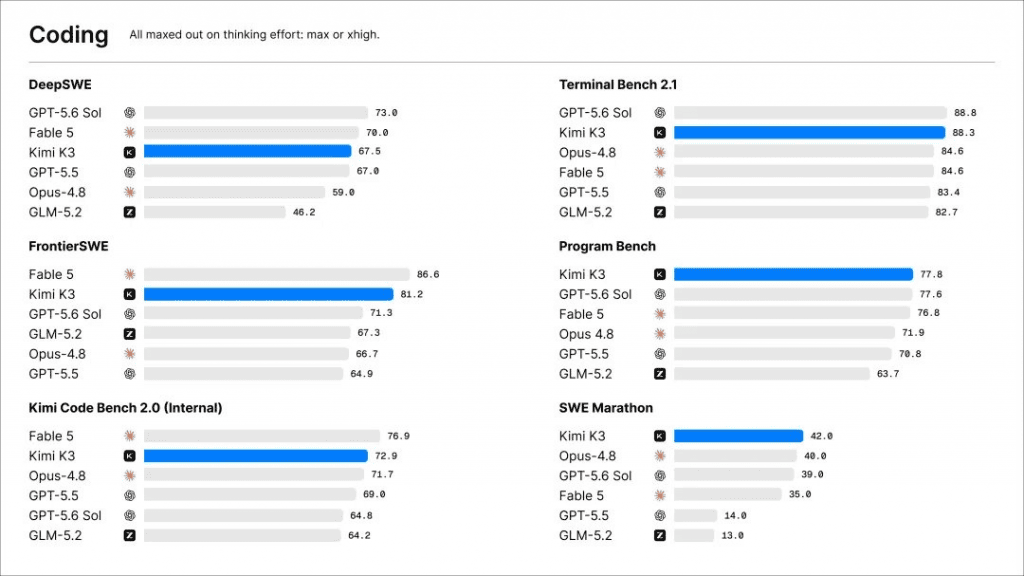
On coding, the split shows up almost immediately. On DeepSWE, GPT-5.6 Sol leads at 73.0 and Fable 5 follows at 70.0, with K3 a step behind at 67.5. But that gap disappears on Program Bench, where K3 tops the field outright at 77.8, edging out GPT-5.6 Sol’s 77.6 and Fable 5’s 76.8. The same pattern plays out on SWE Marathon, a benchmark built around long, sustained coding sessions rather than short tasks, where K3 leads at 42.0 against Opus-4.8’s 40.0, GPT-5.6 Sol’s 39.0 and Fable 5’s 35.0. On Terminal Bench 2.1, K3 comes in at 88.3, just short of GPT-5.6 Sol’s 88.8 but ahead of both Opus-4.8 and Fable 5, which tie at 84.6. FrontierSWE is the one place Fable 5 pulls well clear at 86.6, though K3’s 81.2 still comfortably beats GPT-5.6 Sol’s 71.3 there. Even on Moonshot’s own internal Kimi Code Bench 2.0, where Fable 5 tops the chart at 76.9 and K3 sits at 72.9, K3 still finishes ahead of GPT-5.6 Sol, which trails at 64.8.
Kimi K3 General Agent benchmarks
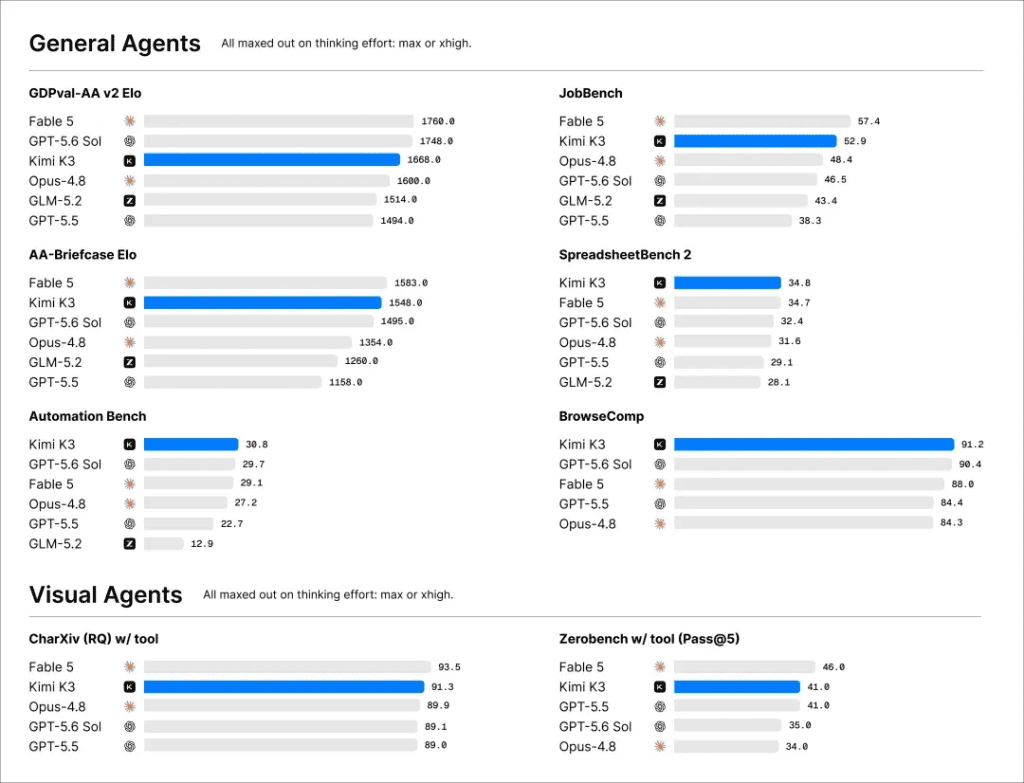
The general agent benchmarks follow a similar shape. K3 loses out on the two headline Elo-based leaderboards, GDPval-AA v2 and AA-Briefcase, where Fable 5 and GPT-5.6 Sol both finish ahead of it, K3 scored 1668 on GDPval-AA v2 against Fable 5’s 1760 and GPT-5.6 Sol’s 1748, and 1548 on AA-Briefcase against Fable 5’s 1583, though it does clear GPT-5.6 Sol’s 1495 there. But on the task-specific agent benchmarks, K3 pulls ahead more often than not. On Automation Bench it leads outright at 30.8, ahead of GPT-5.6 Sol’s 29.7 and Fable 5’s 29.1. On SpreadsheetBench 2 it edges out both again, 34.8 against Fable 5’s 34.7 and GPT-5.6 Sol’s 32.4. And on BrowseComp, the long-context search and retrieval benchmark, K3 posts a state-of-the-art 91.2, ahead of GPT-5.6 Sol’s 90.4 and Fable 5’s 88.0. JobBench is the exception among this group, Fable 5 leads clearly at 57.4, and while K3’s 52.9 beats GPT-5.6 Sol’s 46.5, it doesn’t touch Fable 5’s score.
Kimi K3 Visual Reasoning benchmarks
Visual reasoning shows the same trade-off. On CharXiv, a chart and figure comprehension benchmark run with tool access, Fable 5 leads at 93.5 with K3 close behind at 91.3, ahead of both Opus-4.8 and GPT-5.6 Sol. On Zerobench, a harder visual reasoning test measured at pass@5, Fable 5 again leads at 46.0, K3 ties GPT-5.5 at 41.0, and both sit well clear of GPT-5.6 Sol’s 35.0.
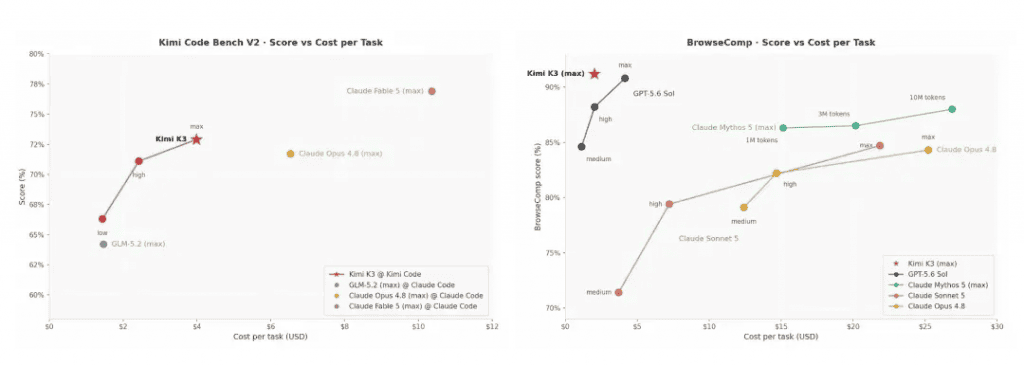
Cost is where Moonshot leans hardest into K3’s positioning. On the Kimi Code Bench V2 score-versus-cost chart, K3 running at max thinking effort lands at roughly 73 percent for around $3.50 per task, while Fable 5 at max effort scores higher near 78 percent but costs closer to $9 per task to run. The BrowseComp cost chart tells an even sharper version of the same story, K3’s SOTA score of 91.2 comes in at under $2 per task, while GPT-5.6 Sol, Claude Mythos 5 and Opus 4.8 all need anywhere from $5 to $27 per task to reach their own scores, with some of those higher scores only achievable by feeding the model multi-million-token context windows.
On Moonshot’s internal knowledge work benchmarks, which compare K3 against GPT-5.5 and Claude Opus 4.8 rather than the two newest frontier models, K3 leads clearly across the board. It scores 75.5 on Online Exp Bench against GPT-5.5’s 70.6 and Opus 4.8’s 65.9, 73.5 on DECK-Bench against 68.2 and 66.9, and 62.6 on Finance-Bench against 60.7 and 58.4.
Taken together, the picture Moonshot is painting is less about topping every leaderboard and more about density of wins across a wide spread of tasks, paired with a cost profile that undercuts both Fable 5 and GPT-5.6 Sol by a wide margin. Whether that holds up once independent evaluators get access to the weights, expected by July 27, will be the next thing worth watching.
Warning bells for OpenAI, Anthropic?
These numbers could put a spanner in the works for the IPO plans of OpenAI and Anthropic. Both labs are looking to go public over the next few months, and if these benchmark results hold in independent evaluations, they could be a big determinant of investor mood in these issues. Moonshot has said that it would soon make the weights open-source, which would mean that enterprieses could simply choose to go with open models like Kimi K3 as opposed to with closed frontier labs like Anthropic and OpenAI. This could result not only in cost savings, putting pricing pressure on the two US labs, but also give large companies more security with their data if they choose to run and deploy an open model on their own hardware. It remains to be seen how things shape up, but Kimi K3’s release is likely being watched just as closely by Anthropic and OpenAI as the broader tech community.