China is within touching distance of the top US frontier labs.
Artificial Analysis has scored Moonshot AI’s Kimi K3 at 57 on its Intelligence Index, placing it third overall, right behind Claude Fable 5 at 60 and GPT-5.6 Sol at 59. That puts K3 in the same band as Claude Opus 4.8 and GPT-5.5, both of which score lower, and ahead of every other model on the board, including GPT-5.6 Terra, GPT-5.6 Luna, Grok 4.5, and GLM-5.2. For an open-weights model going up against the two most talked-about closed releases of the year, third place with a two and three point gap respectively is about as close as anyone has come.
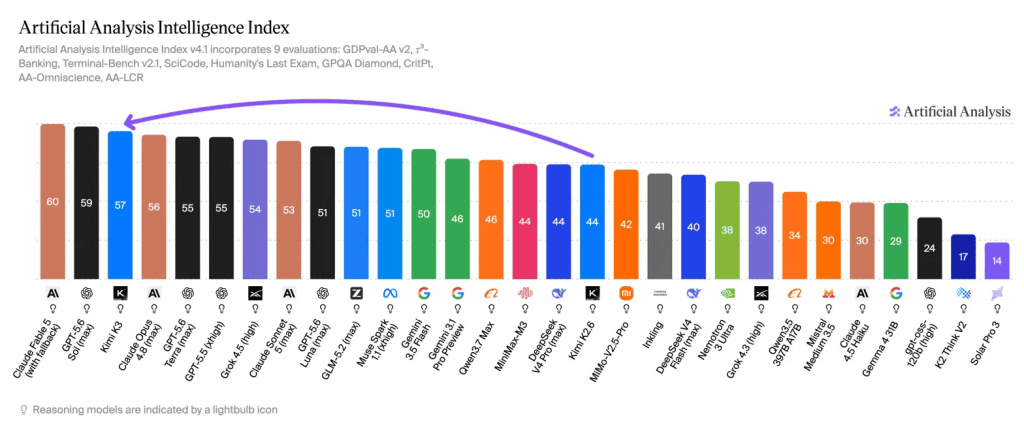
The scale of the jump is what stands out most. Kimi’s previous flagship, K2.6, had debuted at 54 in April, three points behind the top three closed models of that moment on a different version of the index. Kimi K3 hasn’t just kept pace with where the frontier has moved since then, it’s closed the gap further, even as Fable 5 and GPT-5.6 Sol both represent a full generation of improvement over what K2.6 was originally measured against.
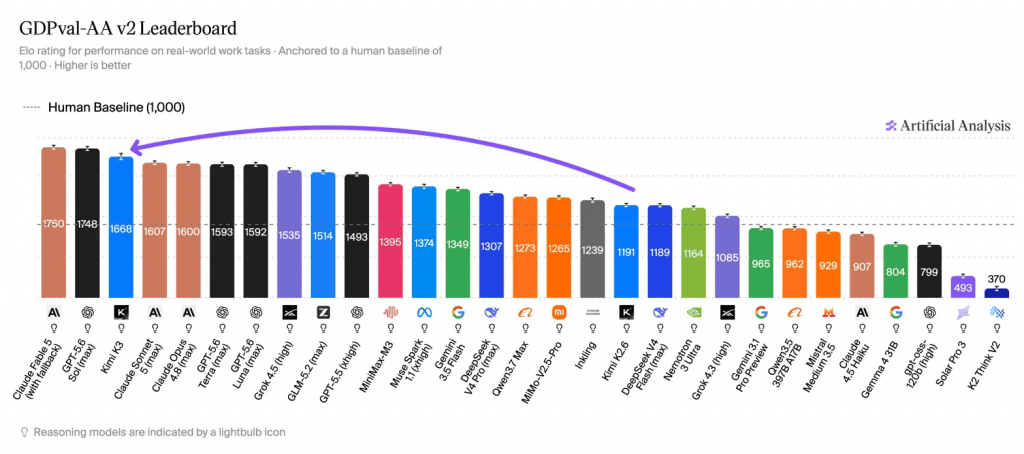
On GDPval-AA v2, Artificial Analysis’ benchmark for real-world work tasks anchored to a human baseline of 1,000, K3 posts an Elo of 1668. That’s a jump of nearly 500 points over K2.6’s 1191, and it puts K3 ahead of Claude Sonnet 5 (1607), Claude Opus 4.8 (1600), and both GPT-5.6 Terra and GPT-5.6 Luna, which sit at 1593 and 1592. Only Fable 5 (1750) and GPT-5.6 Sol (1748) score higher. On AA-Briefcase, a private evaluation Artificial Analysis built specifically for long-horizon agentic knowledge work, K3 comes in at 1548, second only to Fable 5 and a gain of 732 points over K2.6. Artificial Analysis notes that K3’s rubric and analytical scoring on this benchmark are close enough to Fable 5’s that the real separation between the two comes down to presentation quality, an area where GPT-5.6 Sol continues to lead.
K3 also takes outright first place on AutomationBench-AA, Artificial Analysis’ implementation of Zapier’s agentic SaaS workflow evaluation, with a score of 53%.
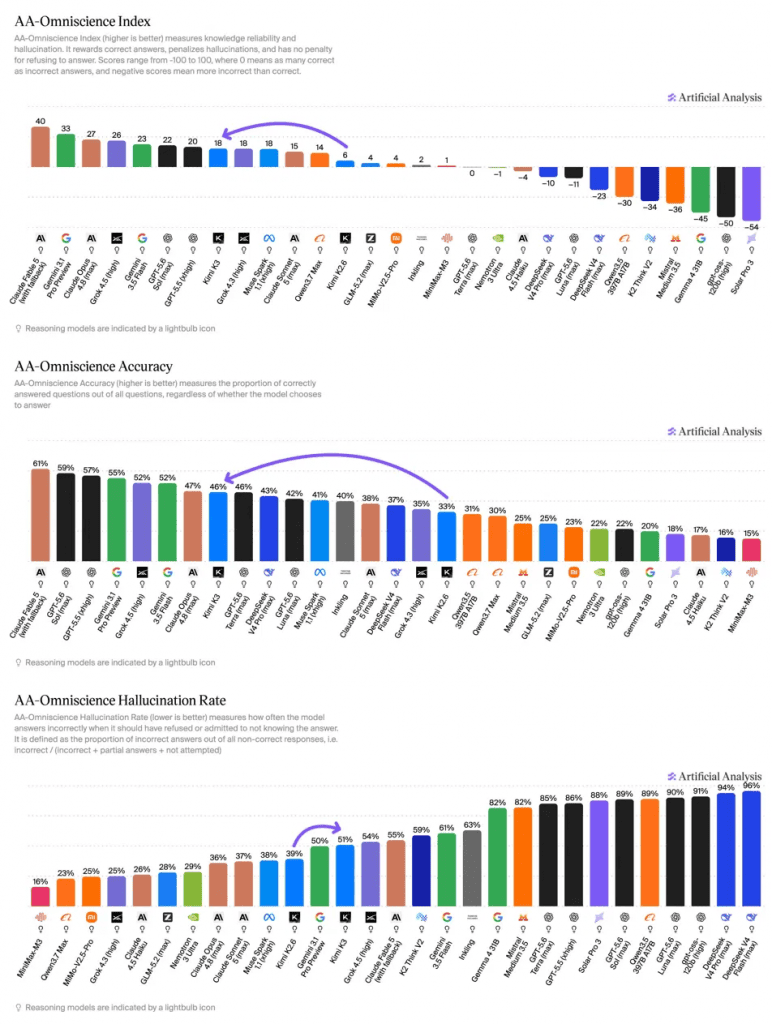
The AA-Omniscience results tell a more complicated story. This benchmark measures knowledge reliability rather than raw capability, rewarding correct answers and penalizing hallucinations while applying no penalty for a model that simply declines to answer. K3’s overall index score improved to 18, up from K2.6’s 6, driven by a jump in accuracy from 33% to 46%. But the hallucination rate rose too, from 39% to 51%, meaning K3 answers more questions correctly than its predecessor while also getting a larger share of its wrong answers flat-out wrong rather than hedging. Claude Fable 5 leads this particular chart by a wide margin, scoring 40 on the index with a 61% accuracy rate and just a 16% hallucination rate.
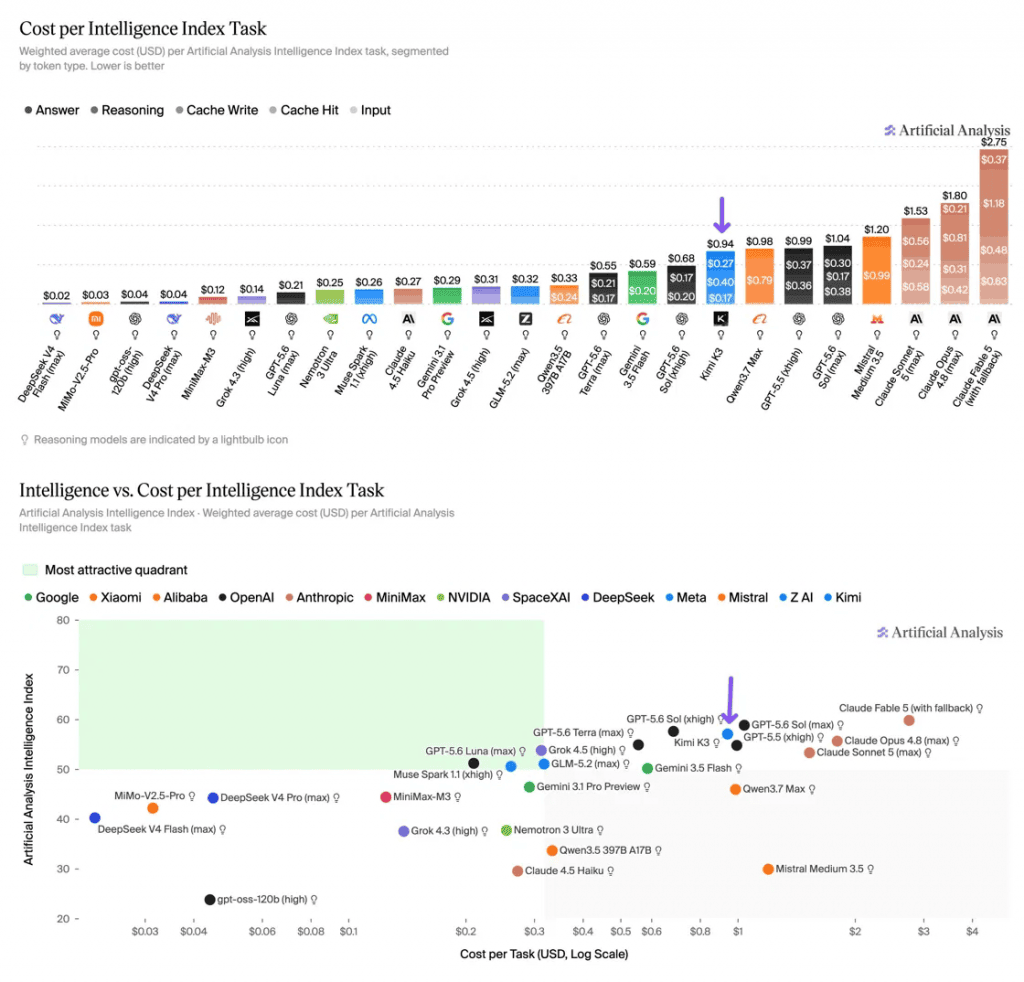
Cost is one of the more favorable parts of the picture for Moonshot. Running K3 through the full Intelligence Index costs an average of $0.94 per task, close to GPT-5.6 Sol’s $1.04 and roughly half of what Claude Opus 4.8 costs at $1.80. That’s a steep climb from K2.6’s own pricing, K3’s output tokens are listed at $15 per million against K2.6’s $4, but it still lands well under what Fable 5 costs to run, at $2.75 per task with fallback enabled. K3 also became more token-efficient in the process, using around 132 million output tokens to complete all nine evaluations in the index, a 21% drop from K2.6’s roughly 166 million, while scoring higher across the board.
Moonshot has not released K3’s weights yet, though the company has said it plans to. Artificial Analysis notes that once they’re out, K3 will lead every other open-weights model on the index by a wide margin, ahead of GLM-5.2 at 51 and DeepSeek V4 Pro at 44, while also being considerably larger than any of them; GLM-5.2 runs at 753 billion parameters and DeepSeek V4 Pro at 1.6 trillion, against K3’s 2.8 trillion. The model also carries over native image and text input from K2.6, which Artificial Analysis flags as a meaningful edge among open-weights models once the weights ship, since multimodal input remains rare at this end of the field.
The result adds to a run that has been building for over a year now. Kimi K2 launched last July as the strongest open model on several benchmarks of the time, and the series has kept closing ground on the closed frontier with each release since, most recently with K2.6 landing just three points behind Anthropic, Google, and OpenAI’s flagships in April. Whether K3 can hold third place once Fable 5 and GPT-5.6 Sol themselves get answered by the next round of releases remains to be seen, but for now it’s the closest an open, Chinese-made model has come to the very top of the leaderboard.