Meta has made a serious play to the very frotiner of the AI space.
Meta has released Muse Wonder, a new family of frontier models the company says brings it to the frontier of personal and professional agentic work, going up directly against Anthropic’s Claude Opus 5.5 and OpenAI’s GPT-6 Astra.
Announcing the release, Meta CEO Mark Zuckerberg said it has been just over a year since Meta Superintelligence Labs was formed, and that Muse Wonder marks a significant step up from Muse Spark, the lab’s first model family. “Muse Wonder is a much larger and more advanced class of models that brings us to the frontier,” Zuckerberg said.
Meta is releasing two models under the Muse Wonder banner: Muse Wonder, aimed at fast frontier performance, and Muse Wonder Full, which Meta describes as the complete version of the model. Both are available starting today, with Zuckerberg saying people can use Muse Wonder to power their Muse agent by subscribing, and that Meta will “work to bring this level of intelligence to everyone over time.” The models are also rolling out through Muse Code and the Meta Model API, with availability in other Meta products to follow.
Muse Wonder Benchmarks
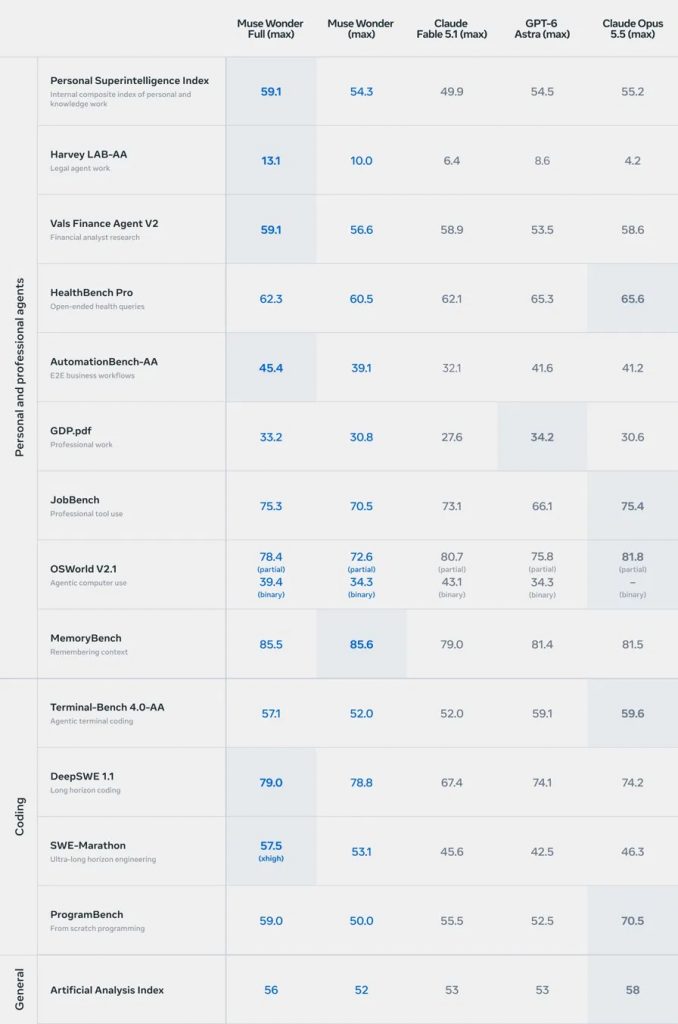
Meta’s own benchmark charts put Muse Wonder Full ahead of Claude Fable 5.1, GPT-6 Astra and Claude Opus 5.5 on several agentic and knowledge-work tests, while trailing on some coding-specific benchmarks.
On Meta’s internal Personal Superintelligence Index, a composite score for personal and knowledge work, Muse Wonder Full scores 59.1, ahead of Claude Opus 5.5 (55.2), GPT-6 Astra (54.5) and Claude Fable 5.1 (49.9). The smaller Muse Wonder model scores 54.3 on the same index.
The gap is widest on Harvey’s LAB-AA legal agent benchmark, where Muse Wonder Full scores 13.1 against Claude Opus 5.5’s 4.2 and GPT-6 Astra’s 8.6. Muse Wonder Full also leads on AutomationBench-AA, a test of end-to-end business workflows, with a score of 45.4 against 41.2 for Opus 5.5 and 41.6 for Astra, and on MemoryBench, a test of how well a model retains context, where the smaller Muse Wonder model edges out the rest of the field at 85.6.
Meta’s models post strong numbers on professional tool use too: Muse Wonder Full scores 75.3 on JobBench, just behind Opus 5.5’s 75.4, and 59.1 on Vals AI’s Finance Agent V2 benchmark, ahead of both GPT-6 Astra (53.5) and Claude Fable 5.1 (58.9).
Coding is where the picture is more mixed. On DeepSWE 1.1, a long-horizon coding benchmark, Muse Wonder Full leads with a score of 79.0. It also tops SWE-Marathon, a test of ultra-long horizon engineering work, at 57.5 running at “xhigh” effort. But on ProgramBench, a from-scratch programming test, Muse Wonder Full scores 59.0, well behind Claude Opus 5.5’s 70.5, and on OSWorld V2.1, a test of agentic computer use, Claude Opus 5.5 leads on the binary pass metric with Muse Wonder Full close behind at 39.4.
On the Artificial Analysis Index, a widely cited third-party composite benchmark, Muse Wonder Full scores 56, ahead of GPT-6 Astra and Claude Fable 5.1, which are tied at 53, but behind Claude Opus 5.5’s 58.
Opus 5.5’s benchmark numbers mark Anthropic’s own attempt to leapfrog OpenAI’s latest model, which Anthropic said beats GPT-6 Astra on most of the benchmarks it publishes while costing a fraction as much to run. Third-party evaluator Artificial Analysis later found that Opus 5.5 had taken the top spot on its own Intelligence Index with a five-point lead over GPT-6 Astra, making Muse Wonder’s benchmark showing a direct challenge to a race that was already tightening between the two companies.
What’s Next
Meta has not said when Muse Wonder will expand beyond the US or when it will begin rolling into the company’s other apps, including Facebook, Instagram and WhatsApp, where Muse Spark had already been deployed.