Meta appears to be making a comeback in the AI space.
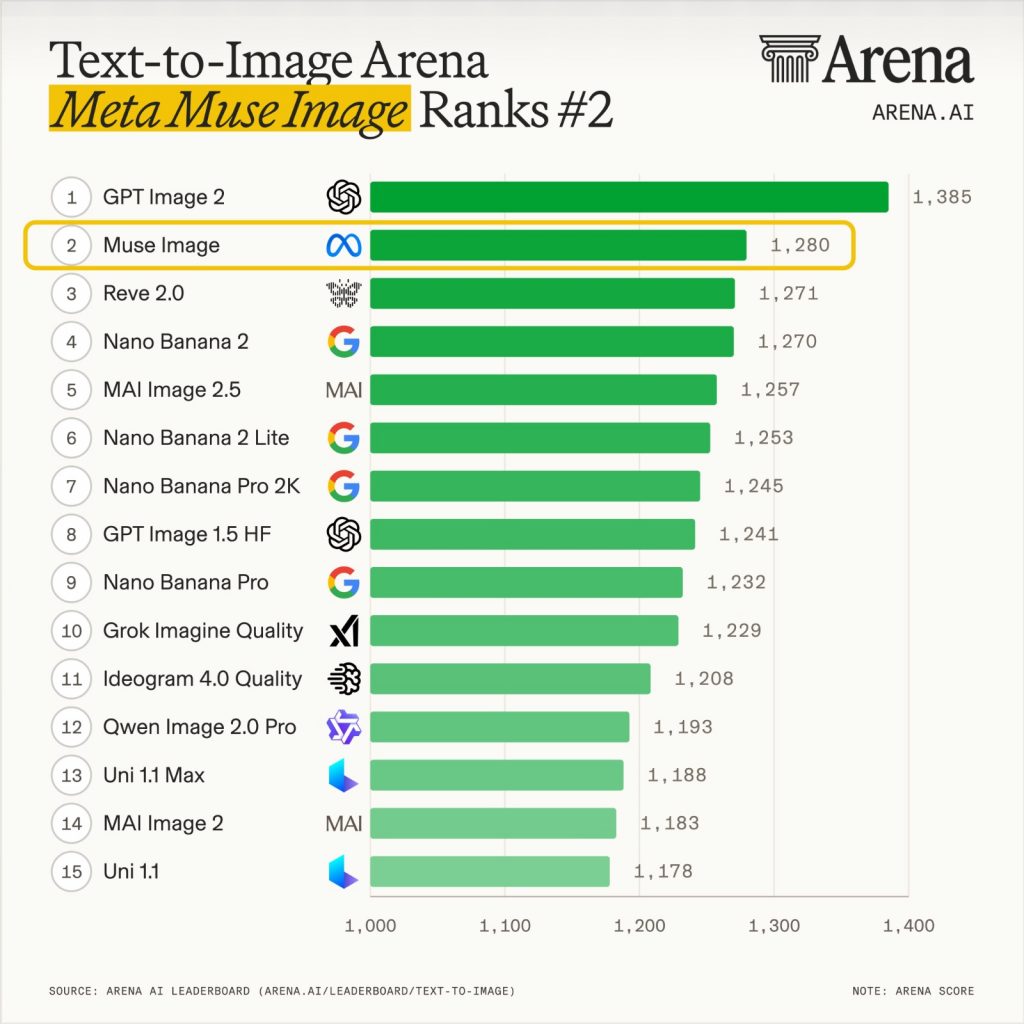
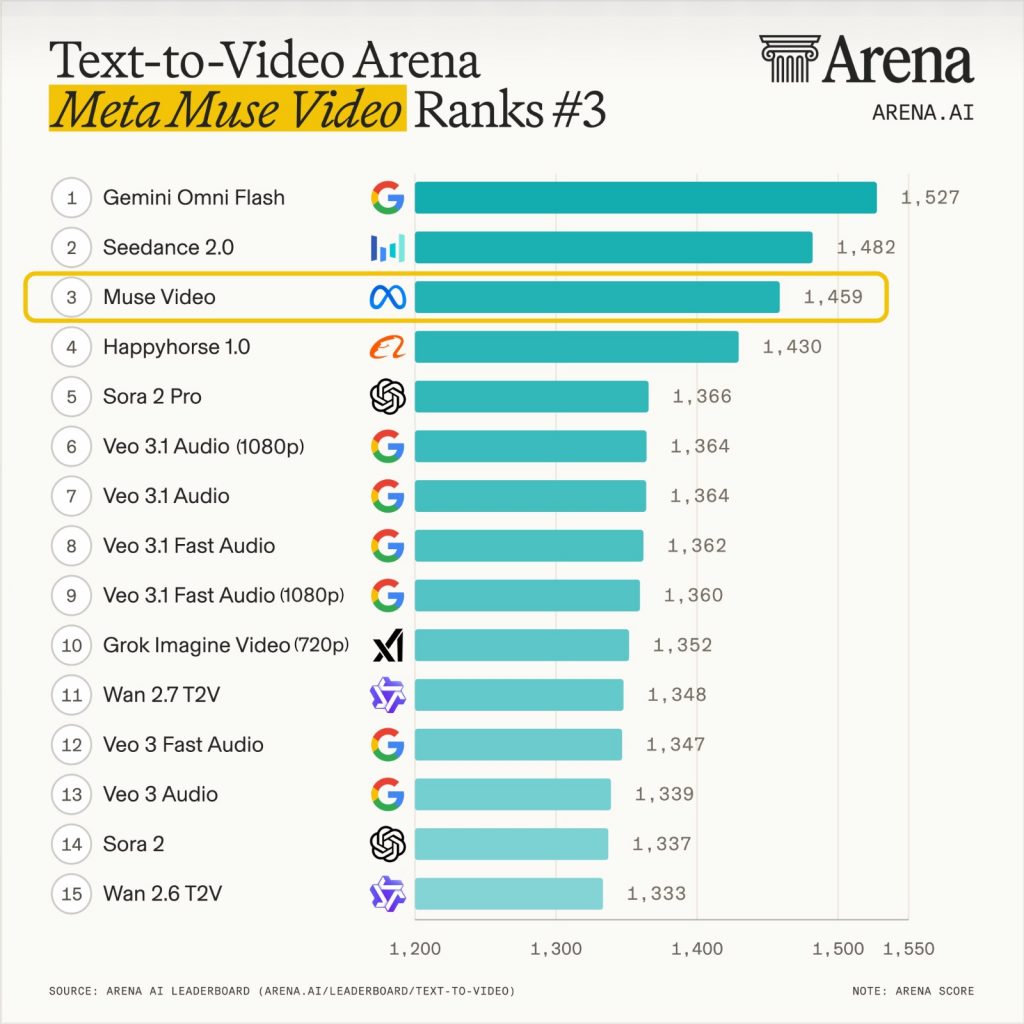
The company has just launched Muse Image and previewed Muse Video, its first media generation models out of Meta Superintelligence Labs, and both are already landing near the top of Arena’s leaderboards. Muse Image has taken the No. 2 spot in the Text-to-Image Arena, while Muse Video has debuted at No. 3 in the Text-to-Video Arena, putting Meta’s newest models directly in the conversation with the best that OpenAI, Google, and Alibaba currently have to offer.
Muse Image scored 1,280 on Arena, placing it just behind OpenAI’s GPT Image 2, which leads the board at 1,385. That’s still a meaningful gap, but Muse Image is comfortably ahead of Google’s Nano Banana 2 (1,270), Microsoft’s MAI Image 2.5 (1,257), and Grok Imagine Quality (1,229). Arena also credits Muse Image with holding the No. 2 position across text-to-image, single-image editing, and multi-image editing simultaneously, which suggests the model isn’t just winning on one narrow benchmark but performing consistently across the different ways people actually generate and manipulate images.
Muse Video, which is still being described as an early preview rather than a full release, scored 1,459 in the Text-to-Video Arena. That’s good enough for third place, ahead of Alibaba’s Happyhorse 1.0 (1,430), OpenAI’s Sora 2 Pro (1,366), and every version of Google’s Veo 3.1 currently ranked. Only Google’s Gemini Omni Flash (1,527) and ByteDance’s Seedance 2.0 (1,482) sit above it. Meta itself has been fairly candid that Muse Video still has ground to cover on things like audio-video synchronization and physically accurate fast motion, but a third-place debut for a preview model is a strong opening statement.
What makes both models notable is how they were built. Rather than generating an image or video in a single pass, Muse Image works more like an agent — it can call coding tools to render accurate plots, QR codes, or figures, and it can search the web to ground its outputs in real-world references, which helps with prompts tied to current events or factual details. Meta says the model also reflects on its own output mid-generation, catching mistakes and either patching a small detail or scrapping a draft and starting over. According to the announcement post, this self-refinement behavior wasn’t explicitly designed in — it emerged during reinforcement learning because it simply produced better images and earned higher reward. Muse Video shares the same pretraining base as Muse Image, which is part of why both models are shipping together despite being at different stages of readiness.
This is Meta’s second notable Arena result in as many months. Muse Spark, the first model to come out of Meta Superintelligence Labs, had already shown that the unit Alexandr Wang set up after leaving Scale AI was producing results that could hold their own against frontier labs, even if it trailed the very top models on agentic coding and abstract reasoning benchmarks. Wang, who Meta named Chief AI Officer after acquiring a large stake in Scale AI, brought in a wave of researchers from OpenAI, Anthropic, and Google DeepMind to build out the lab, and Muse Image and Muse Video are the clearest sign yet that hiring spree is translating into shipped products people can actually use.
For a company whose Llama models had settled into a role as widely used open-source options rather than genuine frontier contenders, back-to-back top-three finishes across text, image, and video categories change the framing somewhat. Meta isn’t topping any of these leaderboards outright, and it’s worth noting Arena scores can shift as more votes come in and rival labs ship updates of their own. But landing second on images and third on video, against models built by teams that have had a considerable head start, is a result Meta will be happy to point to.
Muse Image is rolling out now inside the Meta AI app, on meta.ai, to Instagram Stories in the US, and on WhatsApp in select countries, with Facebook access coming soon. Muse Video is being held back for creators and Meta AI users as the team works through the gaps it has flagged. Both models also ship with Meta’s Content Seal, an invisible watermarking system meant to help people verify whether an image was AI-generated, even after it’s been cropped, compressed, or screenshotted.