China is still nipping at the heels of the top US AI labs.
Chinese AI startup Moonshot AI has released Kimi K3.1 Pro, an upgraded version of its 3-trillion-parameter-class open-weight model, which the company says matches or comes close to the strongest proprietary models from Anthropic and OpenAI on several coding, agentic and knowledge benchmarks.
Kimi K3.1 Pro is a mixture-of-experts (MoE) model with 2.8 trillion total parameters and 104 billion active parameters, and comes with native multimodal support and a context window of up to 1 million tokens. Moonshot is also shipping a faster variant, Kimi K3.1 Pro Highspeed, which runs 2-3x quicker than the standard version. Both are live now on Kimi.ai, Kimi Work, Kimi Code, and the Kimi API, with open weights promised by November 4, 2026.
Moonshot has built its reputation on aggressively priced, high-performing open-weight releases. The company’s Kimi K2 model, launched last year, had already emerged as one of the strongest open-source models on the market, and its Kimi K2.5 update went on to outperform Claude 4.5 Sonnet on the Artificial Analysis Intelligence Index, widening the gap between Chinese and American open models. K3.1 Pro is the company’s attempt to push that lead further into territory typically held by closed, proprietary frontier models.
The company is positioning K3.1 Pro heavily around full-project creative and technical workflows, beyond just chatbot-style question answering. It claims the model can handle full-project coding in game engines like Unreal, Unity and Godot, do parametric 3D modeling in Blender and CAD software, and has become significantly more reliable for finance-related work, with hallucinations in financial modeling tasks down 65% compared to the previous generation.
Kimi K3.1 Pro Benchmarks
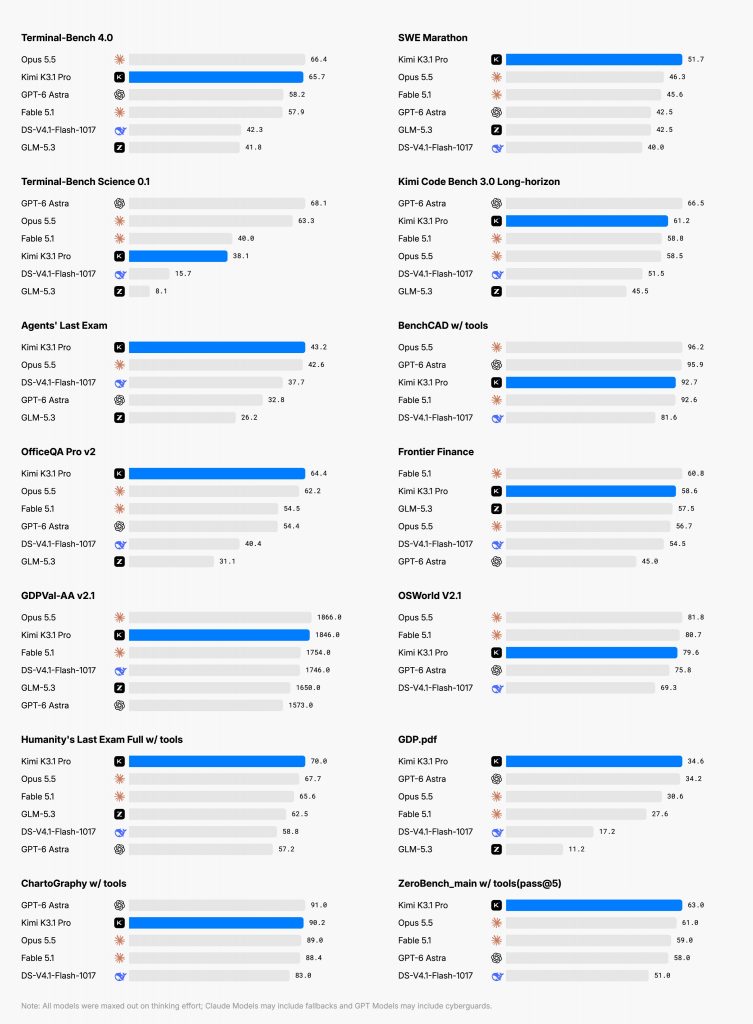
Moonshot’s own numbers put Kimi K3.1 Pro within striking distance of, and in some cases ahead of, the current flagship models from Anthropic and OpenAI, though narrowly behind the very best of them.
On Terminal-Bench 4.0, which tests coding agents on realistic, resource-constrained terminal tasks using strict task-specific checks, K3.1 Pro scored 65.7%. That places it ahead of OpenAI’s GPT-6 Astra, which scored 58.2%, but just behind Claude Opus 5.5, which leads with 66.4%.
On BenchCAD, a benchmark that evaluates 3D reconstruction from multi-view renderings through CAD code generation, K3.1 Pro scored 92.7% when allowed to use tools, which is close to GPT-6 Astra’s 95.9% and Claude Opus 5.5’s 96.2%. Moonshot says the model can carry out a fairly complete creative pipeline on its own, from building assets and assembling scenes to animation and rendering.
The model also claims state-of-the-art status on OfficeQA Pro v2, an internal benchmark for office and business tasks, with a score of 64.4. Compared to the original K3, Moonshot says K3.1 Pro improves by 7.2 points on financial modeling and 11.6 points on financial research, and scores roughly 4.2x higher on simulated business operations. Example outputs the company has shared include a fully linked NVDA DCF/LBO model with traceable formulas, an investment-committee deck for Chinese battery maker CATL, and a quantum-computing sector report with source-level citations.
Kimi K3.1 Pro Pricing
Kimi K3.1 Pro is priced at 2/3rds of what the original K3 cost, continuing Moonshot’s pattern of undercutting Western frontier labs on API pricing while chasing comparable performance.
| Billing Item | Kimi-K3.1-Pro | Kimi-K3.1-Pro-Highspeed |
|---|---|---|
| Input Price | $2.00 / MTok | $4.00 / MTok |
| Output Price | $10.00 / MTok | $20.00 / MTok |
| Cached Input Price | $0.20 / MTok | $0.20 / MTok |
For comparison, that puts standard K3.1 Pro’s input and output pricing at roughly half of Claude Opus 5.5’s $4/$20 per million tokens, and a fraction of GPT-6 Astra’s $10/$50 per million tokens. Even the faster Highspeed variant, at $4 input and $20 output per million tokens, matches Opus 5.5 on price while promising 2-3x the speed.
Both versions of Kimi K3.1 Pro are available now through the Kimi API at platform.kimi.ai.