Meta is now the 2nd highest placed lab on the Artificial Analysis Intelligence Index, ahead of Google Deepmind and OpenAI.
Meta’s newly released Muse Wonder Full has landed in third place on Artificial Analysis’ Intelligence Index, scoring 56 at maximum reasoning effort and placing it ahead of GPT-6 Astra and Gemini 4 Argon, both tied at 53, as well as Claude Fable 5.1.
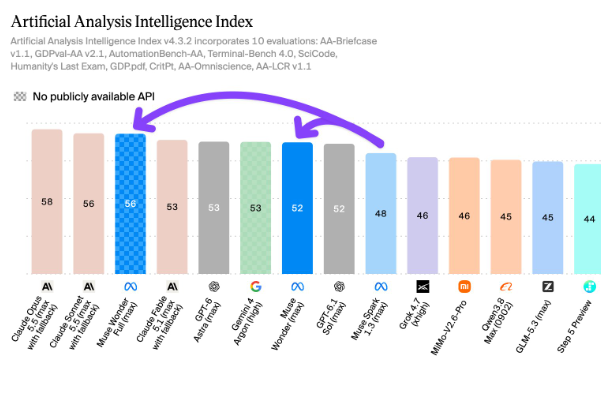
Artificial Analysis, the independent benchmarking firm, said Muse Wonder Full and the smaller Muse Wonder scored 56 and 52 respectively on its Intelligence Index v4.3, a composite of ten evaluations including GDPval-AA v2.1, Terminal-Bench 4.0, SciCode and Humanity’s Last Exam. Both scores mark a material jump from Muse Spark 1.3, Meta’s previous model, which scored 48 on the same index, a gain achieved in a release gap of only six weeks. Only Claude Opus 5.5 (58) and Claude Sonnet 5.5 (56, tied with Muse Wonder Full) score higher.
Where Muse Wonder Gains Came From
Artificial Analysis said Muse Wonder Full improved on Muse Spark 1.3 across all ten evaluations that make up the index, with the largest gains concentrated in agentic tasks. The model’s Terminal-Bench 4.0 score jumped 24 points, from 33% to 57%, while its GDPval-AA v2.1 Elo rating climbed 176 points, from 1,681 to 1,857, and its AA-Briefcase score rose 148 Elo points, from 1,581 to 1,729.
Muse Wonder Full places in the top three on six of the ten evaluations that make up the index. It ranks first on CritPt and GDP.pdf, though Artificial Analysis noted both leads are narrow, with the nearest competitors scoring 31-32%. It ranks second on GDPval-AA v2.1, within the confidence intervals of both Claude Opus 5.5 and Claude Sonnet 5.5, and third on AA-Briefcase, AutomationBench-AA and SciCode.
The smaller Muse Wonder model also posted gains over Muse Spark 1.3, rising from 33% to 52% on Terminal-Bench 4.0 and from 58% to 68% on AutomationBench-AA.
Muse Wonder’s Token Efficiency And Cost
Both Muse Wonder models use fewer output tokens per task than Muse Spark 1.3, at around 54,000 tokens each, down roughly 10% from Muse Spark 1.3’s 60,000. That’s lower than Gemini 4 Argon (62,000) and Claude Fable 5.1 (78,000), though still higher than GPT-6.1 Sol (38,000) and GPT-6 Astra (27,000). Muse Wonder Full also uses 16% fewer input tokens per task than the smaller Muse Wonder (6.44 million versus 7.69 million), making it both more intelligent and more token-efficient by Artificial Analysis’ measure.
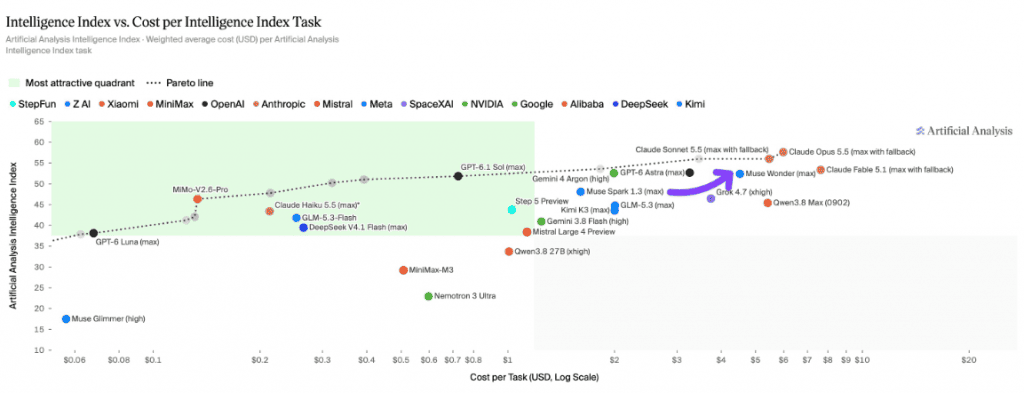
Cost per task tells a different story for Muse Wonder specifically. Despite its efficient output token use, premium API pricing of $4 per million input tokens and $20 per million output tokens, combined with heavy input token consumption, pushes its cost to $4.52 per Intelligence Index task — 2.8 times Muse Spark 1.3’s $1.60. That is still cheaper than Claude Fable 5.1 ($7.63), Claude Opus 5.5 ($5.98) and Claude Sonnet 5.5 ($5.46), but more expensive than GPT-6 Astra ($3.26), Gemini 4 Argon ($1.99) and GPT-6.1 Sol ($0.72). Meta has not yet published per-token pricing for Muse Wonder Full, so Artificial Analysis could not estimate a comparable cost-per-task figure for it.
Muse Wonder: Coding And Knowledge Gaps
Both new models showed sizable gains in coding agent performance. Muse Wonder Full scored 68 on Artificial Analysis’ Coding Agents Index running at max effort in Muse Code, matching Claude Code running Claude Sonnet 5.5 and edging out Claude Code running Claude Opus 5.5, which scored 66. Muse Wonder scored 63. Both are well ahead of Muse Code running Muse Spark 1.3, which scored 54.
Knowledge remains a comparative weak spot. On AA-Omniscience, which measures factual accuracy and hallucination rate, Muse Wonder Full scored 30 and Muse Wonder scored 25, level with Muse Spark 1.3 and behind Claude Opus 5.5 (46), GPT-6 Astra (43), Gemini 4 Argon (42) and Claude Sonnet 5.5 (32). The gains Muse Wonder Full did make on this metric came from a sharply lower hallucination rate, down from 33% to 23%, giving it the second-lowest hallucination rate of any model scoring 45 or above on the Intelligence Index, behind only Gemini 4 Argon at 15%. Muse Wonder ranks third at 27%.
Muse Wonder Availability
Muse Wonder is available now through Meta’s first-party API and Muse Code. Muse Wonder Full, however, is currently restricted to Muse Code users and has not been opened up via the API, where per-token pricing is also still unannounced. Both models carry a 1 million-token context window, unchanged from Muse Spark 1.3, and accept text, image, video and audio inputs, returning text output.
Artificial Analysis congratulated Meta’s AI team, along with Mark Zuckerberg and Chief AI Officer Alexandr Wang, on the release. It lands a little over a year after Meta Superintelligence Labs was formed, and marks the second straight Meta model family to crack the top tier of the Intelligence Index within weeks of launch, keeping the gap between Meta, Anthropic and OpenAI’s flagship models narrower than it has been all year.