As AI becomes human-level at areas like coding and marketing, it seems to be simultaneously reducing the size of founding teams.
New data from Stripe Economics, analyzed by economist Ernie Tedeschi, shows a clear and accelerating shift in how businesses are being built: solo-founder startups are outpacing multi-founder ones across both AI and non-AI categories — and the gap is widening. The data, drawn from Stripe Atlas registrations and shared by a16z, tracks startup formation from Q2 2023 through Q1 2026 and paints a picture of a business landscape being quietly restructured by AI tools.
The Numbers
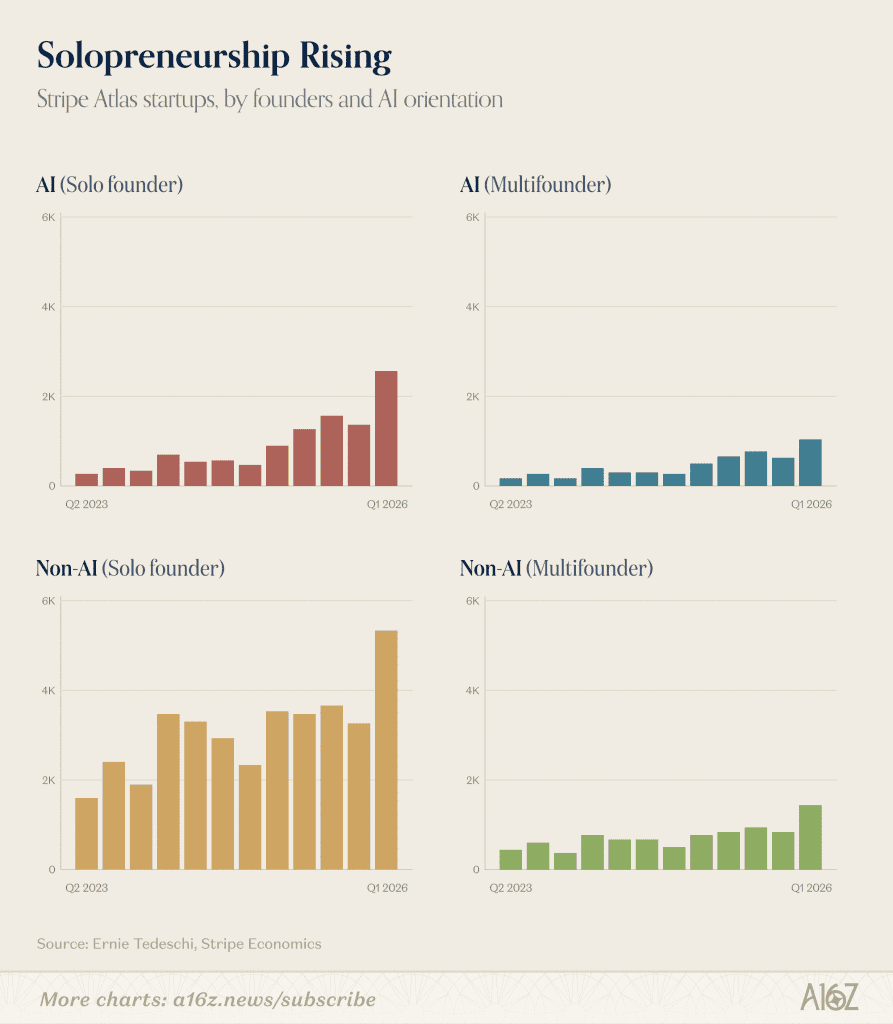
Across all four categories tracked — AI solo founder, AI multifounder, non-AI solo founder, and non-AI multifounder — solo founders dominate in volume. The non-AI solo founder category saw the largest single-quarter spike, reaching close to 5,500 registrations in Q1 2026, up from roughly 3,500 the prior quarter. AI solo founders also surged, crossing 2,600 in Q1 2026 — nearly double their level from just two quarters prior. Meanwhile, multifounder startups in both the AI and non-AI categories grew more slowly, hovering well below 1,500.
The divergence is hard to ignore. The two fastest-growing categories in Q1 2026 are both solo-founder. Multifounders, regardless of AI orientation, are not seeing the same momentum.
AI As A Digital Co-Founder
The underlying dynamic isn’t mysterious. Research has suggested that generative AI is effectively acting as a digital co-founder — automating core tasks, compressing go-to-market timelines, and lowering entry barriers for new ventures. What previously required a team of two or three (one to build, one to sell, one to market) can increasingly be handled by one person with the right stack.
Startups are already using AI to code far more aggressively than enterprises, according to Anthropic data — 33% of Claude Code interactions are startup-related versus just 13% for enterprise. The nimble, solo operator is the natural beneficiary of that asymmetry.
What “Non-AI” Actually Means Here
One important caveat: “non-AI” in Tedeschi’s classification simply means AI is absent from the product description — not that the founder isn’t using AI tools internally. Given the proliferation of AI tools for startups across coding, marketing, customer support, and design, it’s likely that a significant portion of “non-AI” solo founders are still powered by AI behind the scenes. The label reflects what the product does, not how the company operates.
The ARR/FTE Equation
The metric gaining traction in venture circles right now is ARR per full-time employee — a proxy for operating leverage. A firm of one with meaningful recurring revenue represents the theoretical ceiling of that metric. If a solopreneur can crack the distribution problem, there’s no cap on how efficient the unit economics can look.
This is what makes the Stripe data meaningful beyond the headline number. It suggests that the AI-enabled solopreneur isn’t just a curiosity — it may be becoming a structurally distinct category of business with its own economics. Whether this translates into companies that eventually hire and scale, or stays a permanent feature of the landscape, remains to be seen.
Early, But Directional
The trend is still forming. Q1 2026’s spike could partly reflect broader macro conditions that make bootstrapped, lean formation more attractive — not purely an AI story. But the trajectory across nearly three years of Stripe data is consistent: solo founders are growing their share, and the arrival of capable AI tools correlates tightly with the acceleration.
The top AI coding agents have made it possible for a non-engineer to ship software, and a non-marketer to run campaigns. The cost of starting is falling. The cost of adding co-founders — in equity, coordination, and complexity — remains fixed. That math is doing exactly what the data shows.