NVIDIA and Microsoft had teased a partnership a few days ago, and it has now been revealed as to what it was.
At GTC Taipei on June 1, NVIDIA unveiled RTX Spark — a new superchip purpose-built for AI agents on Windows PCs. The announcement marks NVIDIA’s most significant push into the consumer PC market, bringing the company’s full AI and graphics stack — CUDA, RTX, DLSS, TensorRT — into a single chip designed for slim laptops and compact desktops.
What RTX Spark Is
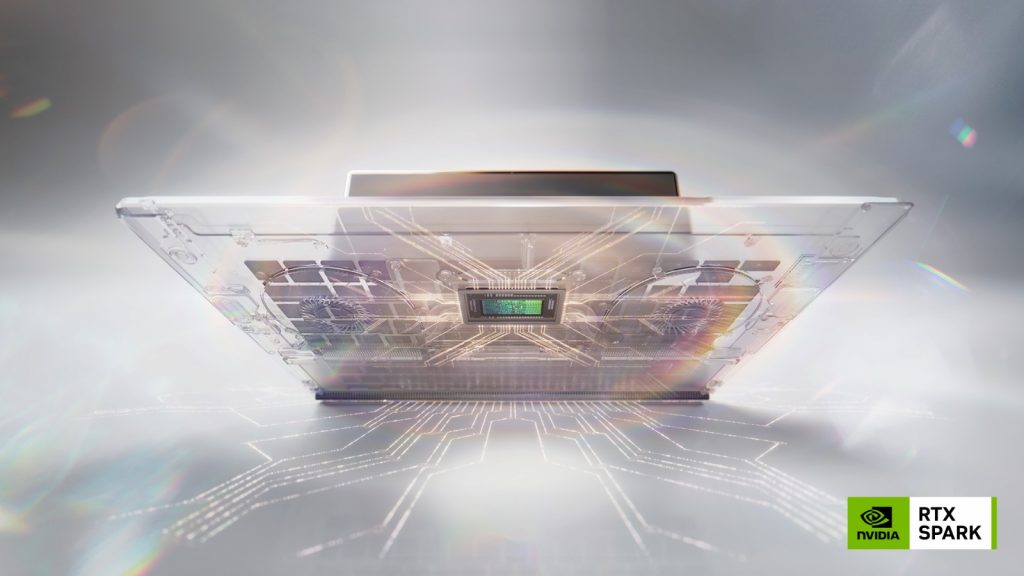
RTX Spark is a superchip combining a Blackwell RTX GPU with 6,144 CUDA cores and fifth-generation Tensor Cores with FP4 precision, connected via NVIDIA’s NVLink-C2C interconnect to a 20-core NVIDIA Grace CPU. The CPU design was co-developed with MediaTek. The chip delivers up to 1 petaflop of AI compute and supports up to 128GB of unified memory — specs previously reserved for workstation-class hardware.
Jensen Huang framed the launch in characteristically sweeping terms: “For forty years, you launched apps. Click. Type. With RTX Spark and Microsoft Windows, you ask — and the PC does the work.”
It’s a line that fits Huang’s broader thesis that computing is undergoing a fundamental platform shift — and that NVIDIA now sits at the center of it.
The Agent Play
The core pitch for RTX Spark isn’t gaming or creative work — it’s agents. NVIDIA and Microsoft are building a new security layer for running AI agents natively on Windows, including new Windows security primitives and a runtime called NVIDIA OpenShell. Together, these let users define what agents can and cannot do, route queries to local models based on privacy preferences, and mask personal data before it reaches cloud models.
Satya Nadella, who has been bullish on agentic AI, called RTX Spark “a real breakthrough” toward Microsoft’s goal of delivering “unmetered intelligence to every home and every desk with Windows.”
The agent story has real momentum behind it. Open-source agent projects like OpenClaw and Hermes Agent are already building native Windows apps on the OpenShell platform. The practical capability unlocked here is significant: RTX Spark can run 120-billion-parameter LLMs locally with 1 million tokens of context — a workload that would have required cloud infrastructure just a year ago.
What It Can Do
Beyond agents, the chip handles a wide range of demanding workloads. On the creative side, it can render 3D scenes larger than 90GB using OptiX and DLSS, edit 12K 4:2:2 video via the Blackwell decoder, and generate 4K AI video in ComfyUI with 4x Frame Generation. For gaming, it drives AAA titles at 1440p and over 100 fps with ray tracing, DLSS, and Reflex, and introduces DLSS 4.5 Ray Reconstruction featuring a second-generation transformer model — coming to Blender 5.3 and dozens of games.
Over 1,000 games and applications already support RTX technology, with more than 100 software partners actively embracing the RTX Spark platform.
The Adobe Partnership
Perhaps the most concrete near-term signal is what’s happening with Adobe. NVIDIA is partnering with Adobe to rearchitect both Premiere and Photoshop from the ground up for RTX Spark — promising up to 2x faster AI, editing, coloring, and effects performance.
Adobe CEO Shantanu Narayen described the collaboration as building “AI-native creative experiences” that deliver “the performance, intelligence and responsiveness people need to create at the pace of their ambition.” Premiere will get a new video pipeline tapping into RTX Spark’s unified memory and TensorRT, while Photoshop will receive a GPU-accelerated compositing engine with live filters and high dynamic range support.
Updates to both apps are expected to roll out alongside RTX Spark’s availability this fall.
Hardware and Availability
RTX Spark laptops will be as slim as 14mm and as light as three pounds, available in 14- to 16-inch sizes with tandem OLED displays and G-SYNC. On the desktop side, compact form-factor PCs are being built for agents, creative work, gaming, and productivity.
Hardware partners committed so far include ASUS, Dell, HP, Lenovo, Microsoft Surface, and MSI, with Acer and GIGABYTE to follow. Dell is putting RTX Spark in the XPS 16 Creator Edition; HP is building one of the thinnest RTX Spark laptops under its OmniBook line; Microsoft Surface is getting its own variant called Surface Laptop Ultra.
NVIDIA and Microsoft are also extending the collaboration to the enterprise end with NVIDIA DGX Station for Windows — a deskside AI supercomputer on Blackwell architecture for enterprise developers running frontier agents.
The Bigger Picture
NVIDIA has spent decades building dominance in data centers and gaming. RTX Spark is the company’s clearest bid to own the personal computing layer of the AI era — one where the PC is less a tool you operate and more an assistant that works alongside you. Paired with Microsoft’s platform reach and a growing ecosystem of agent developers, the RTX Spark launch signals that the next battleground in AI isn’t just the cloud — it’s the laptop sitting on your desk.
More details on Windows agent capabilities for developers will be shared at Microsoft Build, running June 2–3.