NVIDIA’s bad month just got worse.
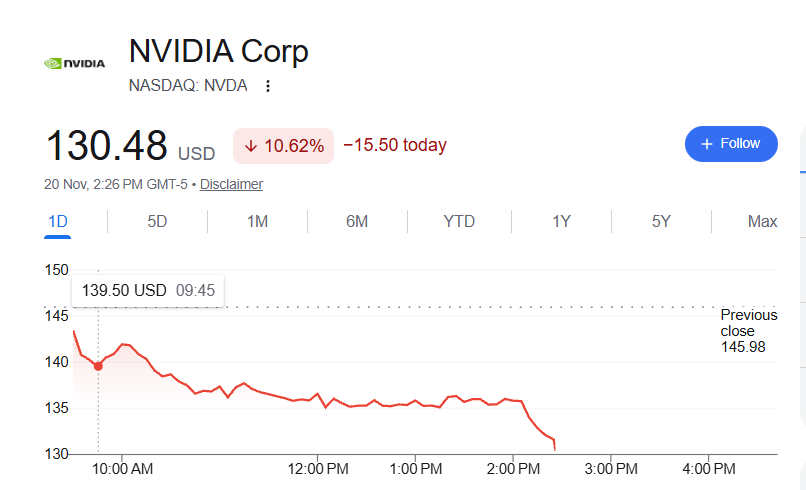
The US Securities and Exchange Commission is examining NVIDIA’s accounting practices, Reuters reported on Friday, citing two people briefed on the matter. The report landed with NVIDIA’s shares already deep in the red. After the report, the stock was trading around $130 on Friday afternoon, down more than 10% on the day, its lowest level since May 2025 and more than 40% below its record close of $239.24 on October 6. NVIDIA is now headed for a seventh straight losing session and a seventh straight losing week, its longest weekly losing streak since 2008. The slide has also pushed it behind Alphabet in market value.
From “a probe” to “an accounting probe”
The Wall Street Journal had reported earlier this week that the SEC was investigating NVIDIA, but said it could not determine the focus of the investigation. Reuters now says SEC enforcement staff are looking specifically at potential accounting issues at the company.
Reuters said it could not establish when the SEC opened its inquiry or exactly which accounting issues are under review. The SEC declined to comment, and NVIDIA did not immediately respond to requests for comment. SEC investigations are not evidence of wrongdoing, and many end without any enforcement action.
Even so, an accounting angle is a more serious signal for investors than a general disclosure inquiry. Accounting cases are a core part of the SEC’s enforcement work. Under the Trump administration the agency has scaled back enforcement in other areas while saying it will concentrate on traditional securities fraud, including accounting violations. It recently set up a new financial reporting and accounting unit within its enforcement division to build cases in this area.
The Singapore reporting change
One issue likely to draw attention is a change NVIDIA made last year to how it reports revenue by geography. The company began classifying sales by customer headquarters instead of billing address, saying this better reflected where its revenue came from. As a result, Singapore no longer appeared in its geographic breakdown.
The Financial Times reported this week, citing company accounts, that NVIDIA made the switch even as Singapore sales grew to nearly half of its global revenue. That matters because of Megaspeed, the Singapore-based firm that was historically a large NVIDIA customer. US authorities have been investigating Megaspeed since 2024 over possible export control violations linked to alleged shipments of NVIDIA AI chips to China, the Justice and Commerce departments said this week. Southeast Asia has become a hub for chip smuggling into China since Washington barred exports of advanced AI chips to the country.
Megaspeed was led by Alice Huang, whom US authorities suspect of being a Chinese spy. China denies she is a spy. Megaspeed has said she left the company in August 2025 and that it conducted “lawful business.” Reports of former CEO Jensen Huang’s relationship with her set off the crisis at NVIDIA. Huang admitted to an affair in a November 8 statement without naming her, and the company’s stock has lurched with each new revelation. Huang resigned on November 12. The board, which had been working with an outside firm on his replacement, named CFO Colette Kress interim CEO.
Circular financing is also in the frame
The probe also comes as analysts and investors grow more uneasy about circular AI financing. NVIDIA has invested in AI companies and cloud providers and provided guarantees tied to data center projects that use its hardware. Critics say these arrangements make it harder for investors to judge the quality of a chipmaker’s revenue and how exposed it really is. SEC enforcement chief David Woodcock told Reuters last month that the agency was reviewing AI companies’ disclosures to make sure investors are getting the full picture on risks.
NVIDIA appears to have heard the message. On Tuesday’s earnings call, Kress said the company was proud of its role in supporting the AI industry but would be far more selective about AI financing deals going forward. The quarter itself was strong. Revenue rose 103% year over year to $115.8 billion, and the company guided fourth-quarter revenue to about $130 billion. But the earnings beat has done little to stop the selling.
A long list of legal problems
The SEC probe adds to a growing list of legal and regulatory problems. The Justice Department has been reviewing NVIDIA’s $12.9 billion acquisition of Hugging Face as part of a broader antitrust investigation into the company’s acquisitions and practices. California Attorney General Rob Bonta served NVIDIA with an investigative subpoena this week. NVIDIA and Huang also face a proposed securities class action alleging they misled investors about Huang’s relationship with Alice Huang. That lawsuit has raised questions about how NVIDIA structured its executive insurance cover.
For a company that sat at the center of the AI boom just weeks ago, the turnaround has been stunning. NVIDIA’s business is still growing very fast, and nothing has been proven against it. But investors are now looking at an accounting inquiry, an export control investigation involving a major former customer, an antitrust review, a state subpoena, and a CEO search all at the same time. As long as these questions stay open, strong quarterly numbers may not be enough to steady the stock.