OpenAI has unveiled Dots, a new line of AI agents designed to work around the clock. Announced during a livestream, Dots is pitched as a helper that stays on 24/7, rather than one that waits to be opened and prompted.
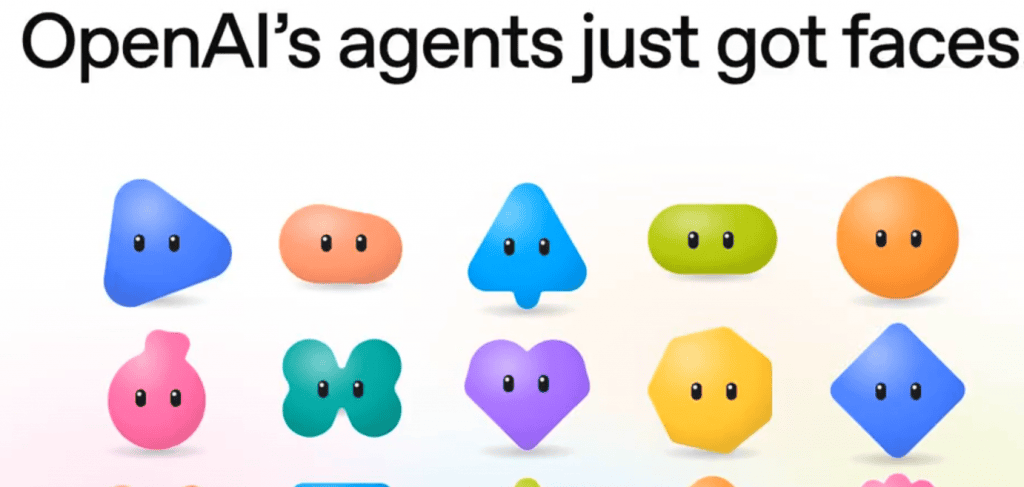
An assistant that never clocks out
Dots is built around the idea of a capable, always-on agent. Instead of a chatbot session that starts and stops, each Dots agent keeps running in the background and can pick up tasks whenever they come in, day or night.
Users can reach their Dots agent through several channels: text, phone calls, and email. Dots also works with OpenAI’s voice mode, so people can talk to the agent in natural conversation.
Buying things and delegating work
Dots can also take action. According to the announcement, the agents are able to buy things on a user’s behalf, moving them from advisor to something closer to a personal assistant that can complete transactions.
On the work side, Dots can delegate tasks. Delegated work runs on Astra, which OpenAI positioned as the system behind these background jobs. This suggests a setup where the Dots agent acts as the front-facing helper while heavier work is handed off to Astra.
Cute by design, and echoing Meta’s Muse
The design is a notable talking point. Dots has a friendly, cute look that closely resembles the aesthetic of Meta’s Muse. Like Muse, users can give their Dots agent a name of their own, which reinforces the idea of a personalized companion rather than a generic tool.
The resemblance is unlikely to be accidental. Consumer AI is increasingly competing on personality and approachability as well as raw capability, and both companies appear to be betting that people will be more comfortable handing over tasks to an agent that feels familiar and personal.
ChatGPT Space
Alongside Dots, OpenAI introduced ChatGPT Space, described as a place where people and agents can work together. Inside Space, employees can delegate tasks to Dots, and agents can be tagged and assigned work much as a human teammate would be.
OpenAI says it is already working this way internally. Employees bring Dots into group chats and give them tasks, and engineers are using the agents to fix dozens of bugs a day. “Dots are extensions of us,” an OpenAI employee said during the livestream, adding that the team has “felt firsthand how Dots have changed what we feel we’re capable of taking on.”
Space and Dots are available to Business Premium and Enterprise users. Notably, Dots usage does not count against a customer’s existing usage limits, which removes one obvious barrier to leaning on an always-on agent heavily.
Enterprise customers get an additional layer: specialized Dots built for specific functions, including accounting, email marketing, legal analysis, and ticket resolution. That points to OpenAI positioning Dots less as a single general assistant and more as a roster of role-based digital coworkers that companies can slot into existing workflows.
GPT-6.1 Sol: near-Astra intelligence at a fifth of the price
OpenAI also announced GPT-6.1 Sol, a model it says delivers near-Astra intelligence at a fifth of the price. The pricing slide shown during the livestream backs that up. Sol is priced at $2.00 for input and $10.00 for output, against $10.00 and $50.00 for GPT-6 Astra. Cached input is $0.10 for Sol versus $1.00 for Astra, a tenth of the cost.
| GPT-6.1 Sol | GPT-6 Astra | |
|---|---|---|
| Input | $2.00 | $10.00 |
| Cached input | $0.10 | $1.00 |
| Output | $10.00 | $50.00 |
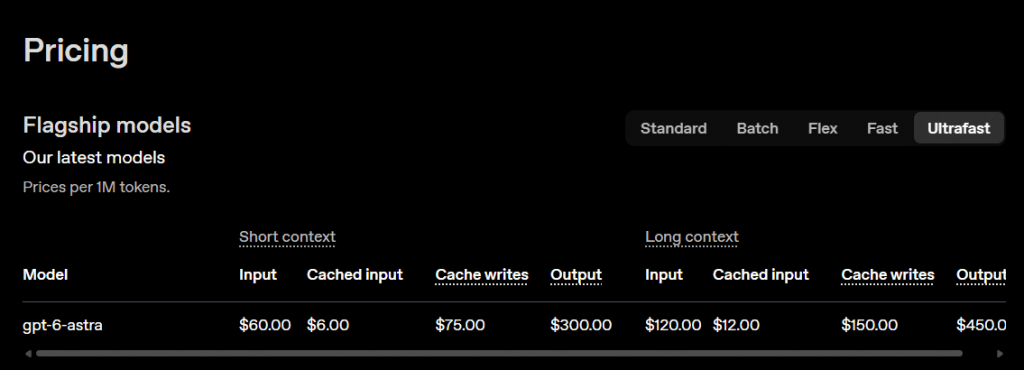
Speed is the other headline. OpenAI is offering an “ultrafast” mode across the API, ChatGPT, and Codex, which it says is 8x faster than standard, at 300 tokens per second. For always-on agents like Dots, which may run many tasks in parallel, a cheaper and faster model matters as much as a smarter one. Ultrafast isn’t cheap — it costs $60/million tokens for input and $300 per million tokens for output. For longer contexts, it’s even pricier — $120/mtok input and $450/mtok output.
A new $500 Pro plan
OpenAI also introduced a Pro plan priced at $500. It includes ultrafast speeds, no 5-hour usage limit, use across partner apps, and 25x the usage of Plus. The pitch is clearly aimed at heavy users who regularly hit rate limits, and it puts a much higher-priced tier at the top of ChatGPT’s individual lineup. Just today, OpenAI had announced that it was halving the token availability on its $200 plan.
Codex is now in the cloud and open-source
Users can use Codex across devices.
OpenAI Private Intelligence
With agents handling sensitive work like accounting and legal analysis, data privacy was also on the agenda. OpenAI introduced Private Intelligence, a set of privacy-focused offerings with two parts. The first, ZDR (Zero Data Retention) with Private Safety Processing, promises enhanced safety without storing customer content. The second, Private Inference, which is currently in preview, offers confidential computing and verifiable controls while data is being processed. OpenAI is partnering with Databricks, Snowflake, and others on the effort, a sign that it wants its agents running close to the enterprise data they will need to work with.
Sign In With ChatGPT & OpenAI Marketplace
The livestream also made clear how big the platform OpenAI is building on has become. The company said ChatGPT now has 1.2 billion weekly users, a scale that gives its ecosystem pitch real weight.
That pitch has several parts. The first is Sign in with ChatGPT, which lets users apply their ChatGPT tokens on other products. OpenAI has 16 launch partners for the feature.
The second is plugin extensions, which bring third-party products into ChatGPT itself. Adobe and Figma were the examples given, meaning users can access those tools through ChatGPT rather than switching between apps. A plugin library sits alongside this, and ChatGPT can recommend plugins to users, so the assistant helps people find the right tool for a task.
Finally, OpenAI announced the OpenAI Marketplace, which has more than 30 launch partners. Taken together, the moves show OpenAI positioning ChatGPT as a platform other companies build into, not just a destination people visit.