OpenAI could be readying to throw its hat into the AI assistant ring with a product that’s simply named ‘o’.
A screenshot doing the rounds on X has AI watchers wondering if OpenAI is about to introduce a new, always-on personal assistant inside ChatGPT Pro, and it’s simply called “o”. The image, shared by X user Jake Boggs, who asked whether he’d “missed a product launch” or stumbled onto a “dev day leak”, shows what looks like the ChatGPT Pro subscription screen. It carries the usual $100 pricing (this appears to be a regional or test price point, with ChatGPT Pro otherwise listed at $200 a month) and the standard “Everything in Plus, and” list of perks: the most capable frontier models, more Work and Codex usage, maximum memory, 100 GB of file storage and early access to new features. Sitting right in the middle of that list, circled in the screenshot for emphasis, is a line that doesn’t match anything OpenAI has publicly announced: “o, your always-on assistant.”
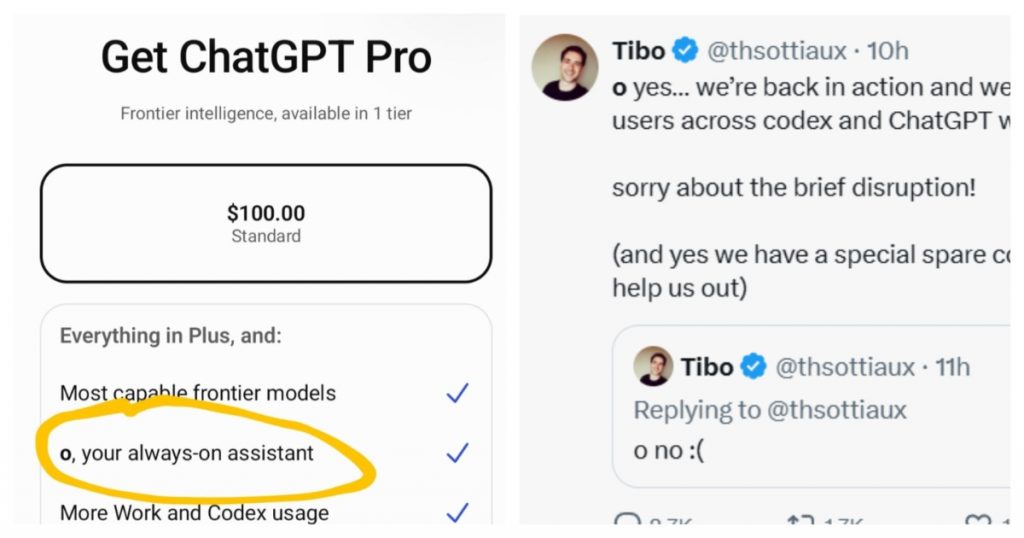
There’s no confirmation yet from OpenAI on what exactly this is. It could be an early build caught mid-rollout, a placeholder string in the app’s code, or a genuine hint at a new product still under wraps. But the phrasing is specific enough, and different enough from OpenAI’s existing feature names, that it’s hard to write off as a rendering glitch.
What’s made the timing even more interesting is OpenAI engineering lead Thibault “Tibo” Sottiaux’s own choice of words over the last half a day. Sottiaux, who oversees Codex and ChatGPT and frequently posts usage-limit updates on X, put out two posts roughly an hour apart after a rough patch for OpenAI’s infrastructure. Codex and ChatGPT Work had gone down, and once service was restored, Sottiaux first replied to his own outage acknowledgment with a simple “o no :(“, then followed it up with a longer note: “o yes… we’re back in action and we’ll reset usage limits for all paid users across codex and ChatGPT work. sorry about the brief disruption! (and yes we have a special spare codex when things are down to help us out).” Neither message would ordinarily draw a second look, “o” is a fairly natural stand-in for “oh” in casual typing. But with an unreleased “o” assistant apparently already sitting inside OpenAI’s own app, and by Tibo’s own account showing no similar use of the letter in his past posts, the coincidence has been enough to set off speculation that it’s a deliberate, if playful, tease.
Read into it what you will, OpenAI has a track record of letting these things leak out sideways, through screenshots, app store strings and offhand social posts, before making anything official. It also fits a company that has, at various points, floated hardware and ambient-computing plans for ChatGPT, the kind of product an “always-on assistant” would sit naturally alongside. Whether “o” turns out to be a real launch or just an unfortunate bit of internal copy, it’s the kind of detail that tends to get confirmed or debunked within days rather than months.
The bigger picture here is that every major AI lab is racing toward the same idea: an assistant that doesn’t wait to be asked, but works continuously in the background on a person’s behalf. Meta has already shipped its version with Muse, a personal agent that runs on its own secure virtual machine and can book travel, shop and manage tasks through WhatsApp or its own app, and it’s since been signing up commerce partners like Shopify and PayPal to let it check out on people’s behalf. SpaceXAI has taken a different route with Grok Bot, a desktop app that lets people spin up named AI “teammates” that log into real software and keep working on jobs like inbox triage or code review even after the person closes the app. Against that backdrop, an always-on “o” would put OpenAI into contention in the AI assistant space, which has seen plenty of interest over the last couple of weeks.