SpaceXAI and Meta had come out with some strong model releases today, but at the frontier, OpenAI too has come up with some big announcements.
In a livestream on Thursday, the company laid out a broad set of updates spanning its model lineup, a new product aimed squarely at business teams, and a desktop app that goes considerably further than anything OpenAI has shipped for the format before.
GPT-5.6 Sol, Terra and Luna go out to users
The centerpiece of the stream was the rollout of the GPT-5.6 family to ChatGPT itself. Sol, the flagship, is going to paid subscribers, while Terra and Luna — the mid-tier and economy variants respectively — are being made available to free users. OpenAI framed this as a deliberate choice to put a genuinely capable model in front of everyone rather than gating its better reasoning behind a paywall entirely, with Terra pitched as the balanced option for everyday work and Luna built for speed and volume rather than depth.
The company also shared a number that puts the scale of this rollout in context: ChatGPT is now sitting at close to a billion weekly users. That is the kind of figure that changes what a model release actually means in practice — every improvement to Sol, Terra or Luna now touches a user base most consumer products never come close to.
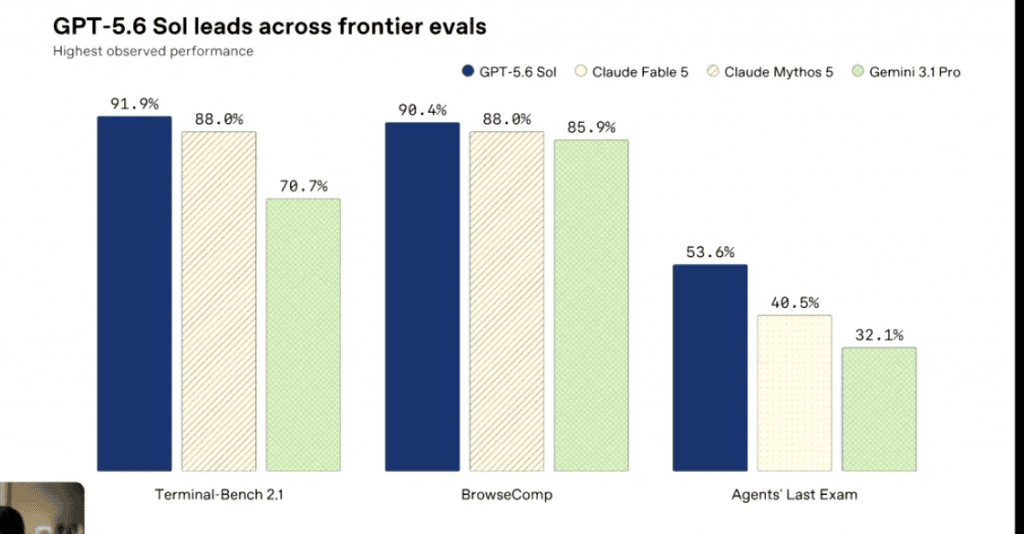
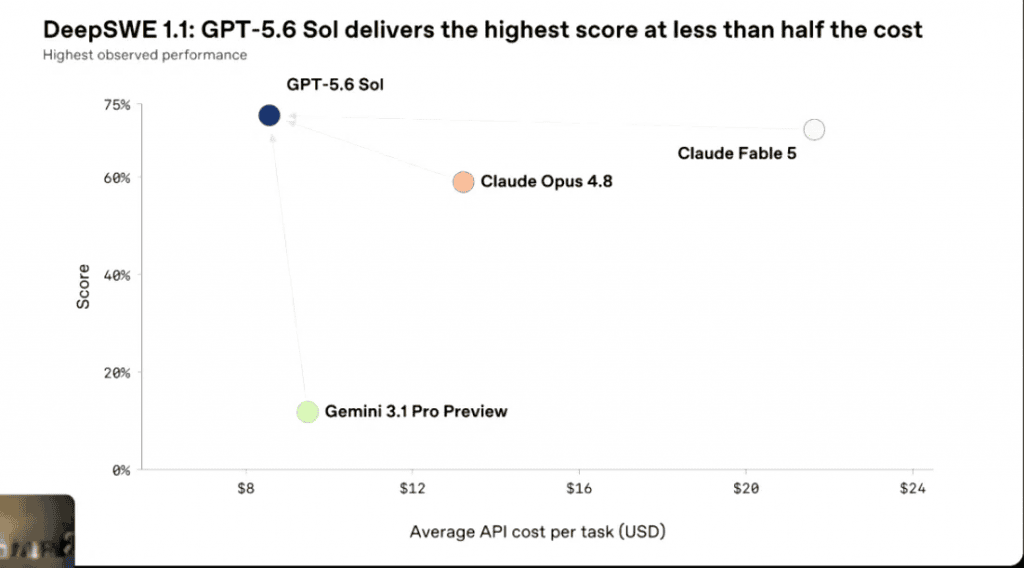
On benchmarks, OpenAI presented GPT-5.6 Sol as ahead of the field on several fronts. On Terminal-Bench 2.1, Sol scored 91.9%, ahead of Claude Mythos 5’s 88.0% and Gemini 3.1 Pro’s 70.7%. On BrowseComp, Sol posted 90.4% against Mythos 5’s 88.0% and Gemini’s 85.9%. The gap widened further on Agents’ Last Exam, where Sol reached 53.6% compared to Mythos 5’s 40.5% and Gemini’s 32.1%. A separate cost-efficiency chart, built around a benchmark OpenAI called DeepSWE 1.1, showed Sol delivering the highest observed score at under half the average API cost per task compared to Claude Fable 5, which scored similarly but at a noticeably steeper price. Claude Opus 4.8 and Gemini 3.1 Pro Preview both trailed on the same chart, with Gemini in particular scoring far lower despite sitting close to Sol on cost.
ChatGPT Work and the new Desktop app
Alongside the model updates, OpenAI introduced ChatGPT Work, pitched as a partner for more ambitious tasks than the standard chat interface handles. It runs on both web and mobile, and in the demo it was shown pulling data from a company’s in-house sources to put together a finance forecast, then sending the finished output straight to colleagues over Slack. The framing throughout was less about answering questions and more about ChatGPT taking on pieces of actual work end to end, sourcing the numbers, doing the analysis, and delivering the result to the people who need it.
The bigger structural change came with the new ChatGPT Desktop app. In the demo, OpenAI staff had it open a spreadsheet, summarize its contents, identify trends in the data, and then turn that analysis directly into a slide deck without leaving the app. A quick search panel sits along the side of the interface for faster lookups while working.
The more striking part of the demo was how far the app reaches into the operating system itself. OpenAI showed it connected to Apple’s Notes app, where ChatGPT was able to take control of the cursor inside Notes and make edits and organizational changes on its own, essentially operating someone else’s application the way a person would, rather than working through an API in the background. It’s the kind of capability that raises obvious questions around permissions and oversight once it ships more broadly, even if the demo itself went smoothly.
OpenAI employees leaned heavily on voice throughout the presentation, talking to ChatGPT rather than typing prompts for much of the desktop demo, which suggests the company sees voice as the primary mode of interaction for this app rather than a secondary option bolted on afterward.
Hosted sites and a look at training
OpenAI also showed off the ability to create and publish websites directly from within ChatGPT, hosted on OpenAI’s own infrastructure under URLs following the pattern xyz.openai.chatgpt.site. That puts OpenAI in the same territory as tools built specifically for AI-assisted site building, except the entire workflow, from prompt to a live, shareable URL, stays inside ChatGPT.
Toward the end of the stream, OpenAI researchers demonstrated something less consumer-facing but arguably more telling: a simple prompt that could kick off an entirely new model training run. The company paired this with a chart showing weekly experiments per OpenAI researcher roughly doubling since the start of the year, framed as evidence that its own research process is accelerating because researchers are now able to hand more of the experimentation loop to the models themselves. A separate internal composite, which OpenAI calls its AGI Index, showed GPT-5.6 Sol at 61%, up sharply from GPT-5.5’s mark in April and continuing a climb that has been more or less uninterrupted since o3 sat at around 8% in April last year.
Taken together, the announcements point to a company trying to hold ground on two fronts at once, pushing raw model capability against Anthropic and Google while also racing to make ChatGPT the default interface people reach for at work, not just the chatbot they open for quick questions. Whether ChatGPT Work and the desktop app’s OS-level access find traction with enterprise IT teams, who tend to be cautious about handing an AI assistant the keys to click around inside other applications, is a separate question from whether the underlying models are competitive. Today’s stream answered the second question with numbers. The first one will take longer to settle.