AI appears to have created its biggest breakthrough yet.
OpenAI says it has solved the Navier-Stokes existence and smoothness problem, one of the seven Millennium Prize Problems set by the Clay Mathematics Institute, and the proof was produced entirely by an unreleased internal model that the company describes as significantly more capable than GPT-6 Astra.
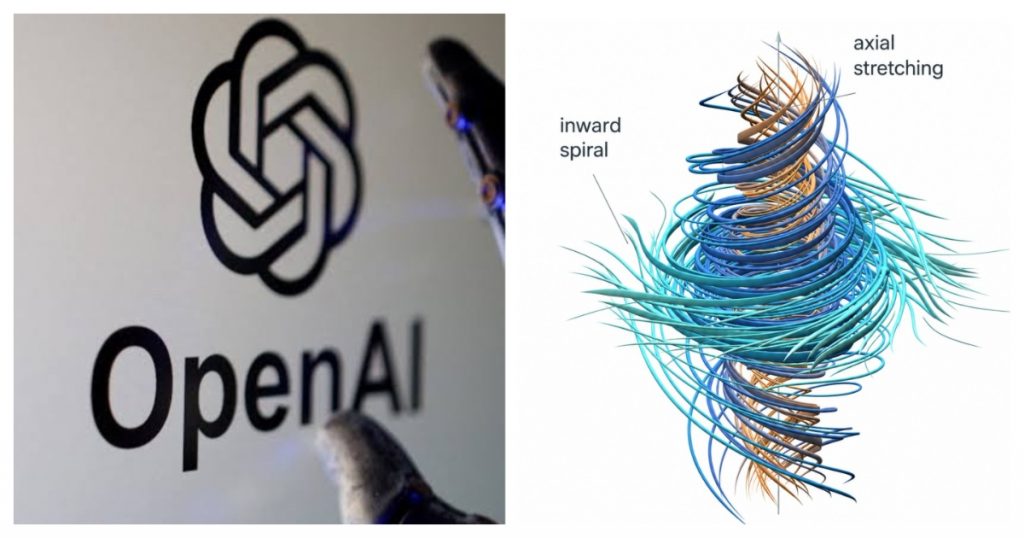
The company published a full write-up of the result along with a Lean formalization, the software mathematicians use to machine-verify that every logical step in a proof actually holds. The Navier-Stokes problem asks whether the equations that describe how fluids move in three dimensions can always be trusted to produce smooth, well-behaved solutions, or whether they can spontaneously “blow up,” with velocities racing to infinity in a finite amount of time. The equations, first written down in the 19th century, underpin aircraft design, weather modelling and blood-flow simulation, and whether they can break down has been an open question for close to 90 years.
What OpenAI says it proved
According to OpenAI, its system showed that a smooth fluid starting at rest, under a smooth external force, can develop a singularity in finite time while its total energy stays finite throughout. The proof describes the mechanism as a vortex that spirals inward while stretching along its axis, shrinking and speeding up in a way that keeps the physics consistent even as the local velocity grows without bound. That satisfies statement “C” (and, per OpenAI, also “D”) of the Clay Institute’s official problem formulation, one of several precise variants the institute laid out when it framed the problem in 2000.
OpenAI is careful to note it is not claiming the actual $1 million prize for this result, and frames the release primarily as a demonstration of how far its unreleased model has advanced.
A 10,000-agent effort born from a rumor
OpenAI’s own account of how the proof came together is almost as striking as the result itself. The company says it has been training a new internal model since August 28, one that has shown a sharp jump in performance on math benchmarks while training is still ongoing. On September 1, after hearing rumors that two Millennium Prize problems had already been cracked elsewhere, OpenAI turned this model loose on every open Millennium Prize problem plus a handful of other high-profile questions, using a system of coordinating agents that could read a cached snapshot of the internet and execute code.
For Navier-Stokes specifically, OpenAI split its agents into groups working different variants of the problem in parallel — some pushed toward a proof that solutions stay smooth, others toward a proof that they can blow up. Along the way, a smaller group of roughly 100 agents spent about 50 hours on a related but separate question, the blow-up problem for the unforced Euler equations (Navier-Stokes without viscosity), and reportedly resolved it. That unexpected result convinced OpenAI to redirect resources toward the full Navier-Stokes problem, feeding the Euler solution back into its remaining agent groups and periodically upgrading them as newer versions of the internal model became available.
By OpenAI’s telling, the winning group reached its result about 88 hours after the effort began, having exchanged 2.7 million messages and consumed roughly 130 billion output tokens; Lean formalization and verification took another 17 hours. Across every problem the agents attempted, the tally comes to 4.9 million messages and about 300 billion output tokens.
A messy, disputed backdrop
The release lands in the middle of an already tense dispute over credit. The rumor that reportedly triggered OpenAI’s sprint traces back to real, independent work by NYU mathematician Tristan Buckmaster and Anthropic’s Levent Alpöge, who spent roughly a year using AI tools to study equations closely related to Navier-Stokes. The pair used their approach to prove that the Euler equations — the frictionless cousin of Navier-Stokes — do blow up, a result significant enough on its own to be considered a major mathematical achievement.
Buckmaster has said that once word of their progress reached OpenAI, the company appears to have already had a team working on the problem, and subsequently shifted its focus toward the “forcing” component of the Clay Institute’s formulation over an intensive weekend push. OpenAI’s own post acknowledges reaching out to Buckmaster and Alpöge only after finishing its work and Lean verification, saying it wanted to offer a coordinated release and credit their priority — while maintaining that its research agents had no access to the pair’s unpublished work.
That account has been directly disputed. Buckmaster says that after the rumor started circulating, he proactively contacted a mathematician affiliated with OpenAI to clarify that his project had no institutional backing from either Anthropic or NYU, and that the reply he got was friendly and even offered compute resources. He has alleged he was later told OpenAI already had a roughly 100-page proof of blow-up for forced Navier-Stokes, and that he was offered a choice between a joint announcement or writing up the result himself while crediting an OpenAI model — with OpenAI scientist Sebastien Bubeck reportedly pushing twice to have Alpöge dropped from authorship because of his ties to Anthropic. Bubeck has publicly called the characterization “false and inflammatory,” and OpenAI’s Noam Brown has offered his own, more conciliatory account of the exchange.
Buckmaster and Alpöge’s own results — covering the Euler, Boussinesq and incompressible porous media equations under smooth forcing — have since drawn praise from Fields Medalist Terence Tao, who has called the work a remarkable achievement and said he sees no obvious obstacle to eventually pushing the same methods all the way to a full Navier-Stokes solution. Tao has separately cautioned that an AI-generated solution released as an opaque, unreviewable result could end up doing more harm than good for the field, even as AI systems continue to notch real wins in mathematics.
Independent verification is still pending
Unlike Buckmaster and Alpöge’s published Euler-family results, OpenAI’s full Navier-Stokes proof has not yet been examined and endorsed by independent mathematicians outside the company, and the Clay Mathematics Institute’s own process for recognizing a solution requires publication and broad expert acceptance — something that will take time regardless of how the current dispute over credit is resolved.