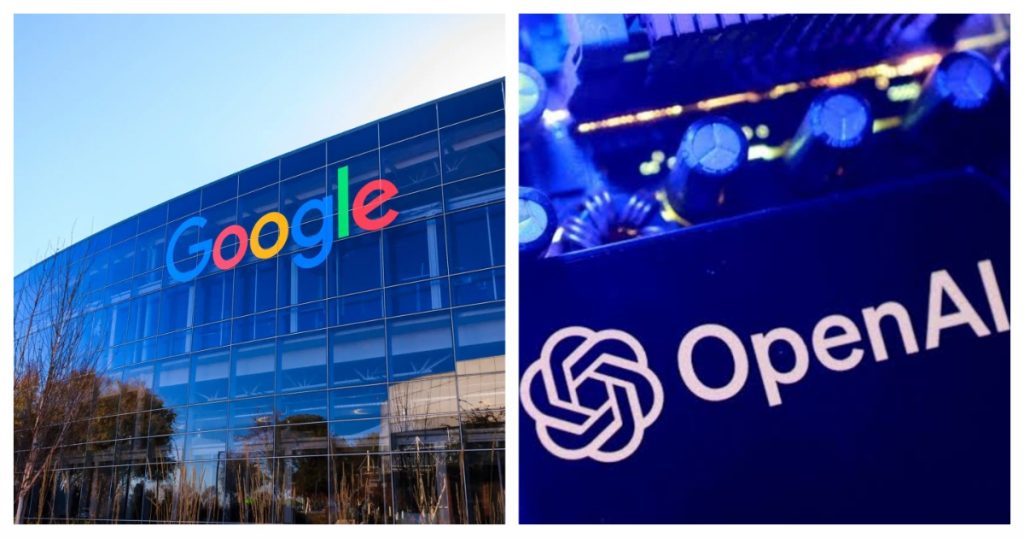
OpenAI and Google, two of the fiercest rivals in the AI race, are now business partners.
Google Cloud has announced that it is bringing OpenAI’s models into its Model Garden, making Google the only one of the major hyperscale cloud providers to now host all three of the leading closed-source AI labs on a single platform.
The initial lineup includes three new OpenAI models built for different price-performance tiers: GPT-6 Astra, pitched as the flagship for coding, computer use and scientific research; GPT-6.1 Sol, a cheaper model aimed at agentic coding and professional work that comes close to Astra’s intelligence; and GPT-6 Luna, a fast and inexpensive option meant for everyday, high-volume use. All three are rolling out in private preview to select enterprise customers, with broader availability, including inside Google’s own Gemini for business and Antigravity coding tool, expected soon.
For enterprise customers, the pitch is flexibility. Google says companies will be able to switch between OpenAI’s models and the rest of the 200-plus models already in its Model Garden depending on cost, latency and the task at hand, without signing separate contracts. Because the deal runs through the Google Cloud Marketplace, spending on OpenAI’s models will show up on the same invoice as the rest of a company’s cloud bill and count toward existing commitments, including its Flexible Savings Plans.
Google has also leaned heavily on security and governance in making its case, pointing to data perimeters that keep customer prompts out of model training, isolated infrastructure for routing OpenAI queries, and unified audit logging across a company’s full cloud footprint — the kind of assurances that regulated industries in particular tend to ask for before adopting a new model provider.
The Microsoft Backstory
This deal doesn’t happen without a prior one. For years, Microsoft held an exclusive license to run OpenAI’s models on its infrastructure, a relationship that effectively made Azure the only cloud through which enterprises could officially access GPT models at scale. That changed in April, when Microsoft and OpenAI restructured their partnership and made Microsoft’s license non-exclusive, freeing OpenAI to sell its models through other clouds while Microsoft continues to receive revenue share and IP access through 2032.
Amazon moved first, striking a $50 billion partnership with OpenAI that saw AWS begin hosting OpenAI’s models within days of the exclusivity clause lifting. Google, which had reportedly lobbied regulators to break up the Microsoft-OpenAI arrangement on antitrust grounds, is the last of the three to get its deal over the line — a wait of roughly six months since the exclusivity ended.
The reversal is notable given how Google and OpenAI are rivals in AI. OpenAI’s ChatGPT was built, in part, to challenge Google’s early lead in AI, and the two have been racing each other on model capability ever since. OpenAI is also far from a stranger to Google’s infrastructure already — reports emerged last year that it had begun using Google’s TPUs to diversify away from Nvidia GPUs. This latest deal formalizes and extends that relationship into a full commercial distribution arrangement.
What It Means For The AI Landscape
The biggest shift is that exclusive AI distribution deals are dead. Microsoft’s lock on OpenAI’s models was once treated as a structural moat for Azure, but its unwinding—followed by OpenAI landing on AWS and now Google Cloud—shows frontier labs no longer see single-cloud exclusivity as worth the trade-off once they have scale and leverage. That puts OpenAI on roughly the same multi-cloud footing as Anthropic, whose Claude models are already spread across AWS, Google Cloud, and Azure.
The rest comes down to positioning. Google Cloud gets a credibility boost by hosting its biggest rival’s models, reinforcing its “neutral infrastructure” pitch where enterprises pick models per-task rather than commit to one lab. That also means the real competition among Microsoft, Amazon, and Google increasingly shifts to the layer around the models—governance tools, pricing, agent orchestration, and reliability—since the underlying models themselves are becoming available everywhere. Enterprises come out ahead in the near term, gaining more negotiating leverage and less lock-in risk.