Even as SpaceX and Google are talking about taking datacenters into space, a startup is looking to bring a part of them to 70% of the earth’s surface area which is yet untapped — oceans.
On May 4, 2026, Portland, Oregon-based Panthalassa announced a $140 million Series B led by PayPal co-founder and venture capitalist Peter Thiel, with participation from an roster of investors: John Doerr, Marc Benioff’s TIME Ventures, Max Levchin’s SciFi Ventures, Susquehanna Sustainable Investments, South Korea’s Hanwha Group, Fortescue Ventures, Super Micro Computer, and Figma CEO Dylan Field, among others. Returning backers include Founders Fund, Gigascale Capital, and Lowercarbon Capital.
The raise values the company at approximately $1 billion, making it an instant unicorn — and one with an unusually concrete, physical ambition.
The Problem: Land Is Running Out
AI’s hunger for compute has become one of the defining infrastructure challenges of the decade. Datacenters now account for roughly 7% of all US electricity demand, up from less than 1% in 2004 — a surge driven almost entirely by the explosion of AI workloads. The constraints are piling up: strained power grids, scarce cooling water, permitting bottlenecks, and communities pushing back on facilities that consume enormous resources while employing relatively few people.
OpenAI alone has set targets that would require energy equivalent to more than half of India’s current installed capacity. The math is brutal, and the race to find new energy sources for AI has become as competitive as the race to build the models themselves.
Panthalassa’s answer is to go offshore.
The Company: Eight Years in the Making
Founded in 2016 as a public benefit corporation, Panthalassa has spent nearly a decade quietly building technology that most investors wouldn’t have touched a few years ago. The name itself — Panthalassa was the ancient ocean that surrounded the supercontinent Pangaea — signals the scale of what the company is after.
CEO and co-founder Garth Sheldon-Coulson, a former senior investment associate at Bridgewater Associates, co-founded the company with Chief Innovation Officer Brian Moffat, who previously developed a novel wave energy system for Spindrift Energy. The team has grown to 120 employees, drawn from energy, aerospace, maritime engineering, and computing.
In 2018, Panthalassa filed a patent for wave-powered computing grids — nodes that function simultaneously as integrated power plants and computing clusters, capable of propelling themselves far from shore. The idea was radical. The execution took years.
The Technology: Floating Data Centers That Power Themselves
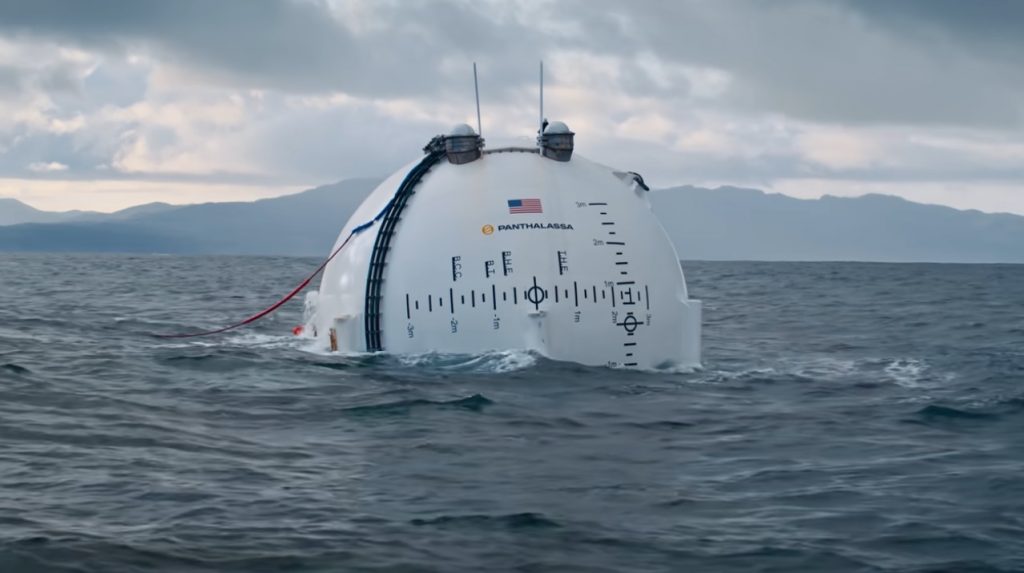
Panthalassa’s core product is an autonomous floating node — a massive steel platform mass-produced in coastal factories. Each node operates far out at sea, continuously harvesting energy from ocean waves and using that electricity directly onboard to run AI inference chips. Instead of transmitting power back to shore (the persistent bottleneck of every previous wave energy project), Panthalassa transmits only data — inference tokens sent to land via low-Earth-orbit satellites.
The ocean itself solves one of the most expensive problems in conventional datacenter design: cooling. Cold seawater provides natural, essentially free supercooling for the hardware, eliminating the elaborate cooling infrastructure that can account for a substantial fraction of a land datacenter’s operating cost — and extending chip lifetimes in the process.
As Sheldon-Coulson put it: “There are three sources of energy on the planet with tens of terawatts of new capacity potential: solar, nuclear, and the open ocean.”
The platform draws a parallel to the surging interest in space-based datacenters. In March, Starcloud, a Redmond, Washington-based startup, raised $170 million at a $1.1 billion valuation to pursue solar-powered orbital compute. Panthalassa is the ocean equivalent — extra-terrestrial thinking, applied to Earth’s most underused resource. As Thiel said in his endorsement: “Extra-terrestrial solutions are no longer science fiction. Panthalassa has opened the ocean frontier.”
From Prototype to Commercial Scale
Panthalassa has not just theorized. It has shipped hardware and tested it in real ocean conditions.
- Ocean-1 and Ocean-2 — early prototypes deployed at sea in 2021, validating power generation, propulsion, and autonomous operation.
- Wavehopper — a subsequent prototype tested in 2024, further proving at-sea computing capabilities.
- Ocean-3 — the pilot node series, scheduled for deployment in the northern Pacific Ocean in 2026, designed to demonstrate AI inference at scale and refine manufacturing processes ahead of commercial rollout.
Commercial deployments are targeted for 2027. The $140 million Series B will fund completion of the company’s pilot manufacturing facility near Portland and accelerate the Ocean-3 deployment.
Why Now, Why Thiel
The timing is not accidental. AI infrastructure investment has become the defining capital allocation story of 2025 and 2026. Every major cloud provider and AI lab is scrambling for power and compute capacity. The grid is constrained. Nuclear is slow. Solar farms face land-use conflicts. Into this environment, Panthalassa offers something genuinely different: untapped energy at scale, with no grid connection required, no land to acquire, and cooling built in by nature.
For Thiel — who made his name betting on contrarian, infrastructure-scale ideas from PayPal to Palantir — Panthalassa fits a familiar pattern: a technology that sounds impractical until the moment it suddenly seems obvious. John Doerr, who called the platform “a breakthrough in clean energy,” and the rest of the investor syndicate appear to share that read.
Wave energy as a sector has seen global investment cross $100 million in individual companies — Sweden’s CorPower Ocean and the UK’s Marine Power Systems have both cleared that threshold — but none have combined it with onboard AI compute in the way Panthalassa is attempting.
What Comes Next
Panthalassa’s near-term roadmap is clear: finish the factory, deploy Ocean-3 in the Pacific, prove the inference workload, and begin commercial sales in 2027. If it executes, it won’t just be a novel energy company — it will be a new class of AI infrastructure provider, one that adds compute capacity without touching a single power grid or acquiring a single acre of land.
The ocean covers 71% of the Earth’s surface. Almost none of it is generating electricity or running AI today. Panthalassa is betting that’s about to change.