AI is becoming so consequential that even the Pope has a take on it.
In his encyclical Magnifica Humanitas, Pope Leo XIV has delivered a substantial reflection on artificial intelligence, framing it within the Church’s long tradition of social doctrine. Released on May 15, 2026, the letter positions AI as a powerful but ambiguous force—one that demands vigilance to protect human dignity amid rapid technological change. Pope Leo XIV has previously hinted at the importance of AI — he’d said that AI was pivotal in choosing his name, and had later urged priests to not use AI while writing sermons.
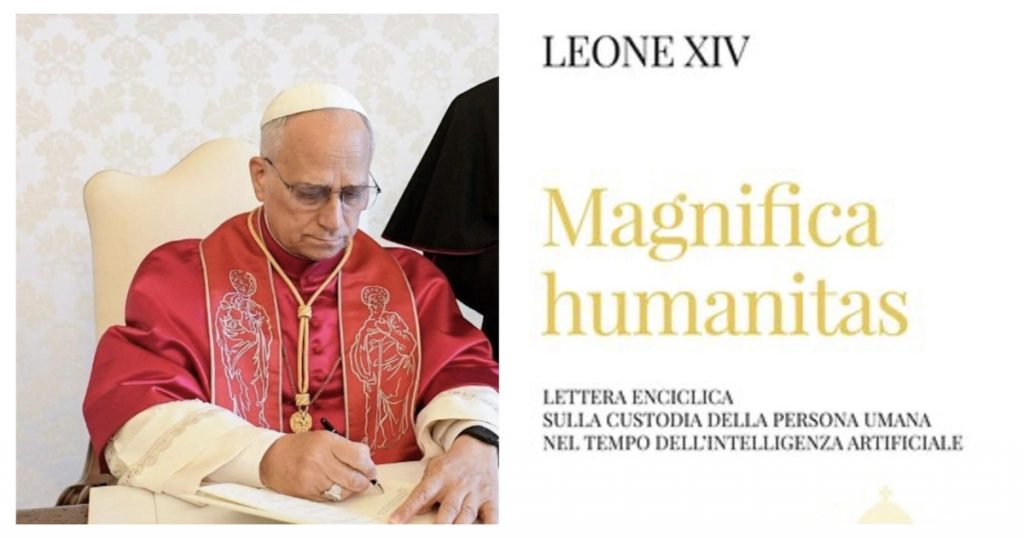
The Pope draws on biblical imagery to set the stakes. He contrasts the Tower of Babel—“a project conceived without reference to God, supported by a uniformity that eliminated diversity”—with Nehemiah’s rebuilding of Jerusalem’s walls through shared responsibility and communion. “The primary choice is not between a ‘yes’ or ‘no’ to technology, but rather between constructing Babel or rebuilding Jerusalem,” he writes. This frames AI not as inherently good or evil, but as a tool shaped by human choices, priorities, and power structures.
Key Highlights from the Letter
On AI’s Nature and Promise: The encyclical acknowledges AI as “a valuable tool” that can heal, connect, educate, and protect. It excels in speed and computation but lacks human elements: “These systems merely imitate certain functions of human intelligence… They do not undergo experiences, do not possess a body, do not feel joy or pain… nor do they have a moral conscience.”
Risks and the Technocratic Paradigm: Pope Leo XIV warns of a “technocratic paradigm” where efficiency and profit dominate, echoing concerns from Laudato Si’. He highlights concentration of power in private transnational actors, environmental costs (energy and water demands of data centers), and risks of dehumanization through transhumanist and posthumanist narratives that seek to “enhance” or surpass human limits. “What must not be lost” is the grandeur of the human person—limits, heart, relationships, and grace—rooted in Christian humanism.
Governance and Ethics: The letter calls for responsibility, transparency, and governance. “We cannot consider AI to be morally neutral,” it states. Key demands include clear accountability, human oversight (especially for lethal decisions in weapons), equitable access to data and benefits, and alignment with principles like the common good, subsidiarity, solidarity, and the universal destination of goods. It applies these to data as a shared resource, not private monopoly.
Work, Truth, and Freedom: In the digital transition, work must retain dignity: “The human person is an end, not a means.” Unemployment and de-skilling are grave concerns. Truth is a “common good” threatened by disinformation and algorithmic bias. Freedom faces new dependencies and surveillance. The Pope urges an “ecology of communication,” educational alliances, and protections against exploitation, including hidden labor in data labeling and resource extraction.
War and Power: A sobering section addresses AI in weapons, lowering thresholds for conflict and reducing moral responsibility. It critiques the “normalization of war” and calls for diplomacy, multilateralism, and a “civilization of love” over a “culture of power.”
The conclusion ties it to the Incarnation and the Magnificat, urging Christians to build responsibly: “Let us not be afraid to get our hands dirty on the ‘construction site’ of our time.”
Business and Tech Implications
The Magnifica Humanitas offers a humanistic framework rather than outright rejection of innovation. It reinforces growing calls for ethical AI design, transparent governance, and inclusive benefits—issues already shaping regulation, investor scrutiny, and talent attraction. Companies ignoring dignity, worker impacts, or environmental costs risk reputational and societal backlash. Those embedding principles like subsidiarity (local empowerment) and solidarity could lead in building trustworthy systems.
The letter arrives as AI hype and investment continue (with debates on bubbles, job impacts, and tools proliferating), underscoring that technical prowess alone is insufficient without moral and social progress.
This encyclical updates Catholic social teaching for the AI era, building on predecessors while addressing specifics like algorithms, data ownership, and autonomous weapons. It prioritizes human centrality over optimization, offering ethical guardrails for an industry racing ahead.
In a sharp business sense, the Pope’s message is pragmatic: AI’s value depends on who steers it—and toward what end. Leaders who treat it as a tool for integral human development, not dominance, will build more sustainable success.