Models aren’t only getting smarter — some companies are also working to make them smaller.
PrismML has released Bonsai 27B, the newest and largest member of its Bonsai family, and the first model in the 27-billion-parameter class built to run on a phone. The model is based on Qwen3.6 27B, and the release marks the point where PrismML’s compression work moves from small, novelty-sized models into genuinely capable, flagship-tier territory — the kind that can reason through multi-step problems, call tools, read screenshots, and hold up across long agentic loops.
This is PrismML’s third major release in the Bonsai line. The company first introduced 1-bit Bonsai 8B, packing an 8.2 billion parameter model into just over a gigabyte. It followed that with Ternary Bonsai, which used 1.58-bit weights to hit a 9x memory reduction while staying close to full-precision benchmark scores. Bonsai 27B pushes both approaches up to a scale that was previously assumed to be off-limits for on-device deployment entirely.
Why 27B Was The Wall
A 27B model in standard 16-bit precision needs about 54GB of memory. Even a well-built 4-bit quantization comes in around 18GB — too large for a phone, and too large for most laptops as well. That’s been the practical ceiling for local deployment: you could shrink an 8B model down to something a phone could hold, but a 27B model, with everything that extra scale buys in reasoning and instruction-following, stayed locked to the cloud or to machines with serious amounts of RAM.
Bonsai 27B is PrismML’s answer to that ceiling, and it ships in two variants built for two different constraints.
Ternary Bonsai 27B uses ternary {−1, 0, +1} weights with FP16 group-wise scaling, landing at 1.71 effective bits per weight. It comes in at 5.9GB, which is small enough to run comfortably on a regular laptop, and it’s positioned as the quality-first option — full reasoning, tool-calling, and agentic capability intact.
1-bit Bonsai 27B goes further, using binary {−1, +1} weights at 1.125 effective bits per weight. At 3.9GB, it fits inside the memory budget an iPhone 17 Pro actually makes available to an app, which is the number that matters here, not the phone’s total RAM. That distinction is worth sitting with for a second: a 12GB iPhone doesn’t hand an app 12GB to work with. It offers around 6GB, and the model has to share even that with its KV cache and activations. No conventional build of a 27B model gets close to clearing that bar. 1-bit Bonsai 27B does, with room left over.
Both variants run the low-bit representation end to end — embeddings, attention, MLPs, and the LM head — with no fallback to higher precision anywhere in the network. Both are multimodal too, with a 4-bit vision tower so the model can read screenshots, documents, and camera input rather than working from text alone. Bonsai 27B also carries a 262K-token context window and supports speculative decoding for additional speed. Everything is released today under the Apache 2.0 license.
How Much Capability Survives The Squeeze
The obvious question with any compression this aggressive is what gets left behind. PrismML ran both variants across a 15-benchmark suite covering knowledge, reasoning, math, coding, instruction following, tool calling, and vision, evaluated in thinking mode so the model’s full reasoning chain gets exercised. Ternary Bonsai 27B retains 95% of the full-precision Qwen3.6 27B baseline. 1-bit Bonsai 27B retains 90%.
Broken down by category, math and coding barely move. Qwen3.6 27B scores 95.3 on the math suite (GSM8K, MATH-500, AIME25, AIME26); Ternary Bonsai comes in at 93.4 and 1-bit Bonsai at 91.7. Coding follows a similar pattern — 88.7 for the baseline versus 86.0 and 81.9. Tool-calling and agentic benchmarks (BFCL v3, TauBench) see a bigger gap, dropping from 80.0 to 74.0 for Ternary and 66.0 for 1-bit, which is worth noting given that agentic tool use is the exact workload PrismML is building this model for.
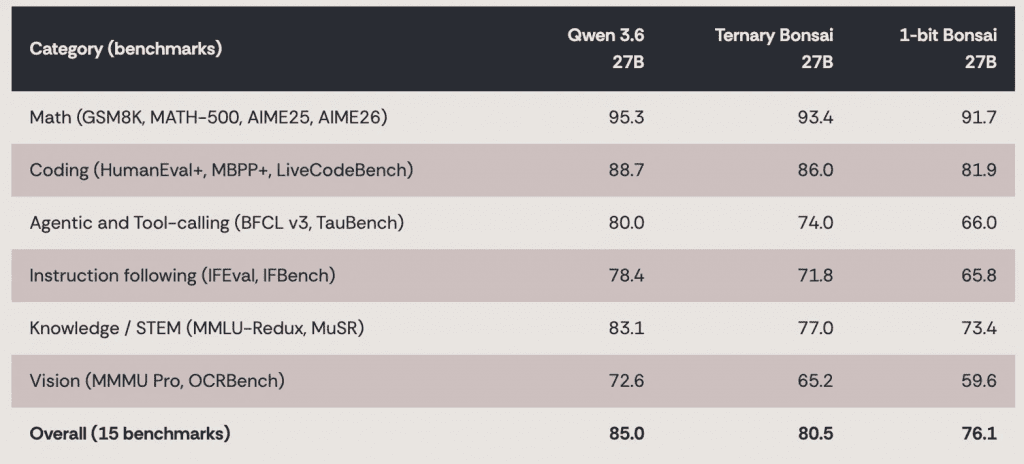
The pattern holds across the rest of the suite: instruction following, knowledge and STEM, and vision all show modest, predictable degradation as the bit budget tightens, with the overall 15-benchmark average landing at 85.0 for the baseline, 80.5 for Ternary, and 76.1 for 1-bit. PrismML’s comparison point is a conventional low-bit build of the same base model, which it says scores meaningfully below 1-bit Bonsai 27B while taking up 2.5x more memory.
The Intelligence Density Pitch
PrismML has been building its whole Bonsai narrative around a single metric it calls intelligence density — the negative log of a model’s error rate divided by its size in gigabytes. It’s a way of asking not “how good is this model” but “how good is this model per gigabyte you have to carry around,” and by that measure, 1-bit Bonsai 27B scores 0.53 per GB, more than 10x the full-precision baseline and roughly 2.7x the best conventional low-bit alternative PrismML tested against.
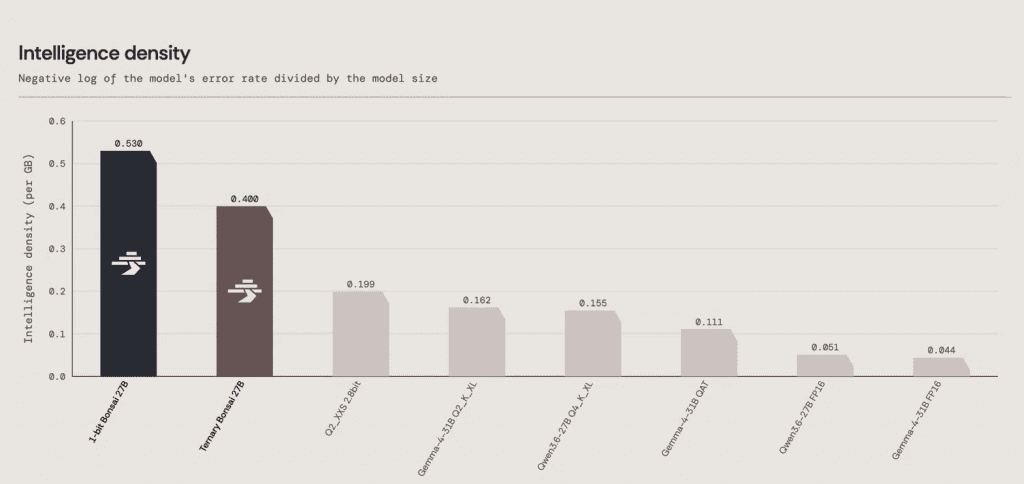
Zoom out across PrismML’s three releases and the density number keeps climbing: 1-bit Bonsai 8B posted 1.06 per GB back in April, Ternary Bonsai 8B followed at 0.803, and now Bonsai 27B extends the same curve to a much larger, much more capable base model. The company’s argument is that this isn’t a one-off trick that works at 8B and falls apart at scale — it’s a methodology that holds as parameter count goes up, which is the harder claim to prove and the one that matters if PrismML wants Bonsai to be taken seriously as infrastructure rather than a demo.
What This Is Actually For
The framing PrismML is leaning on is that AI workloads are shifting from single responses to sustained work — agents that operate real tools across dozens or hundreds of steps, workflows that run unattended and return a result later, research tasks that chew through many documents in sequence. Every one of those steps, if it’s a remote API call, costs tokens, adds latency, and sends whatever the agent is looking at — screens, files, private data — across the network.
Running the model locally removes that constraint entirely. A hundred-step agentic loop on-device costs nothing per step beyond compute you already own, and nothing the agent touches has to leave the machine. PrismML is also pitching a hybrid model on top of this: route the easy, privacy-sensitive, or high-volume steps to a local Bonsai model, and reserve frontier cloud models for the genuinely hard parts of a task, which in theory collapses the cost-per-task of running agents at scale.
On throughput, PrismML says Bonsai 27B hits up to 163 tokens/sec in 1-bit and 134 tokens/sec in Ternary on an RTX 5090, and up to 87 tokens/sec (1-bit) and 58 tokens/sec (Ternary) on an M5 Max. Demos shown alongside the release include a full agentic computer-use loop running on Ternary Bonsai 27B on an RTX 5090, and a multimodal agentic demo running 1-bit Bonsai 27B on an iPhone 17 Pro Max, though PrismML notes the phone demo runs with cached and prefilled image context rather than live end-to-end.
Where PrismML Goes From Here
PrismML frames intelligence density as one of the defining axes of the next phase of AI progress — the idea being that raw capability decides what a model can do, and density decides where it’s actually allowed to run. Every time that frontier moves left, a new set of devices and products become viable hosts for AI that previously had to live in a data center. The company says the compression methodology behind Bonsai isn’t tied to any one architecture, and that larger models and new architectures are already in the pipeline.
Bonsai 27B runs natively on Apple hardware through MLX and on NVIDIA GPUs through CUDA, using custom low-bit kernels built for its hybrid-attention architecture. Weights are available now under Apache 2.0, and PrismML is also opening a free, limited-time developer preview API alongside the release for anyone who wants to try the model without setting up local inference first.