Google’s search usage numbers have risen after the introduction of AI, but things aren’t the same for websites which relied on Google to send them traffic.
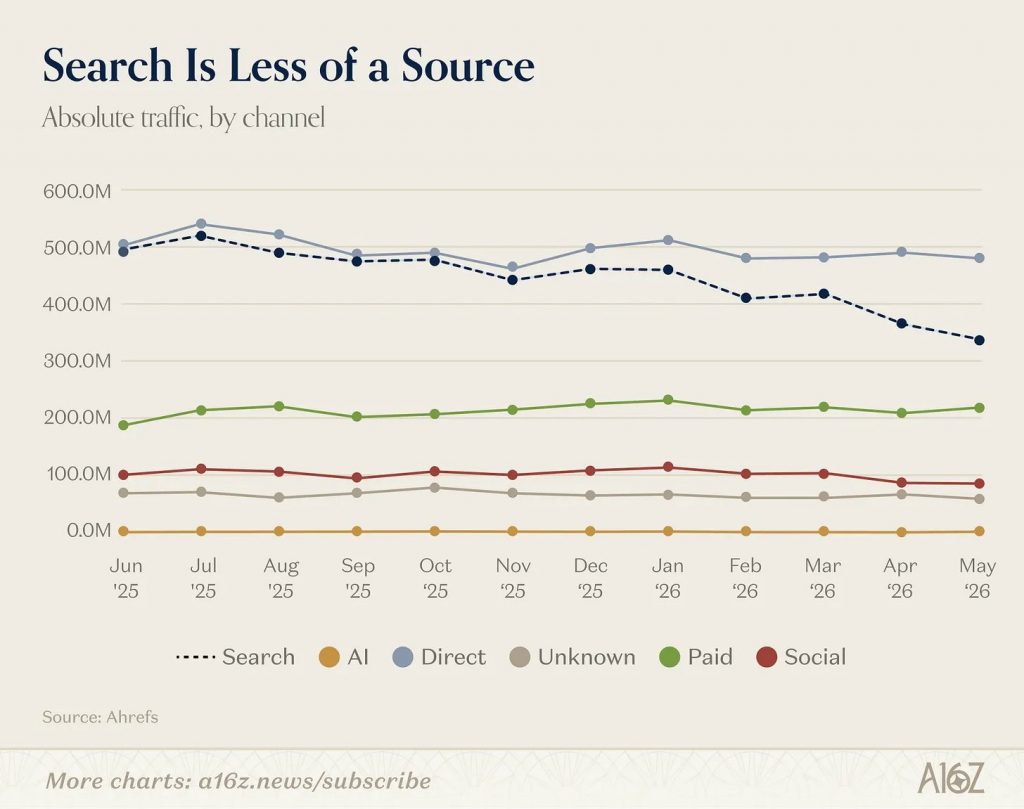
New data from venture capital firm a16z shows that search traffic to websites has fallen sharply — and AI is the most likely reason. According to Ahrefs data cited by a16z, search as a traffic channel dropped from roughly 500 million visits a month in mid-2025 to around 335 million by May 2026, a decline of approximately 25% over the past year. Every other major traffic channel — direct, paid, social — held relatively steady over the same period. Search was the exception.
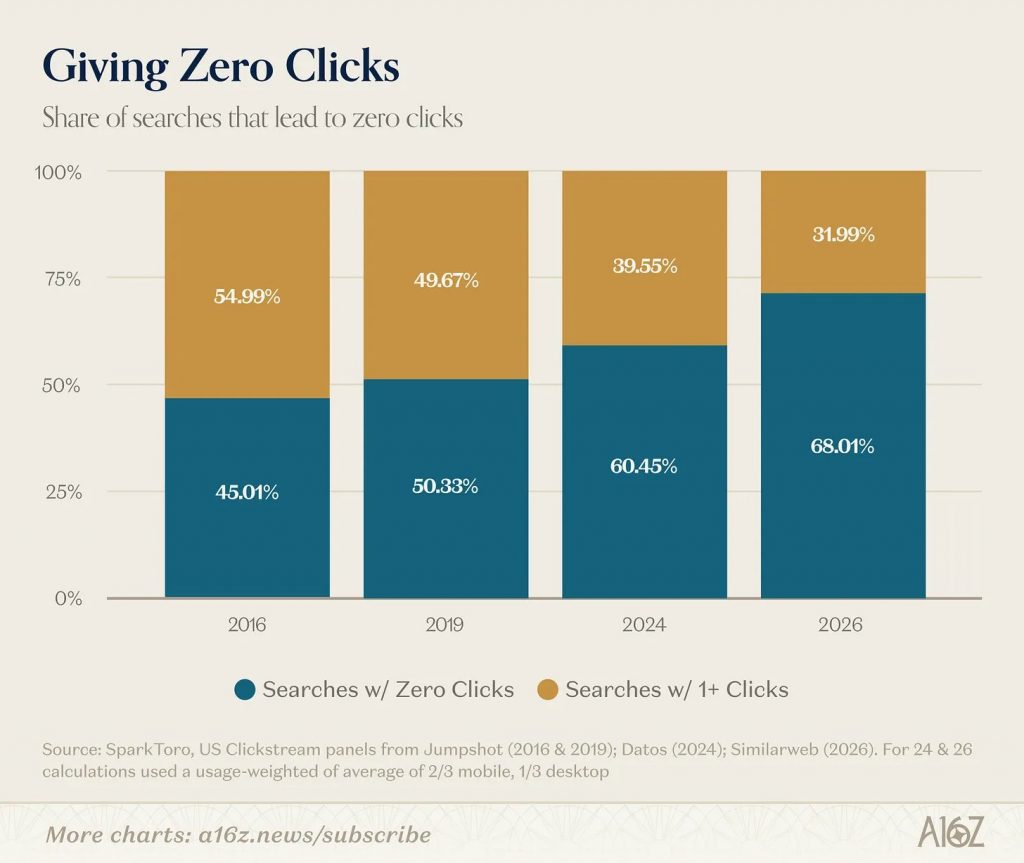
The second chart from a16z points to what’s driving this: a steady and accelerating rise in zero-click searches. In 2016, around 45% of Google searches ended without a user clicking on any link. By 2019 it had crossed 50%. By 2024 it was at 60%. The 2026 figure now stands at 68% — meaning more than two in three Google searches produce no website visit at all.
The mechanism is fairly straightforward. Google’s AI Overviews, which place an AI-generated answer at the very top of search results, answer the user’s query before they’ve had a chance to click anything. Websites have already been reporting the impact of this in their analytics consoles, watching organic traffic slide while impressions in Google Search Console continue to climb. People are seeing their pages. They’re just not visiting them.
The damage hasn’t been uniform. News and informational content — the kind of material that answers factual questions — has taken a disproportionate hit. Organic search traffic to major news sites fell to under 1.7 billion visits in May 2025 from a peak of over 2.3 billion just months earlier, according to Similarweb. The CEO of The Atlantic said publicly that he expects Google traffic to eventually approach zero, and that publishers need to rebuild their business models accordingly. Business Insider laid off roughly 21% of its staff in early 2025, with leadership explicitly citing traffic declines that were, in their words, “beyond our control.”
Google has pushed back on some of these figures, calling them based on “speculative or incomplete information.” The company has also argued that AI Overviews open up more discovery, not less, and that clicks following an AI-assisted search are more qualified. Whether that argument holds for the median website owner is less clear.
What is clear is that the shift in where web traffic comes from has been real and measurable. In the a16z data, “Direct” traffic remained the largest channel throughout the period — staying close to 500 million monthly visits — while search slid past it on the way down. Paid traffic held around 200 million. Social stayed near 100 million. AI as a traffic source, shown in the chart, remains a rounding error — close to zero even as AI tools grow in popularity among users.
That last point is worth sitting with. ChatGPT, Perplexity, and other AI tools are being used by hundreds of millions of people. But the traffic they send back to websites is minimal. AI is absorbing the attention that used to flow through Google, and only a small fraction of it is being redirected elsewhere on the web.
The practical effect of all this is a structural change in how websites get discovered. For a decade and a half, the playbook was relatively stable: rank in Google, get traffic. That equation is breaking down. Whether AI platforms eventually develop into meaningful traffic sources — through citations, linked summaries, or something else — remains to be seen. For now, the pipeline that publishers and content-driven businesses were built around is narrowing in ways that won’t be easy to reverse.