The impact of AI is being seen in all kinds of unexpected places.
A new paper published on SSRN by researchers A. Shah and J. Levy — “Access to justice in the age of AI: evidence from US federal courts” — has found that the number of self-filed civil lawsuits in the United States has roughly doubled since ChatGPT’s release in November 2022. From around 20,000–25,000 per year in the early 2020s, the number has climbed to over 40,000 as of the most recent data, a surge that tracks almost exactly with the widespread adoption of large language models.
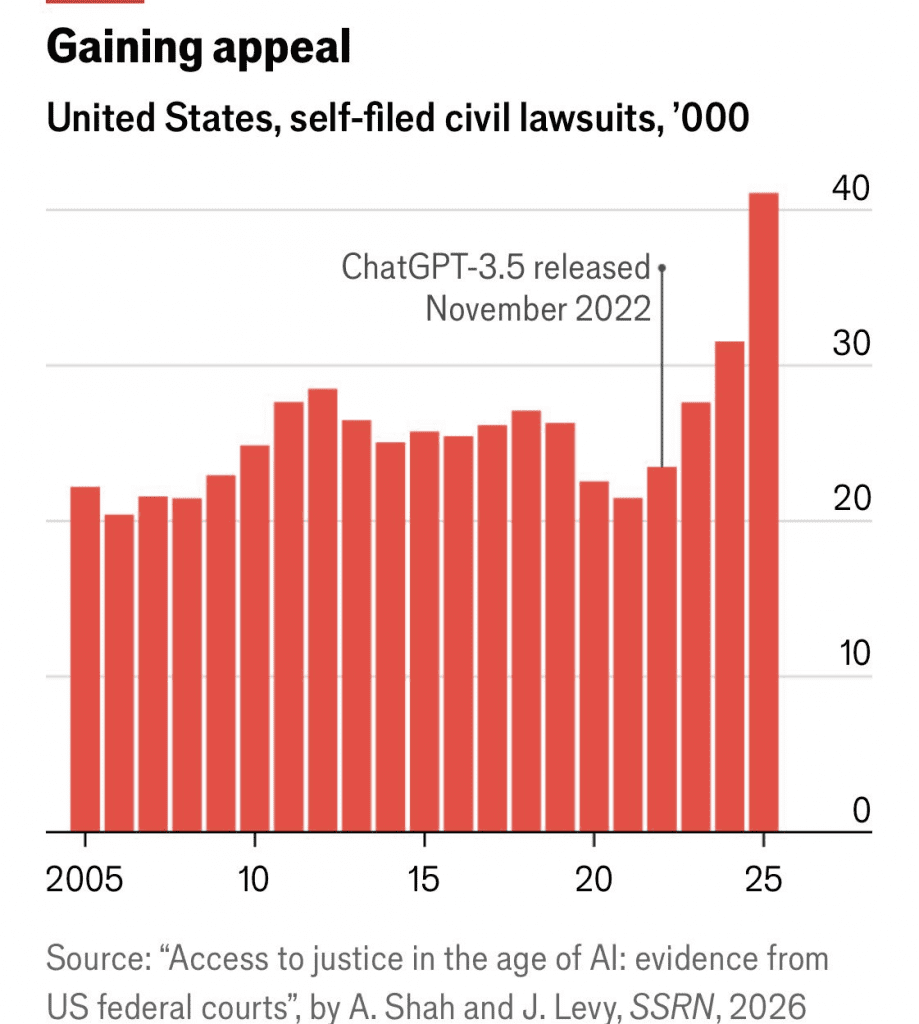
Self-filed suits, also called “pro se” litigation, are cases where individuals represent themselves without an attorney. For most of the past two decades, the number held fairly steady. Between 2005 and 2022, the annual count of self-filed federal civil cases bobbed between roughly 20,000 and 28,000 — with a brief peak around 2011–2012 before settling back down. There was no dramatic trend in either direction. Then, in 2023, the numbers started climbing. By 2025, they had shot past 40,000.
The explanation is fairly straightforward. Hiring a lawyer is expensive. Legal aid is underfunded. For most people with a legitimate grievance — a wrongful eviction, an employer dispute, a civil rights claim — the gap between having a case and being able to pursue it has historically been enormous. AI tools have begun to close that gap. Someone who previously had no way to navigate court filings, understand procedural rules, or draft a coherent complaint can now do so with meaningful assistance from a chatbot.
This is part of a broader pattern of AI quietly reshaping industries and behaviors in ways that weren’t obviously coming. We’ve written about how StackOverflow’s question volume collapsed once developers had AI to answer their coding questions, and how a Japanese toilet manufacturer’s stock doubled because its ceramics business turned out to be critical to AI chip manufacturing. The common thread is that AI’s effects tend to show up in places that are only obvious in hindsight.
The legal system is a particularly significant one. Access to justice has been a structural problem in the US for decades. Studies have consistently found that low- and middle-income individuals lose a disproportionate share of civil cases simply because they cannot afford representation, while their opponents can. Pro se litigants have generally fared poorly against represented parties — not necessarily because their claims were weaker, but because navigating procedural requirements, filing deadlines, and evidentiary standards without training is genuinely hard. AI doesn’t solve all of that, but it meaningfully lowers the barrier to getting into the room.
There are real complications here too. Courts are already under strain, and a surge in self-filed cases adds to docket backlogs. Judges and clerks have noted an uptick in filings that are better formatted and more procedurally coherent than typical pro se submissions — but that also sometimes contain AI-generated content that’s confidently wrong on points of law, a problem that has already surfaced in cases where lawyers used AI without verifying citations. The quality of AI-assisted legal work varies considerably, and someone filing without an attorney still bears the consequences if the AI gets something wrong.
What the data doesn’t tell us is how many of these cases are succeeding. Volume is up, but outcomes for pro se litigants are harder to track in aggregate. A doubled filing rate matters differently depending on whether it reflects a genuine expansion of access to justice or simply more people initiating cases they eventually lose. That’s a question the legal research community will be working through over the next few years.
What’s clear is that the trend is real and accelerating. The jump from around 20,000 to over 40,000 self-filed cases per year is large enough that it can’t be explained by noise. ChatGPT’s release in November 2022 sits right at the inflection point in the data. The causal story is plausible, the timing is precise, and the magnitude is significant. AI has, apparently, made suing someone considerably more accessible than it used to be.