AI seems to be progressing rapidly at the moment, but we might need to strap in for what’s on the horizon.
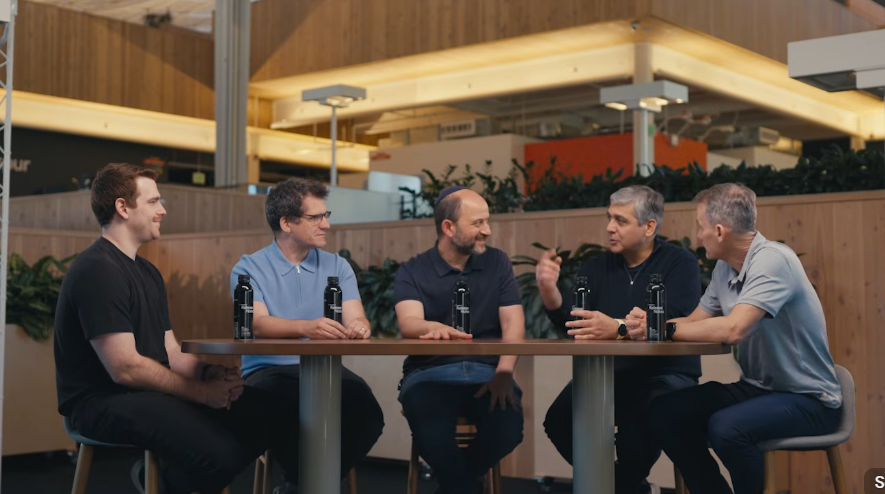
Four of Google DeepMind’s most senior AI researchers — Jeff Dean, Koray Kavukcuoglu, Noam Shazeer, and Oriol Vinyals — have indicated in a conversation that within a year, AI models could begin meaningfully improving themselves. The concept, broadly termed self-learning or self-improvement, represents a significant inflection point: models not just responding to human prompts, but actively contributing to their own development.
Models Improving Models
Kavukcuoglu, who leads research at Google DeepMind, laid out the trajectory plainly. Models are already deeply embedded in the research process — and that involvement is only going to deepen. “We’re going to rely on the models to improve different parts of Gemini,” he said, adding that within a year, the lab expects to be actively on that path and talking publicly about it.
Jeff Dean, Google’s Chief Scientist and one of the most influential figures in modern AI, put it more directly: “We’ll be able to point to some very significant thing in our models that was generated by the models and agents working. So, self-improvement.”
The shift is less science fiction and more a natural extension of how agentic AI is already being used. Noam Shazeer framed it in strikingly practical terms — instead of telling a team member to run an experiment and report back next week, researchers will give that instruction to the model itself.
The Continual Learning Piece
Oriol Vinyals added a related but distinct dimension: continual learning — a model’s ability to improve through its own experience and interactions, without requiring a full retraining of its weights. Think of it as a persistent, updating knowledge base rather than a fixed snapshot.
Vinyals acknowledged the capability exists in early form, but hasn’t yet seen the steep performance curve that would make it ubiquitous. “I think one year seems possible,” he said. It’s a measured take — hopeful without being hype.
This matters because current AI models, however capable, are essentially static after training. An AI that can genuinely update and refine itself through experience — without expensive retraining cycles — would be a fundamentally different kind of system. The AI race between labs is already intensely competitive; self-improving models would raise the stakes considerably.
The Rest Of The Industry Is Saying The Same Thing
The Google DeepMind quartet aren’t speaking into a void. Across the industry, similar signals have been quietly building.
Google DeepMind researcher Matej Balog was among the first to say it plainly, noting that they were “seeing the first signs of self-improvement” in AI systems. Balog outlined three possible futures: a one-off improvement that plateaus, continuous gains that taper off, or an accelerating loop that compounds without limit. He didn’t commit to which scenario was most likely — but the fact that he was mapping the scenarios at all signals how seriously the lab takes the possibility.
Then came a more sweeping claim. Another DeepMind researcher, Mostafa Dehghani, argued that recursive self-improvement is no longer science fiction — it’s already quietly underway at every major lab. His point: the current generation of models is being built heavily using the prior generation. DeepMind’s AlphaEvolve, a Gemini-powered coding agent, has already been used to make AI training itself more efficient. “It’s not fully automatic yet, but the direction is very clear,” Dehghani said.
Mark Zuckerberg has weighed in too, saying he’s starting to see early glimpses of self-improvement in Meta’s models. Elon Musk made a similar claim about Grok, asserting that continuous reinforcement learning is making the model smarter by the day.
Not everyone is sounding the alarm, though. OpenAI researcher Jason Wei has pushed back on the more dramatic readings, arguing that self-improving AI doesn’t exist yet and that even when it does, the takeoff will be “extremely gradual across many years.” His reasoning: self-improvement is not binary — some tasks lend themselves to it far more than others, and real-world experimentation remains a bottleneck that no amount of model intelligence can fully compress.
Capital Is Already Following The Conviction
The debate isn’t staying in research labs. Recursive, a startup founded by alumni from OpenAI, Google DeepMind, Meta AI, and others, recently raised $650 million at a $4.65 billion valuation with the explicit goal of building self-improving AI. Its founders describe it as “the third and perhaps final stage of neural networks” — a system that automates not just inference but the entire research and training pipeline. That kind of funding, at that kind of valuation, for that specific thesis, tells you something about where sophisticated investors think this is heading.
What This Means In Practice
For businesses, this is worth watching closely. The AI tools organizations are deploying today were built through slow, iterative human-led research. Systems capable of self-directed improvement could evolve far faster — and the gap between today’s capabilities and tomorrow’s may be shorter than most enterprise roadmaps assume. The bottleneck shifts from human researcher hours to compute cycles.
Google DeepMind is not alone in chasing this. Across labs, funding rounds, and public statements, the direction is consistent — even if the timeline and mechanism remain contested. Having four of the field’s most credible voices align on a one-year horizon, not as speculation but as an active internal direction, is a signal worth taking seriously.
The age of AI improving AI may be closer than it looks.