Slovenia’s country-code domain is having its Anguilla moment, or at least hoping for one.
When Donald Trump decided that “artificial intelligence” wasn’t good enough and ordered the US government to say “Super Intelligence” instead, he probably wasn’t thinking about the internet’s plumbing. But the abbreviation he chose, SI, happens to be the country code for Slovenia, and domain buyers noticed immediately.
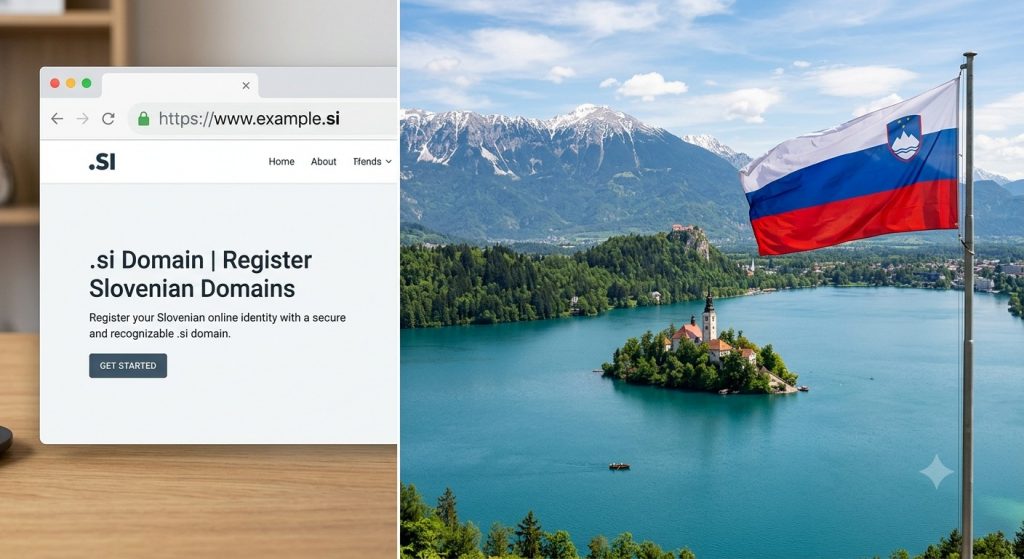
Registrations of .si domains have exploded since Trump’s September 22 speech at the UN General Assembly, where he said all US documents, “and hopefully the world’s,” would adopt the new term. They accelerated further after he signed an executive order on September 29 directing federal agencies to use “Super Intelligence” and “SI” in official communications. And on October 4, Elon Musk added fuel by saying he would rename SpaceXAI to SpaceXSI, replying “Yes, we will make that change” to a user who suggested it.
The numbers
Slovenia’s registry says it has been adding an average of roughly 3,700 new domains a day since Trump’s speech. For comparison, the entire month of August produced about 3,500. The total number of registered .si domains has since crossed 220,000.
Third-party data points the same way. An analysis by Austrian registrar Domaintechnik, reported by CircleID, counted 17,621 new .si registrations between September 23 and 29, against 7,209 for .ai over the same stretch. For about a week, in other words, the upstart extension was out-registering the one that has defined AI branding for the past three years. Registry figures show 46,066 .si domains were registered in September alone.
Registrar Hostinger sold roughly 4,300 .si domains on September 30, the day after the order, and about 5,400 the next day.
Who is buying, and why
Most of this looks like hedging rather than building. Hostinger said only about 3% of the .si domains on its platform are explicitly AI-related. Security firm Netcraft found more than 44,000 cases where someone, or often the same company, now holds both the .ai and .si versions of an identical name, and that roughly half of the .si names registered through one major registrar in the days before Trump’s speech were later listed for resale.
The economics help. A .si domain costs around $12 a year at some registrars, versus about $90 for a .ai, which also requires a two-year commitment. That makes .si cheap insurance for any company that wants to protect a brand in case “SI” takes off the way “AI” did.
Slovenia’s registry, for its part, has been careful not to oversell the moment. A spokesperson was cautious about attributing the entire surge to Trump, and the registry has pushed back on media speculation that it stands to make millions. It has also advised brand owners without a .si domain to grab one soon.
There’s also a political footnote that domain investors are enjoying: Slovenia is the birthplace of First Lady Melania Trump.
The Anguilla playbook
The obvious comparison is Anguilla, the Caribbean territory of about 15,000 people that was assigned the .ai domain back in 1995. For decades it was a curiosity. Then generative AI arrived, and the island’s country code became prime digital real estate.
By 2023, Anguilla was making around a quarter of its annual revenue from .ai registrations, up from $7.4 million in 2021. Since then the numbers have gotten far larger. Anguilla’s government earned about EC$230 million (US$85.3 million) from .ai in 2025, well above its own projections for that year and the two after it. Registrations passed one million worldwide in January 2026, and the first half of this year has already brought in EC$196.8 million, more than 85% of the 2025 total. Officials have said the money is funding infrastructure projects, and the government has talked about building a sovereign wealth fund on the back of it.
The island has no significant AI industry of its own. It simply had the right two letters at the right time.
Whether Slovenia can replicate any of that is doubtful, and the people closest to the market say so. Klaudijus Januitis, head of domains at Hostinger, put it this way: “For Anguilla, .ai became a second economy. For Slovenia, .si is a nice bonus.” Slovenia’s registry is also a long-established national operator with a base of over 200,000 names, so even a historic surge is a smaller proportional change in revenue than it would be for a tiny territory.
Will it last?
That’s the real question, and it hinges on two things.
The first is renewals. Speculative registrations tend to fall away when the hype fades, and a domain bought as a flip has to find a buyer or get dropped. Anguilla’s windfall has lasted because AI itself kept growing, and people kept building real products on .ai addresses.
The second is whether “SI” actually sticks. Trump’s order applies only to the federal government and doesn’t require private companies to change anything. Researchers have also pointed out that “superintelligence” already means something specific in the field: systems that surpass human cognitive ability, which today’s models are not. A YouGov poll cited by Axios found that 53% of respondents preferred “artificial intelligence” while only 9% preferred “super intelligence.” And Musk hasn’t said when SpaceXAI’s rename will take effect; the unit’s X account hasn’t changed yet.
That unit isn’t small. SpaceXAI houses Grok, X, and, since August, Cursor, acquired in a $60 billion all-stock deal, inside a parent company that made Musk the world’s first trillionaire when it went public. If it does move to SpaceXSI, the branding of one of the largest AI operations anywhere will carry the two letters Slovenia has had since the 1990s.
For now, Slovenia’s domain registry is enjoying an unexpected moment in the spotlight. Whether it becomes a lasting windfall or a brief speculative bubble will depend on whether anyone besides the White House and its most enthusiastic allies starts calling AI by its new name.