People aren’t just using AI to build fun projects — they’re now using it to build some serious software.
A developer says he has used AI to rebuild seven of Adobe’s flagship applications from scratch in Rust, and has released all of them for free under open-source licences. The suite covers equivalents of Photoshop, Illustrator, Premiere Pro, Lightroom, After Effects, InDesign and Acrobat. It is the latest sign of how cheaply AI models can now reproduce the surface area of mature commercial software.
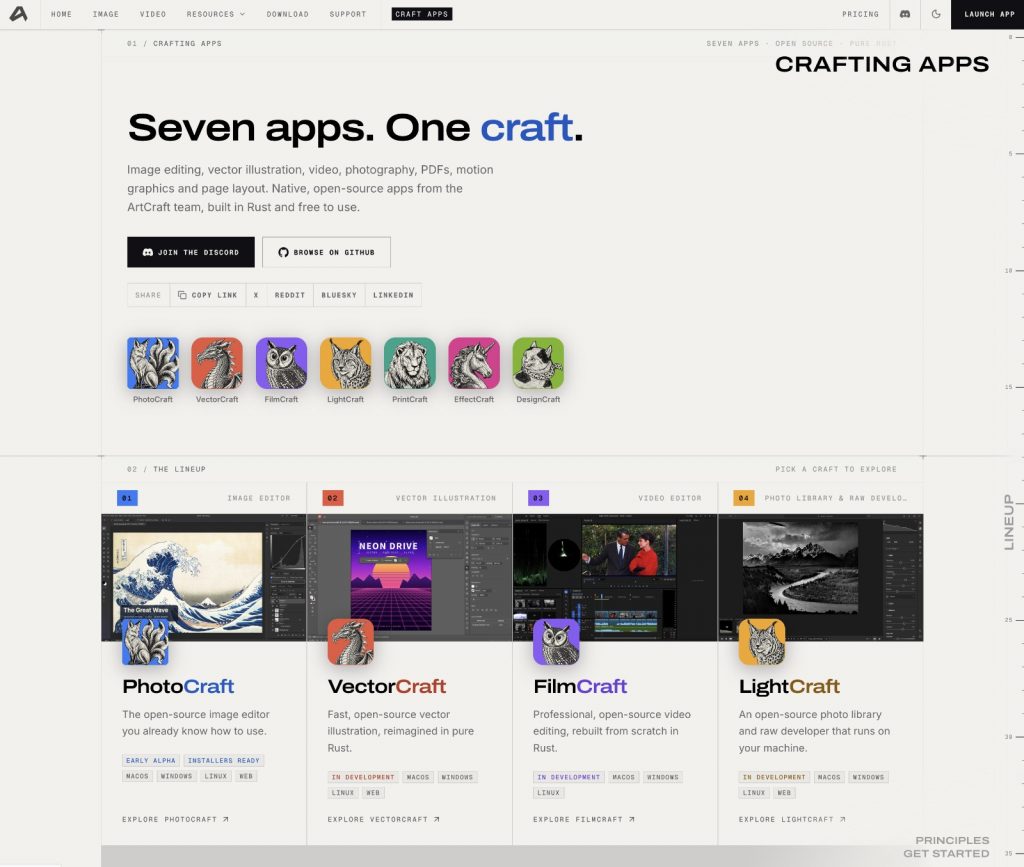
The projects were announced in a Reddit post in which the developer said he built them with Claude Opus 5.5, Anthropic’s newest flagship model, which was released last month. “No more subscriptions with cancellation fees,” the post said, adding that users can fork, build and own the code. The developer bristled at the “vibe coder” label, describing himself as a 15-year industry veteran with a decade of Rust experience, and said the work is funded by a team that already builds software for filmmakers.
The seven apps
Each app lives in its own repository under the storytold GitHub organisation and is part of what the team calls the “Crafting Apps,” built by the ArtCraft team. The 7 apps are PhotoCraft (Photoshop), VectorCraft (Illustrator), FilmCraft (Premiere Pro), LightCraft (Lightroom), PrintCraft (Acrobat), EffectCraft (After Effects) and DesignCraft (InDesign).
All are dual-licensed under MIT or Apache-2.0, run on macOS, Windows and Linux, and can also run in a browser through WebAssembly. Each README states that the code is “clean-room,” written from public specifications and observed behaviour rather than Adobe’s code or assets, and carries a disclaimer that the project is not affiliated with Adobe.
The scale of what’s in the repositories is notable. PhotoCraft lists 58 tools, more than 500 commands and over 1,700 tests, and says it re-saves 307 of the 309 PSD files in a public test set with identical renders. FilmCraft ships its own H.264, HEVC and ProRes decoders written in Rust, with no FFmpeg inside. EffectCraft claims 306 effects, which its README says covers every one of After Effects’ 298, along with built-in Lottie import and export. By its own account, EffectCraft’s first commit was on October 1, which would make it ten days old.
The projects have also attracted a lot of attention. At the time of writing, the seven repositories had a combined total of roughly 79,000 stars and 20,600 forks, with PhotoCraft alone at about 44,000 stars. Between them they have over 8,000 commits.
Every app is also built to be driven by AI agents. Each exposes its full command set through a command-line tool and an MCP server, so that Claude or another agent can edit photos, cut video or lay out pages the same way a person would. The repositories include CLAUDE.md and AGENTS.md files with rules for AI contributors.
In the Reddit post, the developer says the team will reach “100% parity within a month” and asks the community to test the apps and submit pull requests. The repositories themselves are considerably more measured, and most apps are in the alpha stage.
What it means for Adobe and other software providers
For now, none of this is a direct threat to Adobe’s revenue. The apps are alpha-stage by their own admission, most of them cannot reliably open Adobe’s native project files, and they have none of the plug-in ecosystems, collaboration features, commercially indemnified generative AI models or enterprise support contracts that keep studios and agencies on Creative Cloud.
But the more important signal is about cost: a feature checklist that took Adobe decades and thousands of engineers to build can now be approximated, at the level of menus, tools and file formats, in a matter of weeks by a small team using a frontier model, and given away. That strikes at the one thing Adobe’s stock has been defending all year, which is the assumption that complexity is a moat. Adobe shares have been under pressure through 2026 as investors worried that AI would erode software franchises, and the company’s response has been to put its own tools inside AI assistants, including a connector that lets users call its apps from within Claude. These projects complicate that strategy, because they are designed so that an AI agent can drive them directly, with no licence, subscription or Adobe account involved.
The pricing pressure is likely to land first on the low end, with students, hobbyists and freelancers who pay for Creative Cloud mainly for a few core features, and on mid-tier rivals that compete on price rather than on ecosystem or brand. Anyone selling software whose value is mostly a well-documented feature set, from PDF tools to video editors to design suites, should assume that rivals will be able to build credible versions faster and for less money than before, especially as newer models get better at producing finished documents, slides and designs. The defensible ground for incumbents is likely to be what cannot be rebuilt from public specifications: proprietary file formats and the habits built around them, trained workforces, cloud services and shared libraries, licensed content, legal indemnity for AI output and enterprise trust.