Elon Musk had overhauled xAI’s leadership and instead acquired Cursor, and the partnership seems to have shown immediate results.
SpaceXAI, the AI unit that emerged after SpaceX absorbed xAI earlier this year, has released Grok 4.5, its first model built jointly with the coding startup Cursor. It’s also the company’s first major model launch since going public, and the first fruit of SpaceX’s $60 billion deal to acquire Cursor, announced in mid-June.
Unlike earlier Grok releases, which were pitched largely as consumer-facing chatbots, Grok 4.5 is squarely aimed at coding, agentic workflows, and broader knowledge work spanning finance and legal tasks. Cursor said on its blog that the model is built to handle difficult, long-running tasks requiring creative tool use, whether in software engineering, data science, finance, or legal work.
“Opus-Class,” But Cheaper
Musk was characteristically blunt about where he sees Grok 4.5 sitting in the competitive landscape. In a post on X, he described the model as roughly on par with Anthropic’s top-tier Opus family, while being noticeably faster, more efficient with tokens, and cheaper to run.
That pricing pitch is central to the launch. Grok 4.5 is priced at $2 per million input tokens and $6 per million output tokens, with a faster variant available at $4 input and $18 output. That undercuts Anthropic’s Opus 4.8, which is priced at $5 input and $25 output, though it’s roughly in line with OpenAI’s GPT 5.6 Luna at $1 input and $6 output.
Grok 4.5 Benchmarks
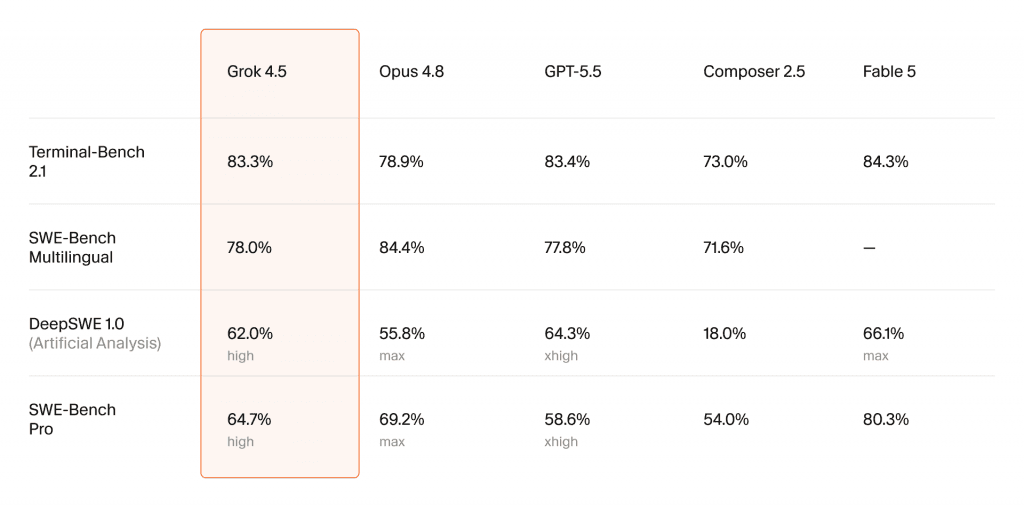
According to the benchmark chart released alongside the model, Grok 4.5 doesn’t top the field outright, but it does beat some heavyweight rivals on select tests:
| Benchmark | Grok 4.5 | Opus 4.8 | GPT-5.5 | Composer 2.5 | Fable 5 |
|---|---|---|---|---|---|
| Terminal-Bench 2.1 | 83.3% | 78.9% | 83.4% | 73.0% | 84.3% |
| SWE-Bench Multilingual | 78.0% | 84.4% | 77.8% | 71.6% | — |
| DeepSWE 1.0 (Artificial Analysis) | 62.0% | 55.8% | 64.3% | 18.0% | 66.1% |
| SWE-Bench Pro | 64.7% | 69.2% | 58.6% | 54.0% | 80.3% |
On Terminal-Bench 2.1, Grok 4.5 edges out Opus 4.8 by more than four points and comes within a fraction of a point of GPT-5.5. It also beats both Opus 4.8 and GPT-5.5 on the DeepSWE 1.0 benchmark. It falls behind Opus 4.8 on SWE-Bench Multilingual and SWE-Bench Pro, however, and trails Fable 5 across every category shown.
Cursor flagged two caveats around the numbers. SWE-Bench Pro and Terminal-Bench figures for third-party models are self-reported, and the GPT-5.5 score on SWE-Bench Multilingual comes from Cursor’s own internal test run rather than OpenAI’s published figures. The company also noted that an earlier snapshot of the Cursor codebase was accidentally included in Grok 4.5’s training data, which may have inflated its results on Cursor’s own internal benchmark — that metric was excluded from the public comparison as a result, and the contaminated data has been removed for future models.
Efficiency is where SpaceXAI leans hardest into its pitch: on SWE-Bench Pro tasks, the company says Grok 4.5 uses roughly 4.2 times fewer output tokens than Opus 4.8, while running at about 80 tokens per second.
Built On Cursor’s Own Data
The technical story behind Grok 4.5 is arguably as interesting as the benchmark numbers. Cursor said the model is a mixture-of-experts system trained jointly with SpaceXAI, using trillions of tokens drawn from real Cursor user sessions — capturing how developers actually work and how coding agents interact with codebases in practice.
That’s a departure from Cursor’s earlier in-house model, Composer 2.5, which the company had trained specifically as a coding specialist. For Grok 4.5, Cursor said it deliberately broadened the training mix to include STEM tasks, research papers, and general knowledge work, so the model could generalize beyond pure software engineering. Composer 2.5 remains available as a separate, smaller model, and Cursor says it plans to keep releasing models in that lighter weight class going forward.
Grok 4.5 Availability
Grok 4.5 is live now in Grok Build, across Cursor on all plans — desktop, web, iOS, CLI, and SDK — and through the SpaceXAI console. Cursor is offering double usage limits for the model’s first week. The model is not yet available in the EU, with SpaceXAI expecting access to open up there in mid-July.
The release lands the same week OpenAI is rolling out GPT-5.6 more broadly, making it a crowded stretch for frontier model launches — and intensifying the pricing and performance battle between SpaceXAI, Anthropic, and OpenAI over developers’ coding workflows.