Plenty of smaller companies are taking on bigger players in specific AI verticals — and are holding their own.
The latest example comes from the text-to-speech world, where SpeechifyAI’s Simba 3.2 has climbed to the number one position on Artificial Analysis’ Speech Arena Leaderboard, edging out models from Google, Cartesia, Alibaba and Inworld along the way.
The leaderboard ranks TTS models through blind, arena-style comparisons, where listeners judge outputs from different providers’ native voices without knowing which model produced which clip. Simba 3.2 currently sits at an Elo score of 1,233, built off 1,258 arena appearances. That puts it ahead of Google’s Gemini 3.1 Flash TTS at 1,214, Cartesia’s Sonic 3.5 at 1,210, Alibaba’s Fun-Realtime-TTS at 1,206, and Inworld’s two entries, Realtime TTS-2 Research Preview and Realtime TTS 1.5 Max, both hovering around the 1,200 mark.
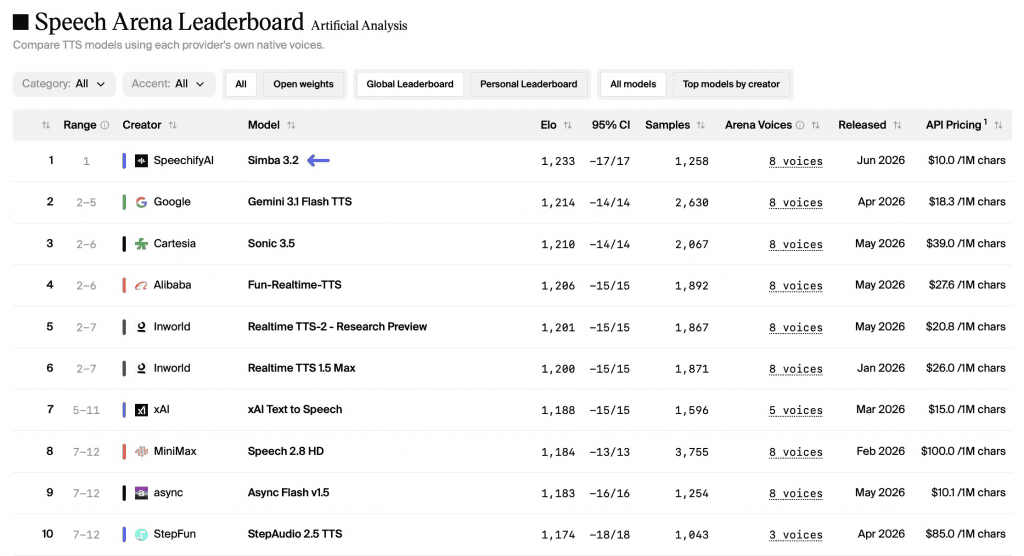
What stands out isn’t just the ranking, but the price tag attached to it. Simba 3.2 is priced at $10 per million characters, which makes it the cheapest model among the top handful on the board. Gemini 3.1 Flash TTS costs $18.3 per million characters, Inworld’s Realtime TTS 1.5 Max runs at $26, and Cartesia’s Sonic 3.5, the most expensive of the group, comes in at $39 per million characters — nearly four times what Speechify is charging for a model currently rated higher on quality.
Speed is where the picture gets more complicated. Simba 3.2 processes speech at 29.2 characters per second, which is respectable but nowhere near Inworld’s Realtime TTS 1.5 Max at 89 characters per second. It is faster than Gemini 3.1 Flash TTS, though, which comes in at 24.5 characters per second. For most use cases — audiobooks, voiceovers, accessibility tools — that gap in raw throughput matters less than output quality and cost, which is likely why Simba 3.2 has still managed to top the board despite not being the fastest model in the field.
The rest of the leaderboard reads like a snapshot of how competitive the voice AI space has become. xAI’s Text to Speech model sits at 1,188, MiniMax’s Speech 2.8 HD at 1,184, Async’s Flash v1.5 at 1,183, and StepFun’s StepAudio 2.5 TTS rounds out the top ten at 1,174. Several of these models were released within the last few months of each other, which says something about how fast providers are iterating in this category right now.
Who’s behind Simba 3.2
Speechify was founded in 2017 by Cliff Weitzman, then a student at Brown University, along with his brother Tyler Weitzman. Cliff’s own experience with dyslexia shaped the company from the start — he built an early version of the text-to-speech tool to get through his own coursework, after years of leaning on audiobooks to compensate for how difficult reading text was for him. That personal starting point is part of why Speechify built its early reputation as an accessibility tool rather than a voice-tech company chasing enterprise contracts.
The company has since expanded well past its original reading-app roots. Speechify now says it serves over 50 million users across its iOS, Android, Chrome extension, web and Mac apps, and has built out Speechify Studio, a suite aimed at creators and businesses that covers voice generation, voice cloning and AI dubbing, alongside a developer-facing TTS API. It has also leaned into celebrity voice licensing, with voices from Snoop Dogg, Gwyneth Paltrow and Mr. Beast available on the platform. In 2025, Apple gave Speechify its Design Award at WWDC.
On the funding side, Speechify has kept a relatively low profile compared to peers like ElevenLabs, which recently raised money at an $11 billion valuation. Speechify’s early backers include G9 Ventures, Adjacent, Streamlined Ventures and Forerunner Ventures, and the company disclosed a $10 million raise at a $100 million valuation. The company is headquartered in Miami and runs as a fully distributed team, with close to 200 employees pulled from places like Amazon, Microsoft, Google and Stripe.
Simba 3.2’s debut at the top of the Speech Arena Leaderboard is a reminder that quality and pricing, not raw scale, can still decide who wins a category — at least until the next model release resets the board again.