For most of modern economic history, building a serious business meant building a team. You needed people to cover the gaps — the things you couldn’t code, couldn’t write, couldn’t sell, couldn’t manage. That logic shaped everything from how companies were funded to how office space was designed. It was so deeply embedded that even the way governments counted businesses reflected it: the US Census Bureau, until recently, would automatically reclassify a solo business as an employer if its revenue crossed a certain threshold. The assumption was that revenue at scale meant headcount.
That assumption is now breaking down, and the data is starting to make that hard to ignore.
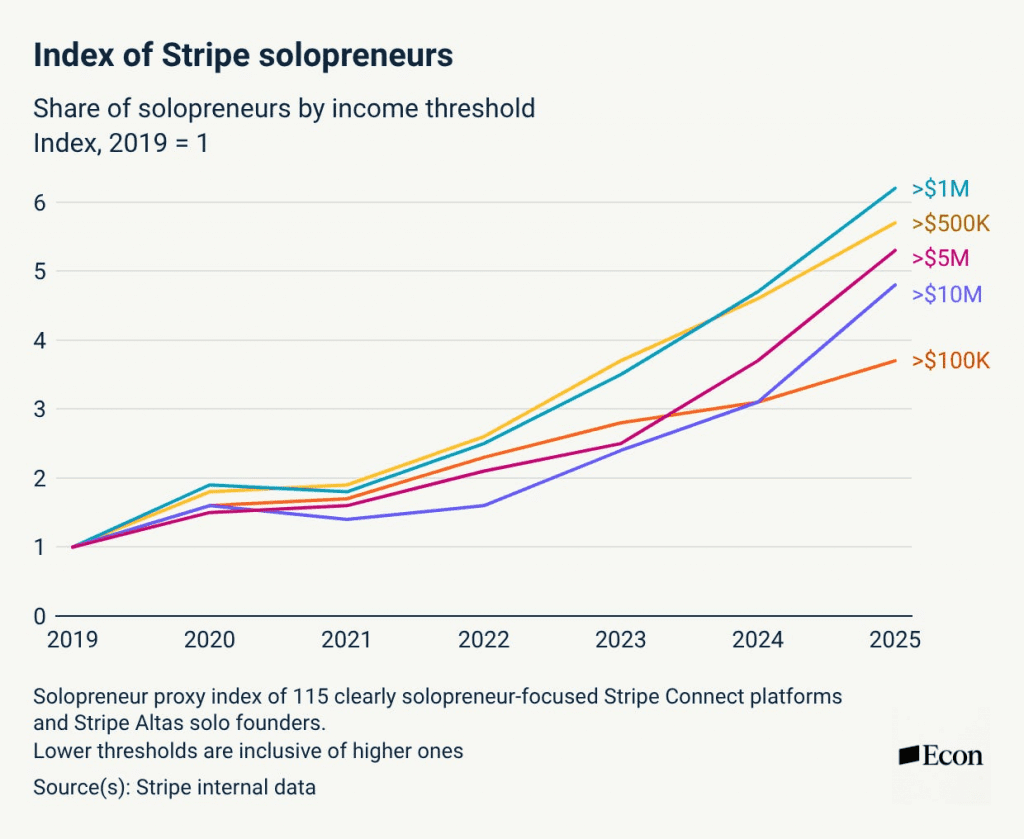
A new report from Stripe Economics puts numbers to a shift that’s been building for years. In 2023, roughly four million Americans earned their primary income as solopreneurs generating over $100,000 in annual revenue annually — up from around 2.5 million in the early 2010s. That’s already a significant change. But what’s happening at the higher end of the income distribution is more striking. The share of solopreneurs earning over $1 million more than doubled between 2023 and 2025. Those clearing $5 million and $10 million nearly tripled.
These aren’t hobbyist freelancers supplementing a salary. These are businesses — real ones, with real revenue — run entirely by a single person.
The Census Bureau Finally Caught Up
The growth in solopreneurs isn’t entirely new. Part of what’s showing up in recent data is a measurement correction. Until 2022, the Census Bureau’s methodology automatically reclassified solo businesses as employer businesses once they crossed certain revenue thresholds, regardless of whether they actually had employees. When the Bureau revised those thresholds, the counts of high-revenue nonemployer businesses jumped substantially — not because something changed overnight, but because the old framework had been systematically undercounting them.
The underlying reality, though, was already there. Platforms like Substack, Kajabi, and Stripe itself had spent the previous decade quietly building the infrastructure that made operating a solo business at meaningful scale actually feasible. Payment processing, subscription management, digital distribution, customer communication — all of it had become something one person with a laptop could run without much friction.
New Business Applications Are Surging — And It’s Not Fraud
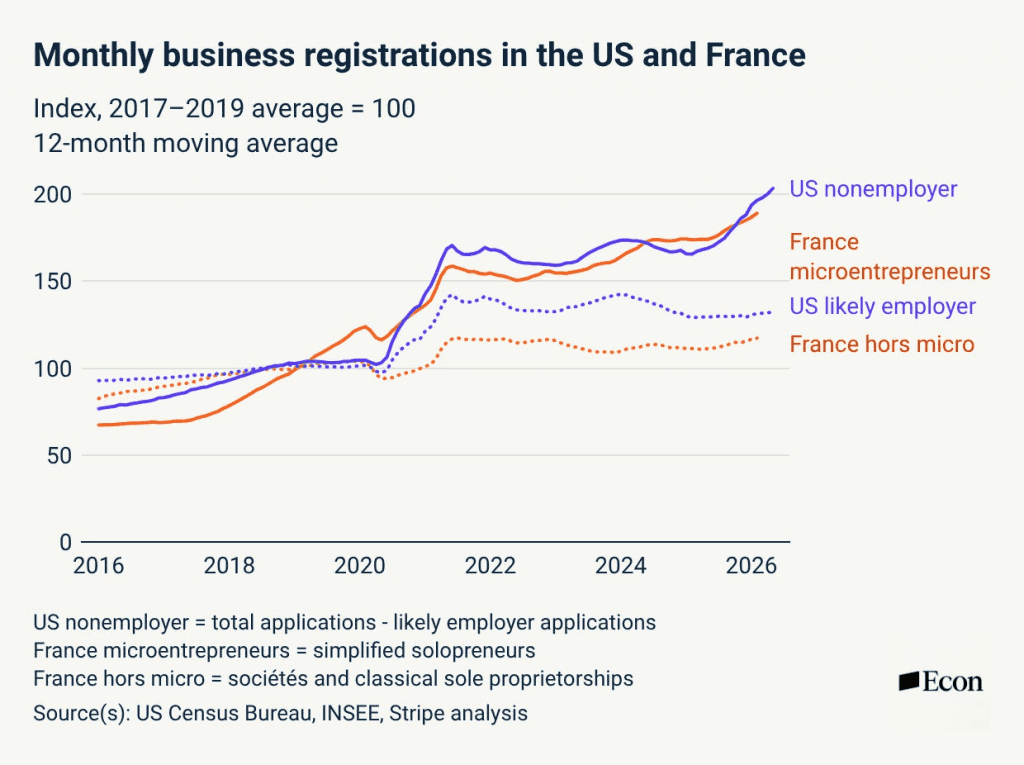
US new business applications have been flashing an unusual signal for the past 18 months. After the pandemic-era spike in 2020 — much of which was driven by the Paycheck Protection Program creating financial incentives to file — formations stabilised and then started climbing again in late 2024. The current acceleration has no comparable government subsidy behind it.
Sceptics have pointed to potential fraud — passive LLC filings, inactive businesses padding the numbers. The Stripe report addresses this directly, and the evidence doesn’t support that reading.
Stripe’s own transaction data shows that businesses signing up on the platform after 2023 reached significant transaction volumes faster than earlier cohorts. The share of businesses hitting $1 million in cumulative revenue within a year of going live on Stripe was roughly 30% higher for the 2025 cohort than the 2023 cohort, and about three times higher than the 2019 cohort. If this were a wave of inactive filings, you’d expect the opposite trend.
The geographic composition of the surge also matters. Delaware incorporations — the jurisdiction of choice for founders who intend to raise capital or set up formal governance structures — have grown roughly 40% year over year since early 2025. Wyoming, another state associated with deliberate legal structuring, is also seeing accelerating growth. These are not the natural destinations for passive bad-faith registrations.
And the trend isn’t confined to the US. New business registrations have risen roughly 40% in Australia, 70% in Finland, and 80% in France since 2017, with meaningful acceleration in 2025 alone. Multicountry acceleration across entirely different regulatory regimes points to something structural, not jurisdictional.
AI Is Filling the Gaps That Used to Require Hiring
The historical reason businesses tended to be built by groups was simple: a single person rarely has all the skills needed across the full arc of building and running a company. Market sizing, product development, coding, marketing, sales, financial management — very few individuals can do all of it, and even fewer can do it simultaneously.
AI is changing that calculus. The Stripe report finds that AI-influenced user journeys now represent nearly four times the share of Stripe sign-ups they did in January 2025. Industry-level data from the Census Bureau’s Business Trends and Outlook Survey shows a positive relationship between AI adoption rates in a given sector and growth in nonemployer business applications in that sector.
What’s happening in practice is that AI tools are handling the skill gaps that once made hiring necessary. A solo founder building a product can now get marketing copy, logo design, pitch decks, financial reconciliation, and lead generation handled with tools that cost a few hundred dollars a month rather than a few hundred thousand in salaries. The coverage isn’t perfect, but it’s good enough — and for a growing number of founders, it’s good enough to run a million-dollar business.
Sam Altman described this as the “revenge of the idea guys.” The Stripe report uses that framing approvingly. There’s something to it: for years, the people with strong ideas but missing technical or operational skills had to find co-founders or build teams to execute. Now the execution layer is increasingly available on tap.
Personal AI assistants are taking this further — handling email triage, scheduling, research, and reporting in the background while the founder focuses on whatever only they can do.
What the Income Distribution Is Actually Showing
The Stripe solopreneur index — built from approximately 115 solopreneur-focused platforms and solo Stripe Atlas businesses — tracks directional trends in both the count and the share of solopreneurs crossing various income thresholds. Both have risen sharply, and the share metric is the more important one.
If the surge in business formation were driven mostly by experimentation — lots of people trying, a handful succeeding — you’d expect the count to rise while the share stayed flat or declined. The fact that the share of solopreneurs reaching meaningful income thresholds has also doubled suggests the quality of new entrants is improving, not just the quantity. The cohorts forming in 2024 and 2025 seem to be performing better, on a per-business basis, than the cohorts that preceded them.
The Stripe report is careful about the limitations of this index. It almost certainly understates the actual solopreneur population, since most solo operators use general-purpose infrastructure rather than platforms specifically built for them. Some businesses in the index may have hired employees since joining. The earnings distribution within the solopreneur category is likely wide. But the directional trend across multiple independent datasets — Census Bureau data, cross-country registrations, Stripe platform data — all point the same way.
The Broader Implication
The traditional model of company building assumed that scale required headcount, that revenue growth meant hiring, and that a serious business was fundamentally a team endeavour. That model produced a particular kind of economy — one where most of the value created by small businesses flowed through employer-employee relationships, and where solo operators were generally assumed to be at the subsistence end of the income distribution.
What the data now suggests is that model was partly a function of the tools available. When the tools improve enough — when an individual can access capabilities that previously required a team — the minimum viable headcount for a serious business drops. Home-based businesses that would have stalled at the consulting-rate ceiling are now scaling into product revenues. Solo operators who would have needed to hire a developer, a marketer, and an ops person are instead using AI to cover those functions and staying lean.
The Stripe report frames this as potentially “the early innings of a fundamental acceleration in business formation.” Whether that turns out to be right depends on whether AI capabilities continue improving at their current pace, whether the tools remain accessible and affordable, and whether the income gains for solopreneurs hold up as more people enter the market.
What’s already clear is that the category of “serious business” now extends much further down the headcount curve than it used to. And that’s a meaningful shift in how the economy works.