The United States is pulling further ahead in the global race for AI compute, and the gap is widening faster than it has at any point since 2022.
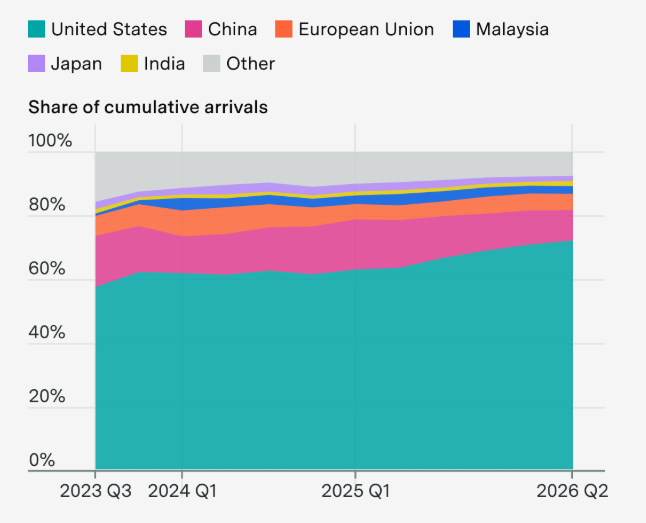
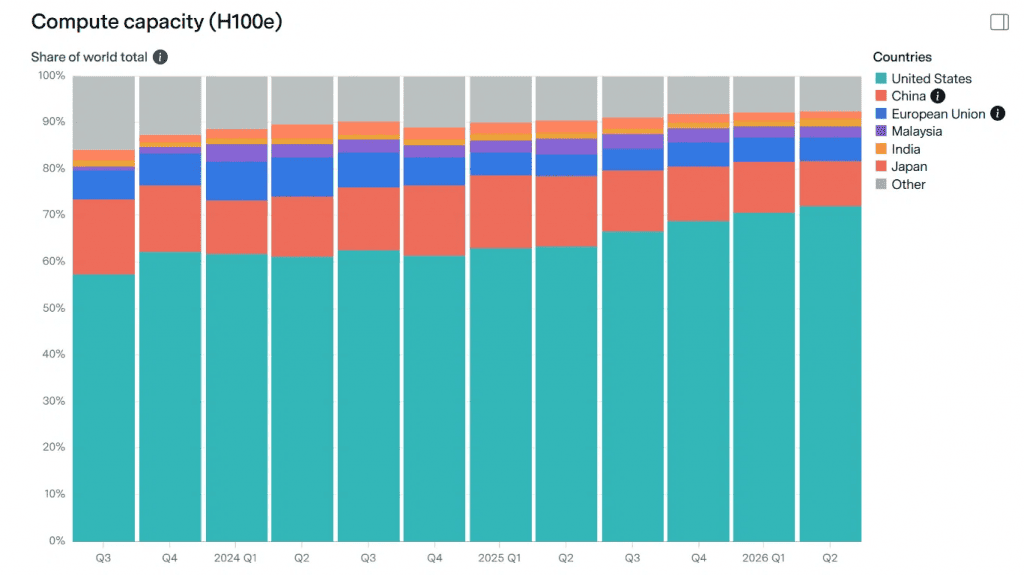
New data from Epoch AI shows that since 2022, the US has accounted for 72% of all AI compute added worldwide, measured in H100-equivalents (H100e). China, by comparison, has picked up about 10% over the same period. But the more striking number isn’t the cumulative total, it’s the trend. The US acquired roughly 60% of new compute added each year between 2022 and 2024. That share jumped to 72% in 2025, and has climbed further still to 78% in the first half of 2026.
In other words, the US isn’t just maintaining its lead, it’s compounding it. Every quarter, a larger share of the world’s new AI chips is landing in American data centers than the quarter before.
Where The Data Comes From
The numbers come from Epoch AI’s AI Chip Imports explorer, an interactive tool that estimates and visualizes national compute shares using customs records. The explorer tracks chip arrivals since 2022 and translates them into H100-equivalent compute, a standard unit that normalizes different GPU models (A100s, H100s, H200s, B200s, and so on) into comparable compute capacity.
The dataset includes chips arriving through cross-border trade as well as China’s domestic production, covering companies like Huawei and Cambricon. It excludes chips made and used entirely within Taiwan. This is a meaningful methodological choice, since Taiwan is home to the bulk of the world’s advanced chip fabrication but most of what it produces for firms like Nvidia and AMD is exported rather than used domestically.
Breaking down the cumulative numbers by country as of Q2 2026: the US holds 72.2% of global compute share, China 9.6%, the European Union 5.1%, Malaysia 2.4%, India and Japan 1.6% each, and the rest of the world makes up the remaining 7.5%.
Malaysia’s presence on that list is worth pausing on. It has emerged as a significant hub in the AI supply chain largely because of its role as a transit and assembly point for chips headed toward data centers across Southeast Asia, benefiting from spillover investment as hyperscalers diversify where they build capacity outside of the US and China.
Why The US Lead Is Widening, Not Shrinking
A few forces are compounding to push the US share higher rather than letting it plateau. Export controls on advanced AI chips to China, which have tightened in stages since October 2022, continue to restrict how much cutting-edge compute Chinese firms can legally import, pushing them toward domestic alternatives that lag in both performance and volume.
At the same time, American hyperscalers and AI labs have kept increasing capital spending on data centers and chip procurement at a pace that dwarfs the rest of the world combined. Anthropic’s own recent S-1 filing, for instance, disclosed a commitment of between $542 billion and $567 billion on future compute and infrastructure alone, a figure that illustrates just how much a single American lab is willing to spend to secure its own compute pipeline. Multiply that kind of commitment across OpenAI, Google, Microsoft, Meta, and Amazon, and the scale of US demand pulling in new chips becomes clear.
Countries like India, meanwhile, remain a small fraction of the global total despite a growing domestic AI ecosystem and government-backed compute initiatives, a gap reflected in how thin the list of India-linked AI stocks still looks compared to the scale of US hyperscalers.
What This Means Going Forward
Epoch AI’s chip import tracker is part of a broader project mapping the AI hardware supply chain, which also includes data on the components used to manufacture chips, sales volumes, the data centers housing them, and the companies that ultimately own and operate them. Together, this gives a far more granular picture of global AI compute distribution than has previously been available, moving past self-reported figures from chipmakers and cloud providers toward independently verified trade data.
If the current trajectory holds, the US share of new compute added each year could climb even higher through the back half of 2026, extending what is already one of the most lopsided infrastructure advantages in the history of a major technology race. Whether that gap narrows will depend heavily on how effectively China’s domestic chip industry, and the broader shadow market of smuggled and re-routed hardware, can close the distance that export controls and capital spending have opened up.