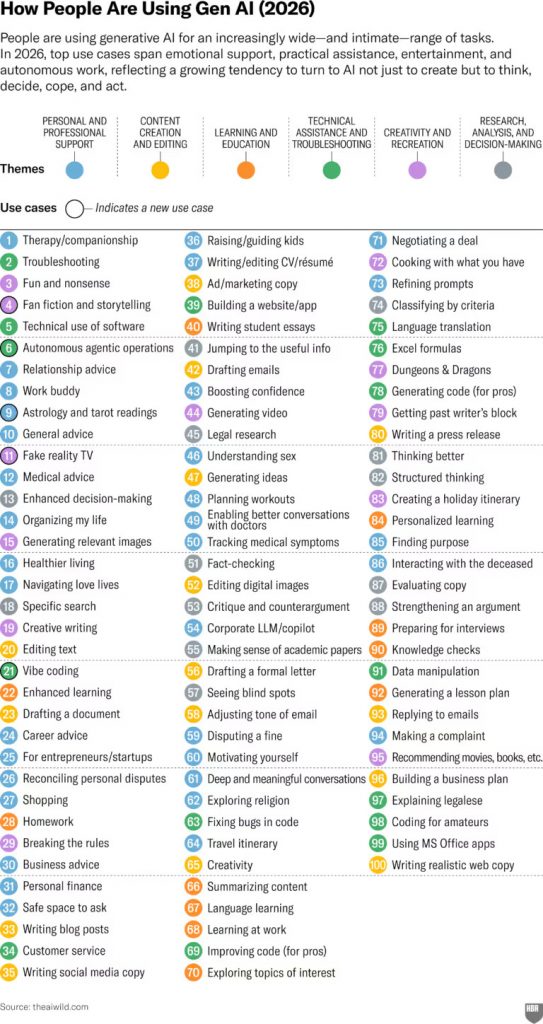
Generative AI has moved well past the hype. In 2026, people aren’t just using it to draft emails or generate images — they’re using it to grieve, parent, negotiate, and think. A new analysis from The AI Wild, surfaced by Harvard Business Review, maps out the 100 most common use cases for generative AI. The picture it paints is striking: AI has become less a productivity tool and more an extension of the self.
The Big Picture
The 100 use cases fall across six broad themes: Personal and Professional Support, Content Creation and Editing, Learning and Education, Technical Assistance and Troubleshooting, Creativity and Recreation, and Research, Analysis, and Decision-Making.
What makes the list remarkable isn’t the breadth — it’s where the weight falls. Therapy and companionship tops the chart. Relationship advice comes in at #7. “Fake reality TV” makes it to #11. These aren’t productivity use cases. They’re deeply human ones.
The data reflects a structural shift: people aren’t just asking AI to do things for them. They’re asking it to be something for them — a thinking partner, a confidant, a coach.
The Findings, Theme by Theme
1. Personal and Professional Support — The Dominant Category
The top of the list is dominated by emotional and personal use. Therapy and companionship is the single most popular use case globally, driven partly by cost, partly by availability, and partly by the absence of judgment. AI companions are always on, always patient, and never distracted — qualities that make them genuinely useful for people navigating anxiety, loneliness, or stress.
This isn’t a fringe phenomenon. A Harvard Business Review analysis and research by the American Psychological Association both confirm that AI therapy and companionship have moved firmly into the mainstream. The appeal is accessibility: in many regions, a licensed therapist is expensive or simply unavailable. AI fills the gap.
Other entries in this cluster — relationship advice (#7), astrology and tarot readings (#9), navigating love lives (#17), reconciling personal disputes (#26), and even “interacting with the deceased” (#86) — signal that users are bringing their most private concerns to AI in ways that would have seemed implausible just two years ago.
The inclusion of autonomous agentic operations at #6 is a bellwether for where enterprise AI is heading. Rather than completing single tasks on command, AI agents are being deployed to manage multi-step workflows independently — browsing, writing, executing, and reporting back. This is the use case that will reshape knowledge work most fundamentally over the next three years.
2. Content Creation and Editing — The Workhorse Category
This is where AI has been longest, and where usage is deepest. Writing blog posts (#33), drafting documents (#23), writing social media copy (#35), writing and editing CVs (#37), ad and marketing copy (#38), and drafting a formal letter (#56) are all firmly established use cases — with mature tooling and measurable ROI.
AI tools for marketing have particularly exploded in sophistication. Platforms can now generate entire campaign strategies, write and A/B test copy, and adapt tone for different audiences — all in a single session. The compression of creative production timelines has been dramatic.
The presence of writing student essays (#40) on the list is pointed. It underscores an ongoing tension in education: AI is being used by students in ways institutions are still figuring out how to respond to.
3. Learning and Education — AI as a Personal Tutor
Enhanced learning (#22), homework (#28), and personalized learning (#84) reflect a genuine democratization of high-quality education. AI tools for studying now allow students to upload course material and receive tailored explanations, quizzes, and feedback — the kind of individualized attention that previously required either expensive tutoring or exceptional luck.
Language learning (#67), learning at work (#68), and generating a lesson plan (#92) extend the pattern. AI is functioning as an always-available, infinitely patient educator — both for students and for the professionals training them.
4. Technical Assistance and Troubleshooting — From Amateurs to Pros
Vibe coding (#21) deserves its own paragraph. Coined by Andrej Karpathy in February 2025, vibe coding has gone from a playful experiment to the dominant paradigm of software development in the space of a single year. Even Linus Torvalds — the creator of Linux — has openly embraced AI-assisted programming for his hobby projects.
The list captures the full spectrum: coding for amateurs (#98), fixing bugs in code (#63), generating code for pros (#78), and improving code for pros (#69) all appear. AI has effectively flattened the barrier to software creation — a non-technical founder can now ship a working prototype without a single engineer.
Technical troubleshooting (#2) is the second-most popular use case overall, reflecting the everyday reality of AI as a first-call helpdesk — for software, hardware, and everything in between.
Medical advice (#12), tracking medical symptoms (#50), and enabling better conversations with doctors (#49) point to AI’s growing role in healthcare navigation. People are using AI to decode test results, understand diagnoses, and arrive at consultations better prepared. The risk — misdiagnosis and over-reliance — remains real, but so does the utility.
5. Creativity and Recreation — Leisure Gets Automated
Fun and nonsense (#3), fan fiction and storytelling (#4), Dungeons & Dragons (#77), and generating video (#44) reveal a user base that wants AI not just for productivity but for play. This is a segment that often gets overlooked in enterprise AI coverage, but it represents a substantial portion of total usage.
Creative writing (#19) and getting past writer’s block (#79) are closely related — AI functions as a drafting partner, a brainstorming engine, and an editorial mirror all at once. For professional writers, the tool is controversial; for amateurs and hobbyists, it’s liberating.
6. Research, Analysis, and Decision-Making — The Enterprise Frontier
AI tools for research have matured from basic summarization into sophisticated analysis engines. Making sense of academic papers (#55), fact-checking (#51), data manipulation (#91), and structured thinking (#82) are all high-value enterprise use cases — and all appear in the top 100.
The presence of preparing for interviews (#89) is notable. AI tools for interview preparation now simulate real interview pressure, analyse verbal delivery, and adapt questions to specific job descriptions — giving candidates a level of preparation access that was previously reserved for those who could afford executive coaching.
Building a business plan (#96), evaluating copy (#87), negotiating a deal (#71), and enhanced decision-making (#13) all signal AI’s movement into strategic territory that was, until recently, firmly human.
What The List Doesn’t Say
The taxonomy matters as much as the rankings. Several use cases that would have been considered “advanced” in 2023 — autonomous agentic operations, corporate LLM/copilot (#54), generating code — now sit comfortably in the middle of the list. The frontier has moved.
What’s conspicuously absent: any mention of AI for physical-world applications. The list is entirely digital and cognitive. That will change rapidly as robotics and embodied AI mature, but for now, generative AI’s use cases remain firmly in the domain of language, image, and reasoning.
The other thing the list signals clearly: people trust AI with a remarkable amount. Medical advice. Legal research. Negotiating a deal. Reconciling personal disputes. Interacting with the deceased. These are not casual use cases. They represent a fundamental shift in where people turn for guidance — and a profound responsibility for the companies building these systems.
The Full List: All 100 Use Cases
| # | Use Case | # | Use Case | # | Use Case |
|---|---|---|---|---|---|
| 1 | Therapy/companionship | 35 | Writing social media copy | 68 | Learning at work |
| 2 | Troubleshooting | 36 | Raising/guiding kids | 69 | Improving code (for pros) |
| 3 | Fun and nonsense | 37 | Writing/editing CV/résumé | 70 | Exploring topics of interest |
| 4 | Fan fiction and storytelling | 38 | Ad/marketing copy | 71 | Negotiating a deal |
| 5 | Technical use of software | 39 | Building a website/app | 72 | Cooking with what you have |
| 6 | Autonomous agentic operations | 40 | Writing student essays | 73 | Refining prompts |
| 7 | Relationship advice | 41 | Jumping to the useful info | 74 | Classifying by criteria |
| 8 | Work buddy | 42 | Drafting emails | 75 | Language translation |
| 9 | Astrology and tarot readings | 43 | Boosting confidence | 76 | Excel formulas |
| 10 | General advice | 44 | Generating video | 77 | Dungeons & Dragons |
| 11 | Fake reality TV | 45 | Legal research | 78 | Generating code (for pros) |
| 12 | Medical advice | 46 | Understanding sex | 79 | Getting past writer’s block |
| 13 | Enhanced decision-making | 47 | Generating ideas | 80 | Writing a press release |
| 14 | Organizing my life | 48 | Planning workouts | 81 | Thinking better |
| 15 | Generating relevant images | 49 | Enabling better conversations with doctors | 82 | Structured thinking |
| 16 | Healthier living | 50 | Tracking medical symptoms | 83 | Creating a holiday itinerary |
| 17 | Navigating love lives | 51 | Fact-checking | 84 | Personalized learning |
| 18 | Specific search | 52 | Editing digital images | 85 | Finding purpose |
| 19 | Creative writing | 53 | Critique and counterargument | 86 | Interacting with the deceased |
| 20 | Editing text | 54 | Corporate LLM/copilot | 87 | Evaluating copy |
| 21 | Vibe coding | 55 | Making sense of academic papers | 88 | Strengthening an argument |
| 22 | Enhanced learning | 56 | Drafting a formal letter | 89 | Preparing for interviews |
| 23 | Drafting a document | 57 | Seeing blind spots | 90 | Knowledge checks |
| 24 | Career advice | 58 | Adjusting tone of email | 91 | Data manipulation |
| 25 | For entrepreneurs/startups | 59 | Disputing a fine | 92 | Generating a lesson plan |
| 26 | Reconciling personal disputes | 60 | Motivating yourself | 93 | Replying to emails |
| 27 | Shopping | 61 | Deep and meaningful conversations | 94 | Making a complaint |
| 28 | Homework | 62 | Exploring religion | 95 | Recommending movies, books, etc. |
| 29 | Breaking the rules | 63 | Fixing bugs in code | 96 | Building a business plan |
| 30 | Business advice | 64 | Travel itinerary | 97 | Explaining legalese |
| 31 | Personal finance | 65 | Creativity | 98 | Coding for amateurs |
| 32 | Safe space to ask | 66 | Summarizing content | 99 | Using MS Office apps |
| 33 | Writing blog posts | 67 | Language learning | 100 | Writing realistic web copy |
| 34 | Customer service |