AI is not only disrupting work, but it’s also disrupting some of the most emotionally laden parts of the human experience.
New data from SensorTower, part of its upcoming State of AI 2026 report, tracks total hours Americans spent on AI companion apps versus dating and social discovery platforms every quarter from early 2025 through the start of 2026. The two lines don’t just diverge, they swap places entirely on what used to be a settled question about where people put their attention when they’re looking for connection.
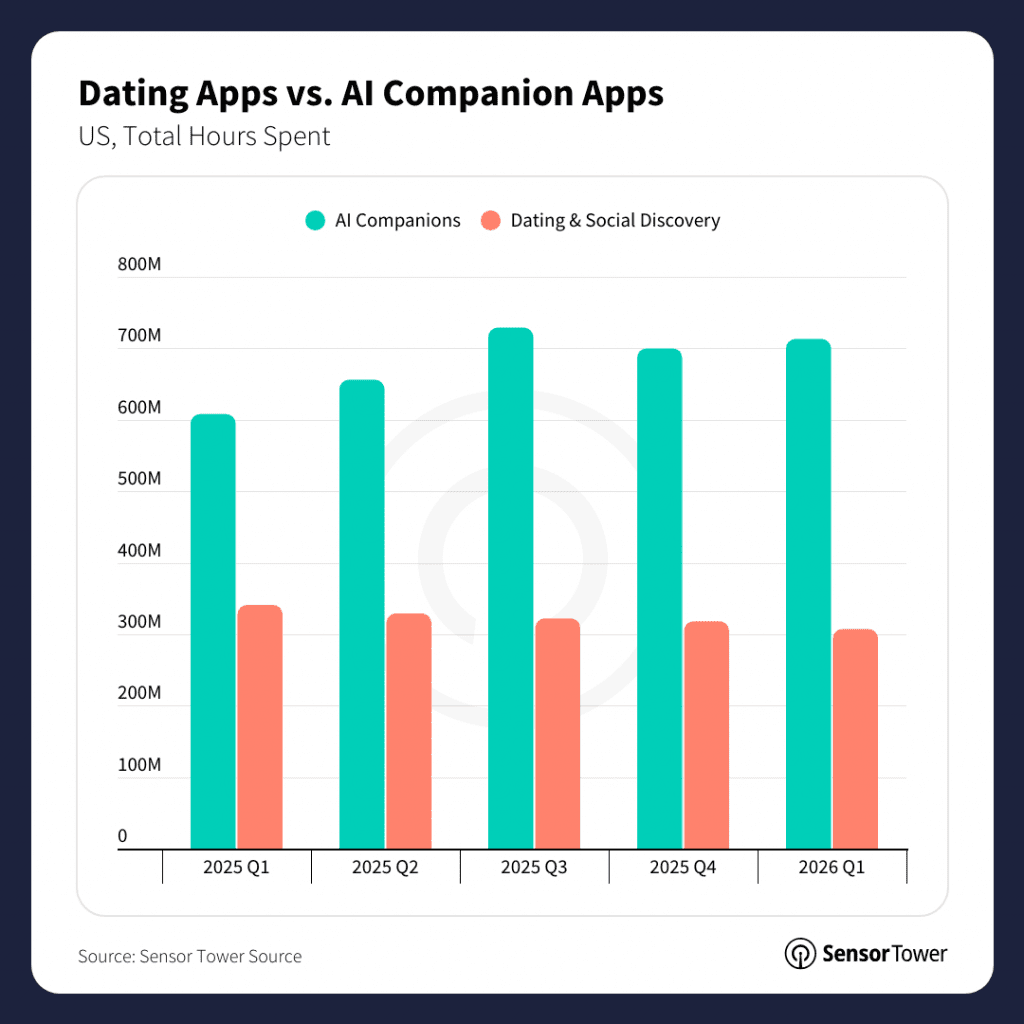
In Q1 2025, Americans logged roughly 580 million hours on AI companion apps against about 330 million hours on dating and social discovery platforms. That’s already a wide gap, but it was still a gap dating apps could plausibly claw back from. By Q3 2025, companion app hours had climbed past 715 million while dating app hours had slipped under 300 million. The most recent data point, Q1 2026, puts AI companions at around 705 million hours against dating apps at roughly 280 million. The gap kept widening. Five quarters in, AI companions are pulling in more than double the engagement hours that dating apps manage to hold onto.
Tinder, Bumble, Hinge and the rest of the dating app establishment haven’t become unusable in that window. They’ve simply stopped being where people choose to spend idle time, while companion apps have spent that same stretch getting better at making themselves hard to leave.
Some of that comes down to product innovation arriving faster than the category can settle into one identity. xAI folded companions like Ani and Bad Rudi directly into Grok, turning what used to be a plain chatbot into something closer to a voice-and-video relationship simulator. Character.AI has held its position among the most visited AI apps in the world for a similar reason — it isn’t offering one companion, it’s offering millions of them, each shaped to whatever the user wants out of company that day.
Dating apps are up against a structural disadvantage that has nothing to do with their product roadmaps. Swiping still demands effort, the risk of rejection, and eventually a real date that might go nowhere. A companion app answers every message instantly, never cancels, and has no opinion about how long you spend complaining about your day. For an industry already dealing with subscription fatigue and burnout among younger users, that’s a tough thing to compete with on engagement alone.
The shift also fits inside a much bigger pattern SensorTower is tracking. The firm’s broader State of AI 2026 report finds that global time spent on generative AI apps is set to more than double year over year, and that ChatGPT became the fastest app in history to cross a billion monthly active users. Companion apps are a narrow slice of that growth, but they’re arguably the slice that says the most about how AI is reshaping not just how Americans work, but who — or what — they’re choosing to spend their evenings talking to.
SensorTower itself seemed to register the irony, floating the idea that its next report might be a deep dive into therapy apps. Given how fast companionship moved from novelty to category leader, that line reads less like a joke and more like a forecast.