The Federal Register’s advanced document search page has quietly stripped out the search modes that ran on Qwen, Alibaba’s open-source AI model, leaving just two options where there used to be five.
Until recently, the “Search Mode” section on federalregister.gov’s advanced search page offered users a choice between a default Semantic mode, a Keyword Only mode, a Neural mode built on msmarco-distilbert-base, and two separate Qwen3:0.6B options — one described as a hybrid retrieval setup with “512D, Recursive Splitting, Distilled, Prefixed” processing. That’s now gone. The page, run by the National Archives and Records Administration, currently shows only Keyword Only and Semantic as options, with Semantic set as the default. Both the Neural and the two Qwen-based modes have been removed entirely, without any public changelog or announcement explaining why.
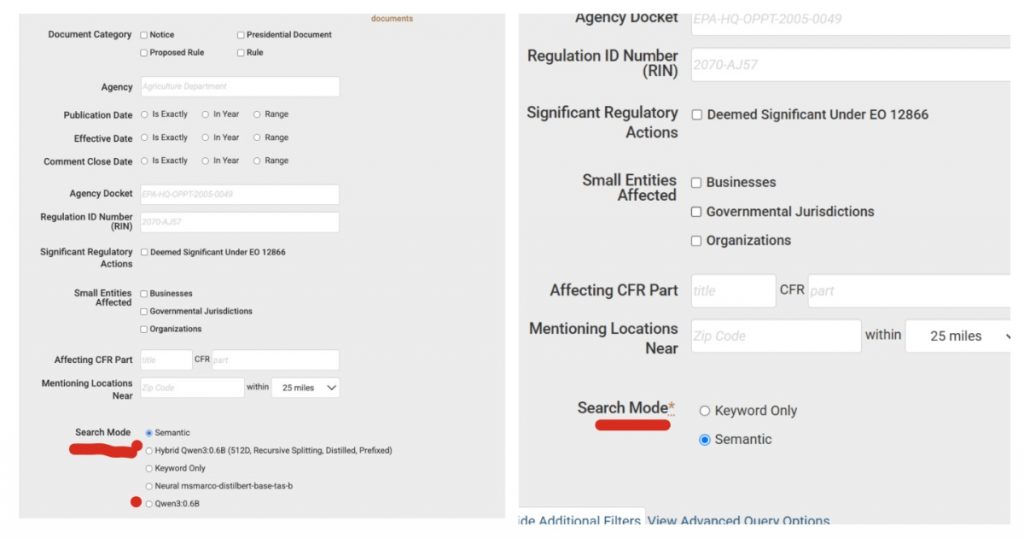
The change comes not long after it emerged that the site — the government’s official journal for rules, notices, and presidential documents — had been letting the public run searches through a small distilled version of Qwen, the open-weight model family built by Alibaba’s Qwen team. It was a minor technical detail buried in an advanced-search dropdown, but a notable one given how aggressively Washington has otherwise tried to keep Chinese AI out of federal systems, from the Commerce Department’s ban on DeepSeek to legislation aimed at keeping any Chinese-linked model off government devices.
There’s no confirmation of what prompted the removal after it went viral on X — it could just as easily be routine search-infrastructure maintenance as a response to the model’s origin. Federal Register search tools have changed configurations before without explanation, and swapping out an embedding model for a search feature is a fairly unremarkable engineering decision on its own. But the timing, coming right after the Qwen option was reported on, makes a security- or optics-driven rollback the more obvious read.
If it was optics, it also underlines just how porous the line between “American” and “Chinese” AI actually is inside government systems. Qwen3:0.6B is released under Apache 2.0, meaning it was never something Alibaba pushed into the Federal Register’s stack — it’s far more likely a contractor or engineering team pulled the open weights off Hugging Face the same way they’d grab any other free model, the sort of low-friction adoption that has helped models like Qwen3.6-35B-A3B spread well beyond China’s borders. Pulling the option out of a dropdown menu doesn’t undo that pattern; it just makes one visible instance of it disappear.
Alibaba, for its part, has kept shipping Qwen models at a pace few labs can match, including frontier-scale releases like Qwen3.8-Max that it’s pitched directly against the best from OpenAI and Anthropic. Whether or not this particular removal was a deliberate scrub, it’s unlikely to be the last time a US institution finds a Qwen model quietly doing work somewhere inside its infrastructure — and unlikely to be the last time it gets quietly pulled back out once someone notices.