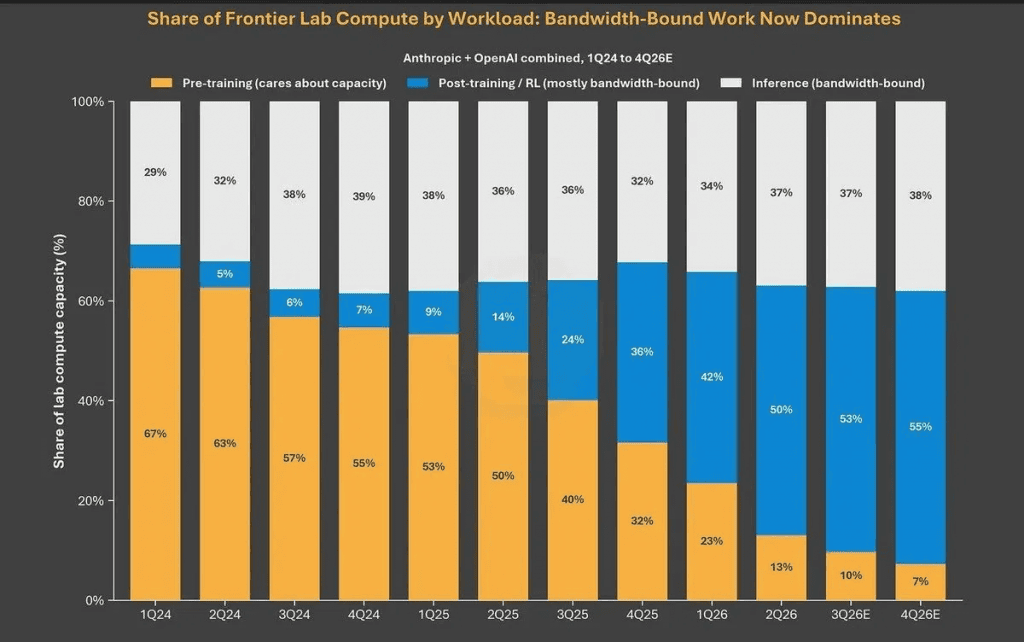
For two years, the story of frontier AI compute was simple: most of it went into pre-training, a smaller slice went into inference, and almost nothing went into what happened in between. A new chart from Semi Analysis, tracking combined Anthropic and OpenAI compute allocation from 1Q24 through an estimated 4Q26, shows that story has flipped.
In early 2024, pre-training ate up 67% of combined lab compute, post-training/RL took a sliver at 5%, and inference held 29%. By the most recent quarter in the dataset and the estimates running out to late 2026, pre-training has collapsed to single digits — 7% — while post-training and reinforcement learning have ballooned to 55%. Inference, meanwhile, has barely moved, oscillating in a band roughly between 29% and 39% across the entire two-year window, settling around the mid-to-high 30s.
The Numbers, Quarter By Quarter
The Semi Analysis chart breaks compute share into three buckets: pre-training (described as “cares about capacity”), post-training/RL (described as “mostly bandwidth-bound”), and inference (also bandwidth-bound). Plotting those three slices from 1Q24 to a 4Q26 estimate shows a near-total inversion between the first two categories.
Pre-training’s share fell quarter after quarter: 67% in 1Q24, 63% in 2Q24, 57% in 3Q24, and down into the 50s through 2025. By 4Q25 it had dropped to 32%, by 1Q26 to 23%, and by the 3Q26E and 4Q26E estimates it sits at just 10% and 7% respectively.
Post-training/RL moved in the opposite direction almost in lockstep. It started at a negligible 5% in 1Q24, crept into double digits by 2Q25 (14%), and then accelerated sharply — 24% in 3Q25, 36% in 4Q25, 42% in 1Q26, and up to 53-55% by the 3Q26E-4Q26E estimates. In other words, more than half of all combined Anthropic and OpenAI compute is now projected to go toward post-training and reinforcement learning rather than the base pre-training runs that used to define frontier model development.
Inference is the one line that hasn’t moved much at all. It opened the period at 29%, peaked around 38-39% in late 2024 and early 2025, dipped into the low-to-mid 30s for much of 2025 and early 2026, and is estimated to land at 37-38% by late 2026. Across twelve quarters of data and estimates, inference’s share has stayed inside a roughly 10-point band, never collapsing the way pre-training did and never spiking the way post-training did.
Why The Shift Happened
The shift tracks closely with the industry’s broader move toward reasoning models. When OpenAI’s o1 and its successors, and Anthropic’s own extended-thinking Claude models, started spending meaningfully more compute per query to “think” before answering, the compute budget needed to teach a model how to reason well — through reinforcement learning on verifiable tasks, preference optimization, and related post-training techniques — grew far faster than the budget needed to simply pre-train a larger base model on more text. Also, the major labs have already used up most of the data that’s freely available to train their models, so gains from pre-training would now be modest at best.
This lines up with what Semi Analysis has separately noted about frontier labs’ Tokenomics models: the compute going into post-training and inference increasingly reflects repeated reinforcement learning “hero runs” on top of a single base model, rather than one-off pre-training jobs. A lab might run a single large pre-training job and then put many multiples of that compute into post-training experiments — reward modeling, RL fine-tuning passes, and reasoning-trace generation — before a model ever reaches a customer.
That also explains why the chart labels post-training and inference as “bandwidth-bound” while pre-training is described as caring about raw capacity. Pre-training is dominated by large, dense matrix multiplications that scale efficiently with more chips. Post-training and inference, especially for reasoning models that generate long chains of thought token by token, lean much more heavily on memory bandwidth — how fast data can move in and out of a chip — rather than on how much raw compute capacity a cluster can throw at a single giant training run. That’s a big part of why Nvidia, AMD, Google and Broadcom have all been racing to improve memory bandwidth on their newest AI accelerators rather than purely chasing FLOPs.
What It Means For Anthropic And OpenAI
The practical consequence is that the two labs’ spending priorities have shifted even as total compute demand keeps climbing. With inference holding steady around a third of total compute even as post-training’s share has swelled past half, the two labs are effectively running three different compute businesses at once: a shrinking pre-training operation, a post-training operation that has become the single largest consumer of compute, and a stable but still enormous inference operation that has to serve paying customers in real time. But this will also raise the question — with inference currently requiring only 38% of available compute capacity, how will all the additional compute be used once models are at a level that any improvements would be largely indistinguishable for the average user.