There are data-points popping up that hint at a white-collar job slowdown following the rapid advancements in AI.
According to data from Bank of America Global Research and Bloomberg, the total number of employees across S&P 500 companies fell in 2025 — the first annual decline in nearly a decade. The headcount dropped by approximately 400,000, settling at 28.1 million. This ends eight consecutive years of uninterrupted employment growth that had added over 3 million jobs in total since 2016.
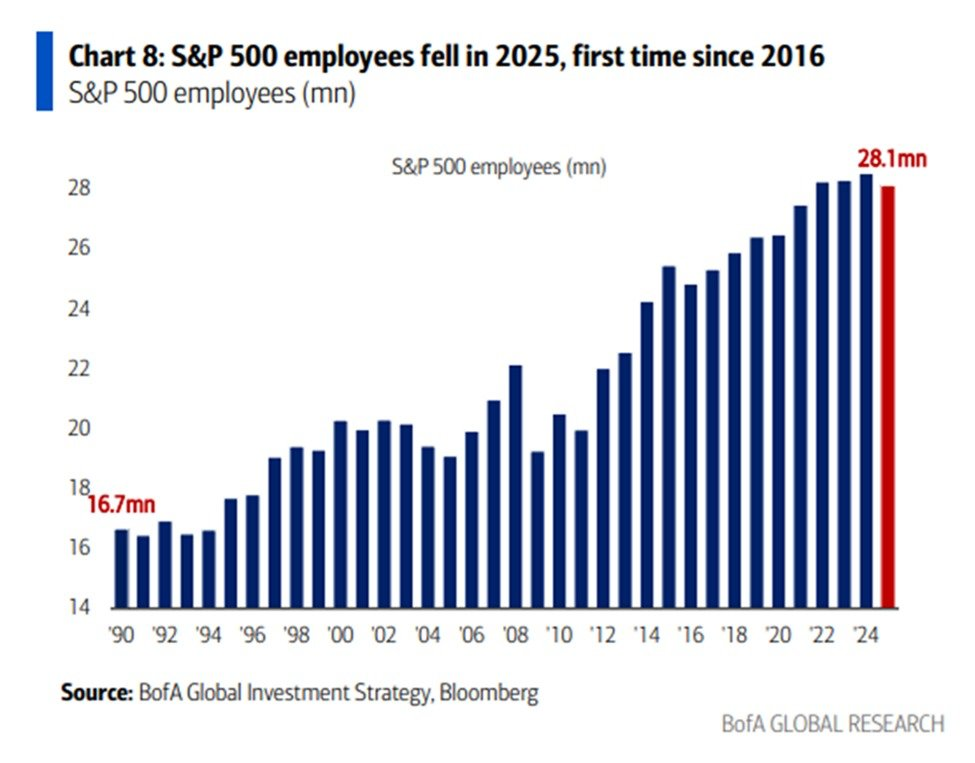
The chart, shared by The Kobeissi Letter, tells a stark story: from a base of 16.7 million employees in 1990, S&P 500 companies went on a multi-decade hiring spree. There were a few instances when the total number of employees fell, most notably during the 2008 economic crisis and during a slowdown from 2002 to 2008, but the latest fall is the first since 2016.
Big Tech Leads the Cuts
Major tech players have been at the vanguard of this shift. Meta announced cuts of 8,000 jobs — about 10% of its workforce — citing efficiency and reallocation toward AI investments. Microsoft followed with buyout offers to 7% of its staff. Both companies made these moves while simultaneously ramping up AI infrastructure spending. The message is clear: AI is beginning to replace parts of the workforce.
Salesforce said it would not hire any software engineers in 2025 because of gains from AI. Klarna, too, halted human hiring entirely, with its CEO stating that AI could already perform every job humans do at the company.
The Warnings Were Loud and Clear
This shift did not arrive without warning. Anthropic CEO Dario Amodei had said that AI could wipe out half of all entry-level white-collar jobs within one to five years, predicting unemployment could spike to 10–20%. He argued that both companies and governments were “sugar-coating” what was coming — a mass elimination of jobs in technology, finance, law, and consulting.
OpenAI’s Sam Altman had warned that AI would disrupt white-collar and creative jobs first, flipping the long-held assumption that automation would come for factory workers before knowledge workers. An Anthropic researcher went further, predicting that AI models would be capable of automating any white-collar job by 2027 or 2028.
Ford CEO Jim Farley was direct: AI will replace literally half of all white-collar workers in the US. Entry-level hiring at tech companies, he noted, has already fallen 50% since 2019.
A Structural Shift, Not a Cyclical Dip
What makes this moment significant is the scale. S&P 500 companies account for a disproportionate share of high-paying, knowledge-economy employment. A decline here ripples outward — into hiring pipelines at universities, into demand for professional services, into consumer confidence among the very class of workers who have historically been insulated from economic downturns.
Reports suggest that corporate America could replace as many as 3 million workers with AI by the end of 2026. If even a fraction of that projection holds, the 400,000-job decline in 2025 will look like the opening chapter of a much longer story.
JPMorgan CEO Jamie Dimon has acknowledged the tension, calling for companies and governments to proactively think about retraining and relocation support. But preparation has lagged behind the pace of change.
White-collar work — the kind done on laptops, in meetings, via email — is now on the front lines of AI disruption. The 2025 employment figures are the first hard evidence that what was once a theoretical risk could become a measurable reality.