The lines between AI and real life are blurring, and people are finding it hard to tell the difference.
A post on X recently set off a viral pile-on of art criticism — with one catch. The painting being picked apart wasn’t generated by AI at all. It was a real Monet.
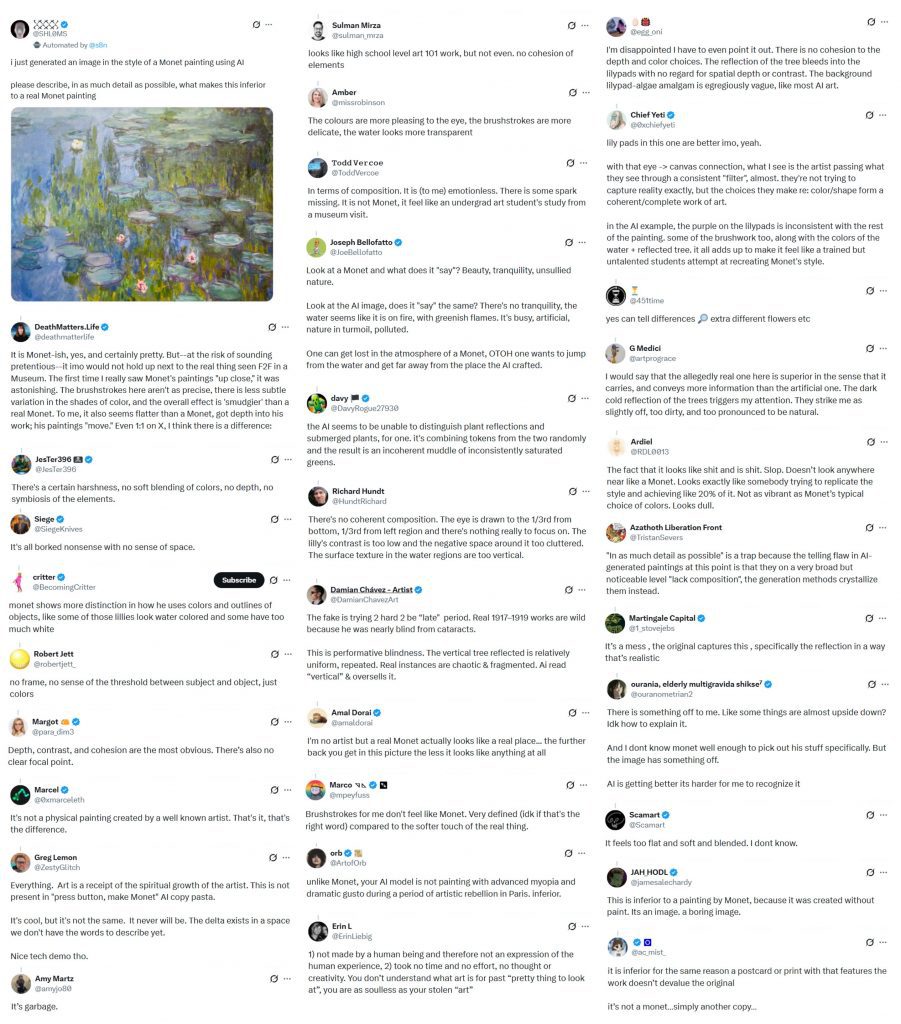
The account posted an image of an authentic Claude Monet painting titled ‘Seerosen’ and told followers it had been created using AI, asking them to describe how it differed from a genuine Monet. Hundreds of users — including self-described art critics and verified accounts — obliged, producing a torrent of confident, detailed critiques. Then came the reveal: the painting was real. Several accounts quietly deleted their responses.

A Cascade of Confident Criticism
The replies came fast and certain. One user wrote that the water in the painting “seems like it is on fire, with greenish flames. It’s busy, artificial, nature in turmoil, polluted.” Another said there was “no frame, no sense of the threshold between subject and object, just colors.” A third, pointing to technical failures, noted: “There’s no coherent composition. The eye is drawn to the 1/3rd from bottom, 1/3rd left region and there’s nothing really to focus on.”
The critiques were specific, layered, and — crucially — completely wrong in their premise.
“The fake is trying 2 hard 2 be ‘late’ period,” wrote one account. “Real 1917–1919 works are wild because he was nearly blind from cataracts.” Another explained with authority: “The AI seems to be unable to distinguish plant reflections and submerged plants, for one. It’s combining tokens from the two randomly and the result is an incoherent muddle of inconsistently saturated greens.”
One user who identified as an art professional went further: “In terms of composition. It is (to me) emotionless. There is some spark missing. It is not Monet, it feel like an undergrad art student’s study from a museum visit.”
Even the painting’s supposed spiritual deficiency was anatomized: “Look at a Monet and what does it ‘say’? Beauty, tranquility, unsullied nature. Look at the AI image, does it ‘say’ the same? There’s no tranquility.”
The Confirmation Bias Machine
What the experiment exposed isn’t just that people can’t tell AI from real art — it’s something more troubling. Once users were told the painting was AI-generated, they found exactly what they expected to find. The label did the work, not the image.
This is a well-documented psychological pattern. Research published in Scientific Reports found that people devalue art labeled as AI-made across multiple dimensions — even when they report it is indistinguishable from human-made art. The label shapes the judgment; the art itself becomes secondary.
“Doesn’t look anywhere near like a Monet,” declared one user. “Exactly like somebody trying to replicate the style and achieving like 20% of it. Not as vibrant as Monet’s typical choice of colors. Looks dull.”
Another added: “It feels too flat and soft and blended.”
A third delivered perhaps the most cutting verdict: “It’s garbage.”
None of them were looking at AI. They were looking at one of the most celebrated painters in history.
When Expertise Becomes a Liability
Particularly striking was how confident the critiques were from users who positioned themselves as knowledgeable. One account that appeared to be an artist wrote: “Unlike Monet, your AI model is not painting with advanced myopia and dramatic gusto during a period of artistic rebellion in Paris. Inferior.”
Another offered a technical breakdown: “The vertical tree reflected is relatively uniform, repeated. Real instances are chaotic & fragmented. AI read ‘vertical’ & oversells it.”
A self-described non-artist at least hedged: “There is something off to me. Like some things are almost upside down? I don’t know how to explain it… AI is getting better, it’s harder for me to recognize it.”
That last line — AI is getting better, it’s harder for me to recognize it — turned out to be the most accurate thing anyone said in the thread.
The Delete Button Tells the Story
After the reveal, a number of accounts deleted their critiques. The disappearing posts may be the most telling data point in the whole episode — not because people were embarrassed to be wrong, but because they were embarrassed to have been so certain.
That certainty is the real story. Confidence in AI detection has become its own kind of bias. As AI image generation tools continue to advance and proliferate across every creative domain, the mental model people use to spot “AI” is based on yesterday’s tools — not today’s, and certainly not tomorrow’s.
One user’s comment — made in criticism, but landing as prophecy — captures where things stand: “It’s not a Monet… simply another copy.”
It was Monet. And almost nobody knew.