A study out of UC Berkeley and Caltech, led by neuroscientists Janis Hesse and Doris Tsao, recently reported something genuinely strange: when monkeys were shown two conflicting images at once — one consciously perceived, one suppressed from awareness — their brains didn’t settle on a single steady representation of “what’s conscious.” Instead, neurons in high-level visual and prefrontal cortex rapidly flickered, about 15 times a second, between fully representing the seen image and fully representing the unseen one. Consciousness, in this data, doesn’t look like a place. It looks like a rhythm.
That’s a narrow, carefully controlled finding about macaque visual cortex. It is not a discovery about the soul, and the paper itself makes no claims about metaphysics. But it’s hard to read it without noticing that several contemplative traditions — particularly in India — spent millennia arguing that consciousness is not a stable, continuous thing at all, but something closer to a rapid, discrete, flickering process. Below is an (opinionated) look at where this new data rhymes with old philosophy, and where the analogy breaks down.
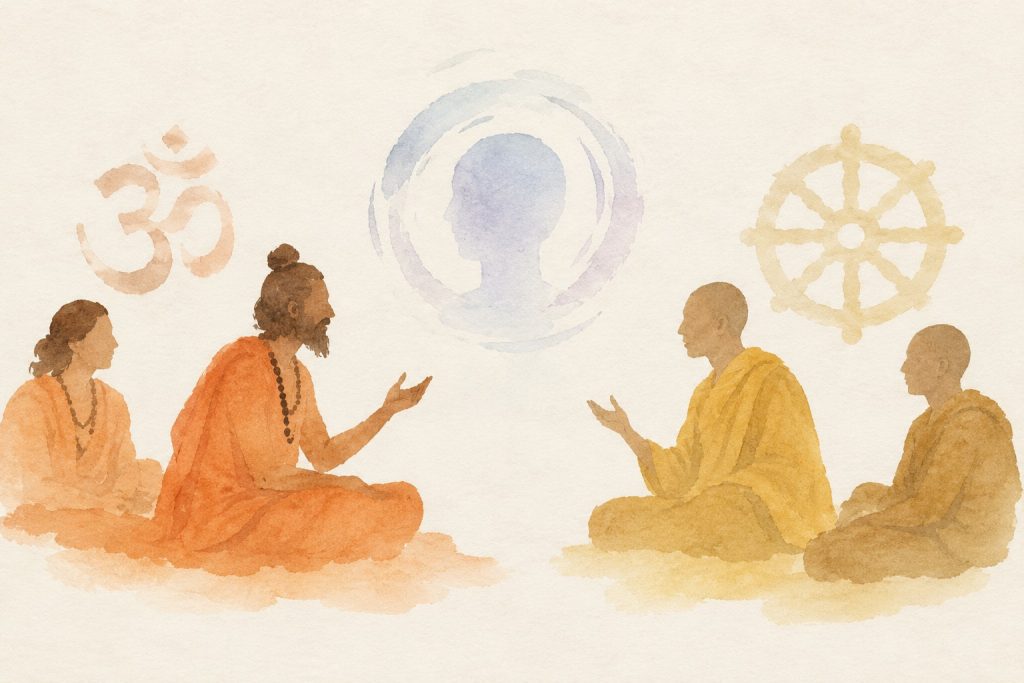
Buddhism: consciousness was never supposed to be continuous
Of all the traditions, Buddhist Abhidharma philosophy comes closest to predicting something like this result outright. Classical Theravada Abhidhamma describes the mind not as a continuous stream but as a rapid sequence of discrete “mind-moments” (citta), each arising and ceasing almost instantly — commentators famously claimed billions of these moments could occur in the time it takes to snap a finger. The Sanskrit term for this is kṣaṇikavāda, the doctrine of momentariness: nothing in experience, including consciousness itself, actually persists. What feels like a continuous, stable “self” watching a continuous world is, on this account, an illusion stitched together from discrete flickers — not unlike how a strip of film frames creates the illusion of continuous motion.
Even more specific is the Theravada concept of bhavanga, sometimes translated as the “life-continuum” or “ground-state” of mind. Abhidhamma psychology describes consciousness as constantly dipping in and out of active, object-directed cognition and a passive, background resting state, cycling back and forth extremely rapidly between moments of actually processing sensory objects and moments of this subliminal, inactive stream. It’s not a one-to-one match with “conscious state” versus “suppressed state” in the new paper — bhavanga is not itself a second, rival percept — but the basic architecture, a mind that is never stably “on” but is instead toggling at high speed, is strikingly similar in spirit.
The Yogācāra (“consciousness-only”) school pushes this further with the idea of ālaya-vijñāna, a storehouse consciousness holding latent impressions (bīja, or seeds) that are not currently experienced but remain present and available, occasionally surfacing into active awareness (pravṛtti-vijñāna). A monkey’s brain that keeps a rich, decodable representation of a face it isn’t consciously seeing — accurate enough that researchers could reconstruct the suppressed image from neural activity alone — maps uncannily well onto a tradition that insisted, long before electrodes existed, that unconscious content isn’t absent, just not currently “manifesting.”
Samkhya and Yoga: the witness and the waves
Samkhya philosophy, one of the oldest systems in the Indian tradition, draws a hard line between Purusha (pure, passive consciousness — the witness) and Prakriti (matter, including the mind and intellect, which actually does the work of cognition). On this view, it’s never “consciousness itself” that flickers or processes images; it’s buddhi (intellect/discernment), the subtlest layer of Prakriti, that takes on the shape of whatever is being cognized, moment to moment, and presents it to the unmoving witness. A neuroscientist reading Samkhya might say: of course the machinery that represents content keeps changing shape at high speed — that’s exactly what machinery made of matter should do. What stays constant, on this view, is something the Berkeley/Caltech study was never built to measure in the first place.
Yoga philosophy, closely related to Samkhya, gives this churning mental machinery a name: vritti, usually translated as “fluctuations” or “modifications” of the mind-stuff (chitta). Patanjali’s Yoga Sutra opens with the definition that yoga is the stilling of these fluctuations (yogash chitta vritti nirodhah). Classical commentators on the sutras, including Vyasa, explicitly describe ordinary cognition as a rapid-fire succession of discrete vrittis rather than one smooth state — again, a picture of mind as inherently discontinuous, pulsing rather than flowing, which is close to what this paper measured directly in spiking neurons for the first time.
Vedanta: awareness as the screen, not the movie
Advaita Vedanta takes a related but distinct position. Consciousness (often identified with Atman/Brahman) is held to be the one truly continuous, unchanging thing — compared to a screen on which a film plays, or the ocean on which waves rise and fall. The waves (again, vrittis, arising in the mind) are what constantly change; the screen or ocean itself does not flicker at all. Vedanta also has its own four-state model of consciousness — waking, dreaming, dreamless sleep, and a fourth, background “witness” state called turiya said to underlie all three. If Buddhism’s momentariness is the closest match to the paper’s literal finding (fast, discrete switching), Vedanta is closer to a complementary claim: that whatever switches 15 times a second in the cortex is the content being illuminated, not the illuminating awareness itself — a distinction the paper, being a study of neural content representation rather than subjective experience, doesn’t and can’t adjudicate.
Kashmir Shaivism: consciousness as a pulse
One tradition deserves a special mention for sheer specificity. Kashmir Shaivism’s Spanda doctrine — spanda literally means “vibration,” “throb,” or “pulsation” — holds that consciousness is not inert but is intrinsically, constantly vibrating, a kind of creative pulse that is the very nature of awareness rather than something imposed on it from outside. Of every framework discussed here, this is the one whose central metaphor — consciousness as a throb or pulse rather than a steady state — maps most literally onto a brain signal that alternates on a ~60-millisecond rhythm.
The honest caveat
None of this means Buddhist monks or Vedantic sages “discovered” temporal multiplexing in inferotemporal cortex 2,000 years before Neuropixels probes existed. These traditions were doing introspective phenomenology and metaphysics, not predicting firing rates in macaque face patches, and the mapping between “neural representation of a stimulus” and “phenomenal conscious experience” is exactly the unsolved problem — the explanatory gap, in philosopher’s terms — that this paper, honestly, leaves untouched. A population of neurons representing a face is not the same claim as a person consciously experiencing a face, and the study’s authors are careful to say their results concern what the authors call “conscious access” (whether content is routed to systems involved in report and behavior), not the hard problem of subjective experience itself.
What is fair to say is this: a wide swath of contemplative philosophy converged, independently and often centuries apart, on the idea that minds are not stable and continuous in the way they feel from the inside — that underneath the sense of a smooth, unbroken stream of awareness is something far more granular, discrete, and fast-moving. A controlled electrophysiology experiment just measured something that looks a great deal like that, in real neurons, for the first time. Whether that’s a genuine point of contact between contemplative insight and modern neuroscience, or simply a case of two very different methods arriving at superficially similar-sounding metaphors, is very much a matter of interpretation — which is exactly why this is an opinion piece, and not a news report.