AI tools for voice over have become the fastest, most cost-effective way for businesses, creators, and educators to produce professional-sounding narration without ever booking a recording studio. What used to require hiring a voice actor, scheduling studio time, and waiting days for edits can now be done in minutes, with results that are often indistinguishable from a real human voice. As demand for video, e-learning, podcasts, and ads keeps climbing, more teams are turning to AI tools for voice over to keep production fast, affordable, and scalable. Below, we break down the 23 best options on the market in 2026, what each one does, how much it costs, and a real-world example of how to use it.
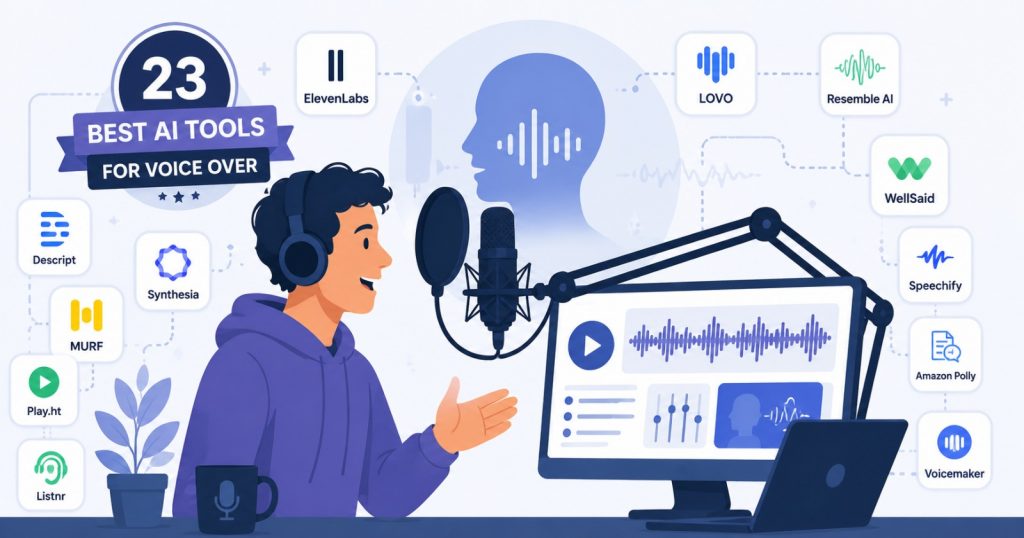
AI Tools For Voice Over
ElevenLabs
ElevenLabs remains one of the most widely used AI tools for voice over thanks to its highly realistic speech synthesis, instant voice cloning, and broad language support spanning more than 70 languages. The platform is popular with podcasters, video creators, and developers because it offers both a polished web interface and a robust API for automating voice generation at scale. Pricing starts with a free tier, with paid plans beginning around $5/month for the Starter plan and scaling up based on character usage, with higher tiers unlocking more custom voice slots and commercial licensing.
A marketing team producing a 60-second product launch video could write the script, paste it into ElevenLabs, select a warm, conversational voice from the library, and generate broadcast-ready narration in under a minute. If the brand later wants a consistent “signature voice” across every video, they can clone a voice actor’s recording once and reuse it indefinitely across campaigns, which is one of the reasons ElevenLabs is consistently ranked among the top AI tools for voice over for both creators and enterprises.
Murf AI
Murf AI is a script-first voiceover studio built specifically for marketing, training, and e-learning teams that need fast edits and export-ready audio. It supports more than 35 languages and accents, and its standout features include word-level emphasis, pitch and pause controls, and a built-in grammar assistant that polishes scripts before narration. Murf offers a free trial, with paid Creator plans starting around $19–$23/month and higher Business and Enterprise tiers for teams that need commercial rights and collaboration tools.
An instructional designer building a corporate onboarding course could draft the training script directly inside Murf’s editor, select a clear, professional-sounding voice, and use the word-level emphasis tool to stress key compliance terms so they land with new hires. Because Murf is one of the more workflow-friendly AI tools for voice over, the same project can be revised in seconds whenever the company updates its policies, without re-recording from scratch.
WellSaid Labs
WellSaid Labs (now operating under the Podcastle umbrella after a 2024 acquisition) is an enterprise-grade voice platform known for studio-quality, ethically sourced voices recorded by consenting professional voice actors. It’s favored by Fortune 500 companies for training videos, internal communications, and product demos because of its consistency and compliance-friendly sourcing. Pricing has historically started around $49–$55/month for individual creator plans, with Business and Enterprise tiers requiring a custom quote.
A Learning & Development team rolling out a new software tool across a global workforce could use WellSaid to generate dozens of short tutorial voiceovers with the same consistent narrator voice, ensuring every module sounds like it came from the same trainer. For companies that need documented, licensed voice provenance to pass procurement review, WellSaid is one of the few AI tools for voice over built around that exact requirement.
Resemble AI
Resemble AI specializes in custom voice cloning and branded voice infrastructure, letting businesses create a unique synthetic voice for IVR systems, virtual assistants, and advertising. It offers a pay-as-you-go Flex plan starting at $0 to begin, with usage-based pricing around $0.03/minute for text-to-speech and per-second rates for voice agents and deepfake detection tools, plus custom enterprise pricing for larger deployments.
A call center could clone the voice of its most well-liked customer service representative and deploy it across its automated phone system, so callers hear a familiar, on-brand voice instead of a generic robotic one. Because it offers granular API control and governance features, Resemble is frequently chosen among AI tools for voice over by companies that need a signature voice baked into a product rather than a one-off audio file.
Amazon Polly
Amazon Polly is a cloud-based text-to-speech service from AWS that converts written text into natural-sounding speech using deep learning, and it’s widely used by developers building voice-enabled applications. It supports SSML for fine-grained pronunciation and pacing control and integrates directly into the AWS ecosystem, making it a natural fit for companies already running infrastructure on AWS. Pricing is usage-based per character processed, with a free tier for the first 12 months covering several million characters monthly.
A transit authority could use Amazon Polly to power real-time automated announcements at train stations, converting live schedule data into spoken alerts about delays or platform changes. Because it’s built for predictable, programmatic scaling, Polly is one of the AI tools for voice over best suited to IVR systems and high-volume automated speech rather than expressive creative narration.
Play.ht
Play.ht is a developer-friendly AI voice generation platform offering ultra-realistic voices, unlimited downloads on higher plans, and one of the larger voice libraries on the market with support for 100+ languages. It’s a strong fit for high-volume content creators and developers building voice into their own products through its API. Pricing includes a free tier, with paid plans starting around $31–$39/month and an Unlimited plan available for teams with heavy, predictable usage.
A multilingual e-learning publisher could take a single English course script, run it through Play.ht’s translation and voice library, and generate matching narration in Spanish, French, and Hindi without hiring separate voice talent for each language. This kind of rapid multilingual scaling is exactly why Play.ht shows up so often in roundups of the best AI tools for voice over for global content teams.
Speechify
Speechify started as a text-to-speech reading app for accessibility and has since expanded into Speechify Studio, a content-creation product with voice cloning and professional voiceover features. The core app converts PDFs, web pages, and documents into natural audio, while Studio targets creators who need commercial-use voiceovers. Pricing includes a free tier, with Premium around $11.58–$29/month (billed annually or monthly) and Studio plans ranging from free up to $49/month for cloning and advanced features.
A student with dyslexia could use Speechify’s browser extension to have lecture PDFs and research articles read aloud at up to 4.5x speed during a daily commute, turning reading-heavy coursework into a passive listening habit. For creators who also want to produce voiceovers rather than just consume content, Speechify Studio extends the same underlying technology, which is why it consistently appears in lists of practical AI tools for voice over for both accessibility and content creation.
Descript
Descript is an all-in-one audio and video editing platform that edits recordings the way you’d edit a text document, and its Overdub feature lets users clone their own voice to fix flubbed lines without re-recording. It’s especially popular with podcasters and video editors who want transcription, multitrack editing, and voice generation in a single workspace. Pricing includes a free tier, with Hobbyist around $24/month and Professional around $33/month, both including commercial usage rights.
A podcast host who stumbles over a sentence mid-recording can simply retype the corrected line in Descript’s transcript view, and Overdub will generate the fix in their own cloned voice, seamlessly blending it into the existing audio. Because it merges editing and generation in one place, Descript is one of the more practical AI tools for voice over for anyone who needs to polish existing recordings rather than generate audio from a blank script.
Synthesia
Synthesia is an AI video generation platform that pairs lifelike avatars with natural-sounding AI voiceovers, letting users turn a script into a fully narrated video without cameras, actors, or a studio. It supports voiceovers and avatars in 140+ languages and includes enterprise-grade security like SOC 2 and GDPR compliance, making it popular for corporate training and customer-facing content. Pricing includes a free trial, with paid plans typically starting in the range of $20–$30/month per seat and custom Enterprise pricing for larger teams.
An HR department rolling out a new compliance policy across 12 country offices could write one script, select a Synthesia avatar, and generate the same training video narrated in a dozen languages, complete with lip-synced visuals. Because it bundles voice generation with full video production, Synthesia stands out among AI tools for voice over for teams whose end deliverable is a finished video rather than a standalone audio file.
LOVO AI
LOVO AI (built around its Genny platform) combines text-to-speech with video editing and offers 500+ voices across 100+ languages, along with emotional tone controls, SSML support, and 10-second voice cloning. It’s positioned as a one-stop shop for ads, explainers, audiobooks, and social content, and it supports a robust API for businesses automating voiceover production. Pricing includes a free tier, with paid plans starting around $24–$29/month and higher Pro/Business tiers for teams needing more characters and commercial rights.
A social media team producing daily short-form ads could use LOVO to test the same script in five different emotional deliveries—upbeat, urgent, calm, playful, and serious—to see which tone drives the best click-through rate before committing to a final cut. With its blend of voice and basic video tools in one subscription, LOVO is one of the more flexible AI tools for voice over for fast-moving content teams.
Listnr
Listnr is a generative AI voice engine built with podcasters in mind, offering 1,000+ voices across 142+ languages along with voice cloning, emotional fine-tuning, and embeddable audio widgets for websites. It’s designed to take a piece of written content and turn it into a polished, podcast-ready voiceover in minutes, with built-in distribution tools for publishing audio online. Pricing includes a free tier, with paid plans typically starting in the $20–$30/month range depending on usage and language access.
A blog publisher could use Listnr to automatically convert every new article into an audio version, then embed a “Listen to this article” player directly on the page using Listnr’s widget, giving readers the option to consume content hands-free. This kind of content repurposing is a major reason Listnr keeps appearing on lists of practical AI tools for voice over for publishers and podcasters alike.
Fliki
Fliki is an AI text-to-video and text-to-speech platform offering 2,500+ voices and strong integration with social media publishing workflows, making it popular for marketers who want narrated videos without hiring a production crew. It converts scripts into studio-quality video paired with AI voiceovers and supports multiple languages and accents. Pricing includes a free plan, with paid tiers starting around $21–$28/month depending on minutes of audio/video needed.
A small business owner could turn a blog post into a 90-second narrated explainer video by pasting the article text into Fliki, choosing a voice and visual style, and publishing the finished video straight to social channels the same afternoon. Because it removes the need for filming or editing software, Fliki is one of the more approachable AI tools for voice over for non-technical marketers and solo creators.
Fish Audio
Fish Audio has built a reputation as one of the more technically capable AI tools for voice over, with its S2 model ranking highly on independent voice-quality benchmarks and the ability to clone any voice from just a 15-second sample across 80+ languages, including cross-lingual cloning. Beyond text-to-speech, it also offers speech-to-text, sound effect generation, and vocal removal, plus a community library with over two million user-uploaded voice models. Plans range from a free tier (7 minutes/month) to Plus at $11/month (200 minutes) and Pro at $75/month (27 hours), with developer API access around $15 per million characters.
A game studio localizing a character’s dialogue into multiple languages could clone the original voice actor’s performance from a short reference clip, then generate the same character’s lines in Japanese, German, and Portuguese while preserving the actor’s distinctive tone and cadence. Its low-cost API and benchmark-leading quality make Fish Audio a favorite among developer-focused AI tools for voice over.
Podcastle
Podcastle is a podcast-focused platform that combines recording, AI editing, and voice generation tools in one workspace, and it now also houses the WellSaid voice engine following its 2024 acquisition. It’s designed for creators who want to record, clean up, and enhance podcast audio without juggling multiple apps, plus generate AI voiceovers for intros, ads, or filler segments. Pricing includes a free tier, with paid plans typically in the $12–$25/month range depending on storage and export needs.
A podcast producer could record a raw interview, use Podcastle’s AI tools to remove background noise and filler words automatically, and then generate a short AI-voiced sponsor read to insert mid-episode without booking separate studio time. Because it blends production and voice generation, Podcastle is one of the more convenient AI tools for voice over specifically built around the podcasting workflow.
Typecast
Typecast specializes in avatar-led video narration with expressive, character-driven voices, making it a strong choice for creators who want a virtual presenter rather than plain audio. The platform offers a range of synthetic personas with adjustable emotional delivery, suited to marketing videos, e-learning, and social content. Typecast offers a free plan to test the platform, with paid tiers scaling based on minutes generated and the number of custom voices needed.
An online course creator could assign a friendly, animated Typecast persona to host an entire video lesson series, generating consistent, expressive narration for every module without ever appearing on camera themselves. For creators who want personality and visual presence alongside narration, Typecast is one of the more character-forward AI tools for voice over on the market.
HeyGen
HeyGen produces fully rendered, presenter-led video with AI avatars, lip-synced voiceovers, branded templates, and automatic subtitles, covering 175+ languages in a single workflow. It’s often chosen by teams that want their AI voice paired with a believable on-screen presenter rather than audio alone. HeyGen offers a free plan with three videos per month, with the Creator plan starting around $24/month and higher tiers for teams needing more video minutes and brand controls.
A sales enablement team could script a new product walkthrough, select an AI presenter, and generate a polished, lip-synced video in Korean, Spanish, and English simultaneously, distributing localized versions to regional sales reps the same day it was written. Because it outputs finished video rather than raw audio, HeyGen is one of the AI tools for voice over best suited to teams whose deliverable needs a visual presenter attached.
Inworld
Inworld is a developer-focused real-time voice platform recognized as a top performer on independent latency and quality benchmarks, offering a full voice pipeline alongside its Realtime API for building conversational AI agents. It’s built for products that need sub-300ms response times, such as voice assistants and customer support bots, rather than pre-recorded narration. Pricing is usage-based and competitive on a per-character basis, with custom enterprise plans for high-volume deployments.
A startup building a voice-based customer support agent could integrate Inworld’s Realtime API to generate natural-sounding spoken responses on the fly during live phone calls, with low enough latency that the conversation feels natural rather than robotic. For engineering teams building products that talk back in real time, Inworld is one of the more specialized AI tools for voice over and conversational voice agents.
Cartesia
Cartesia is a low-latency text-to-speech API best known for its Sonic model, which delivers some of the fastest time-to-first-audio speeds on the market, making it well suited for live, interactive applications. It targets developers building voice agents, in-game characters, or real-time assistants where speed matters as much as voice quality. Pricing is usage-based and billed per character or per minute, with enterprise plans available for high-volume products.
A voice-controlled smart home app could use Cartesia to generate spoken confirmations the instant a user issues a command, keeping the interaction feeling instantaneous rather than introducing an awkward pause. Because raw response speed is its biggest differentiator, Cartesia stands out among AI tools for voice over built specifically for real-time, latency-sensitive use cases.
OpenAI TTS
OpenAI’s text-to-speech API offers natural-sounding voice generation through the same billing and account infrastructure developers already use for ChatGPT and other OpenAI tools, making it an easy add-on for teams already building on OpenAI’s stack. It’s usage-based, priced per character generated, and integrates directly with other OpenAI models for end-to-end voice applications. There’s no separate subscription; costs are billed alongside other OpenAI API usage.
A developer already using GPT models to power a customer-facing chatbot could pipe the chatbot’s text responses directly into OpenAI’s TTS endpoint to add a spoken voice layer, without needing to manage a second vendor relationship or billing account. For teams already inside the OpenAI ecosystem, this is one of the simplest AI tools for voice over to bolt onto an existing product.
Kokoro TTS
Kokoro TTS is an open-weight, Apache 2.0-licensed text-to-speech model that’s remarkably small (82 million parameters) yet produces voice quality comparable to far larger models, and it can run efficiently on standard CPUs. It ships with 19 pre-trained voices, adjustable speed from 0.1x to 5.0x, and is one of the cheapest per-character options available at roughly $0.02 per 1,000 characters. Because it’s open source, it can also be self-hosted at no licensing cost for teams with their own infrastructure.
A budget-conscious indie developer building a text-reading mobile app could self-host Kokoro TTS to generate narration locally, avoiding both per-character API fees and the cost of premium cloud voice services while still delivering clear, natural-sounding speech. For teams prioritizing cost efficiency and open licensing, Kokoro is one of the more accessible AI tools for voice over in the open-source space.
Index TTS 2.0
Index TTS 2.0 is a text-to-speech model built for clarity over expressiveness, prioritizing clean, accurate pronunciation that’s well suited to instructional content, documentation narration, and accessibility applications rather than dramatic storytelling. It’s available through API platforms like fal at a low cost of around $0.002 per generated audio second, making it attractive for high-volume, informational use cases. Its focus is on intelligibility, so listeners absorb the words without being distracted by an overly performative delivery.
A software company documenting a complex onboarding flow could use Index TTS 2.0 to narrate step-by-step setup instructions inside an in-app help video, ensuring every instruction is heard clearly without unnecessary vocal flourishes getting in the way. For documentation-heavy use cases, it’s one of the more understated but useful AI tools for voice over.
Visme
Visme is an all-in-one content creation platform best known for presentations, infographics, and design templates that also includes a capable built-in AI voice generator. Rather than being a dedicated voiceover tool, it lets users add narration directly to presentations, training content, and marketing videos inside the same platform where the visuals were designed, with 10,000+ templates available. Pricing includes a free tier, with paid plans typically starting around $15–$29/month depending on team size and export needs.
A sales team building an investor pitch deck could design the slides in Visme and then generate a matching AI voiceover narration track directly inside the same project, exporting a polished, presenter-style video without switching to a separate audio tool. For teams that want design and narration bundled together, Visme is a convenient entry point into AI tools for voice over.
NaturalReader
NaturalReader is a straightforward text-to-speech reader app aimed at students and everyday users who want a clean, simple way to have documents and web pages read aloud. It supports common file formats like PDFs and Word documents and offers adjustable reading speeds and voice selection, without the production-oriented features found in creator-focused platforms. Pricing includes a free tier with basic voices, and paid plans for premium voices and additional features typically start in the affordable $10–$20/month range.
A student studying for exams could upload a dense textbook PDF into NaturalReader and listen to the material read aloud while commuting or exercising, reinforcing retention without sitting at a desk. For casual, personal-use cases rather than commercial production, NaturalReader remains one of the simplest AI tools for voice over to pick up with no learning curve.
Voicemaker
Voicemaker is an easy-to-use text-to-speech tool designed for quick, no-frills voice generation for videos, presentations, and e-learning modules. It keeps its interface intentionally simple, letting users paste text, choose a voice, and export audio without navigating a complex studio environment. Voicemaker offers a free tier for basic use, with paid plans available for higher character limits and commercial usage rights, generally priced in the budget-friendly range for solo creators.
A small business putting together a quick product demo for a trade show could use Voicemaker to generate a clear, professional voiceover for the demo script in just a few minutes, without needing any prior audio editing experience. For users who want speed and simplicity over deep customization, Voicemaker is one of the more beginner-friendly AI tools for voice over available today.
Why AI Tools For Voice Over Are Useful
AI tools for voice over have reshaped how businesses, educators, and independent creators approach audio production, primarily because they remove the time and cost barriers that used to come with hiring voice talent and booking studio sessions. A script that once took days to cast, record, and edit can now be turned into finished narration in minutes, which matters enormously for teams producing high volumes of video, training, or marketing content on tight deadlines. This speed advantage is one of the biggest reasons AI tools for voice over have become standard infrastructure rather than a novelty.
Consistency is another major benefit. Human voice actors have good days and bad days, but AI tools for voice over deliver the same tone, pacing, and pronunciation every single time, which is critical for brands that want a recognizable, repeatable voice across every video, ad, or training module. This is especially valuable for companies managing large content libraries where re-recording with a human actor for every update simply isn’t practical.
Multilingual reach is a third area where AI tools for voice over genuinely change what’s possible. Many platforms now support dozens or even over 100 languages and accents, allowing a single piece of content to be localized into multiple markets without hiring separate voice talent for each language. For global teams, that turns what used to be an expensive, multi-vendor translation project into a same-day task.
Finally, AI tools for voice over significantly improve accessibility. Turning written content into spoken audio helps people with visual impairments, reading disabilities like dyslexia, or simply a preference for audio learning consume information more easily. Combined with the cost savings and speed, this accessibility benefit is a major reason these tools have moved from a creative shortcut to a genuinely useful piece of everyday business infrastructure.
AI Tools For Voice Over: Final Thoughts
The right choice among AI tools for voice over really depends on what you’re building. Developers integrating voice into a live product will care most about latency and API pricing, which points toward tools like Inworld, Cartesia, or OpenAI TTS. Marketers and content creators producing ads, explainers, or social videos will likely get more value from script-first studios like Murf, ElevenLabs, or LOVO. Enterprises with compliance and governance requirements may lean toward WellSaid Labs or Resemble AI for their ethical sourcing and custom voice controls, while podcasters and video editors will appreciate the all-in-one workflows offered by Descript and Podcastle.
Whichever platform you choose, the underlying shift is the same: AI tools for voice over have made professional-sounding narration accessible to anyone with a script, regardless of budget or technical skill. As the technology keeps improving in realism, emotional range, and language coverage, expect these tools to keep closing the gap with human voice talent, while making high-quality audio production faster and more affordable than ever before.