The Startup India Certificate is one of the most valuable — and underutilised — tools available to Indian entrepreneurs today. Officially known as the DPIIT Certificate of Recognition, it is the government’s formal stamp of approval that identifies your venture as a legitimate startup under the Startup India initiative, launched on 16 January 2016 by Prime Minister Narendra Modi. If you are building a business in India and have not yet applied for this recognition, this guide covers everything you need to know — from eligibility and required documents to the step-by-step application process, benefits, common mistakes to avoid, and answers to the most frequently asked questions.
What Is the Startup India Certificate?
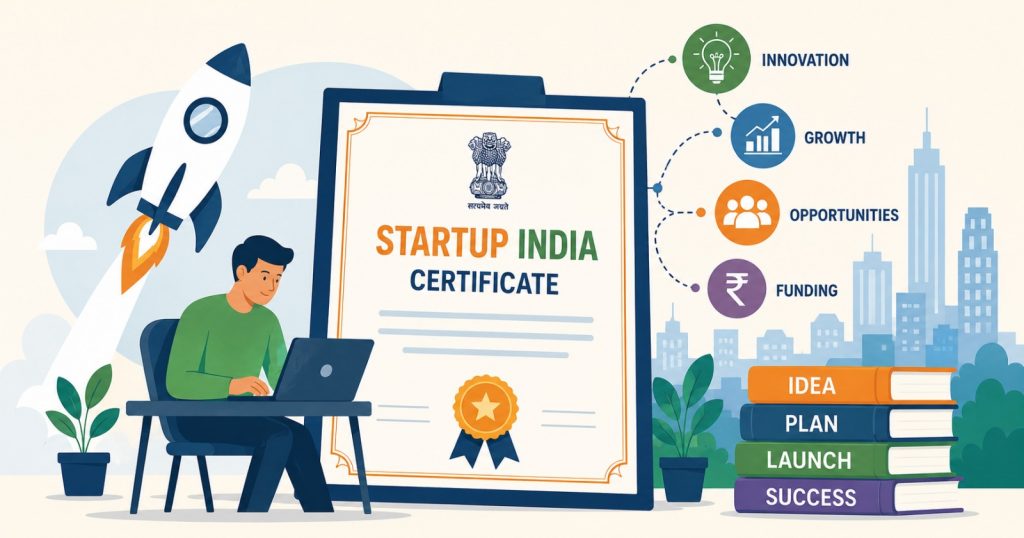
The Startup India Certificate is an official recognition granted by the Department for Promotion of Industry and Internal Trade (DPIIT), which operates under the Ministry of Commerce and Industry, Government of India. It formally recognises your entity as a “startup” under the Startup India scheme, making it eligible to access a wide range of government-backed benefits — including tax exemptions, relaxed regulatory compliance, subsidised intellectual property filings, and access to funded programmes.
Think of the Startup India Certificate as your business’s gateway into India’s formal startup ecosystem. Without it, you may still operate as a company, but you miss out on every financial incentive, funding scheme, and compliance relaxation that the government has specifically designed for early-stage innovators.
As of October 2025, over 1,97,000 startups have received DPIIT recognition under the Startup India initiative — a testament to the scale and reach of the programme. And the numbers keep growing.
Who Is Eligible for the Startup India Certificate?
Before applying, your startup must meet a specific set of eligibility criteria laid down by DPIIT. Here is a detailed breakdown:
1. Entity Type
To qualify for the Startup India Certificate, your business must be legally incorporated as one of the following:
- Private Limited Company (under the Companies Act, 2013)
- Limited Liability Partnership (LLP) (under the LLP Act, 2008)
- Registered Partnership Firm (under the Partnership Act, 1932)
- Cooperative Society
Sole proprietorships and public limited companies are not eligible for recognition. If you are currently operating as a sole proprietor and wish to obtain the Startup India Certificate, you will need to first convert your business into an eligible entity type.
2. Age of the Business
Your startup must not be older than 10 years from its date of incorporation. If your business has crossed this threshold, it no longer qualifies under the Startup India scheme, even if it meets all other criteria. (An exception exists for “deep tech” startups recognised under specific categories, who may have up to 20 years from incorporation.)
3. Annual Turnover
The startup’s annual turnover must not exceed ₹100 crore in any financial year since the date of incorporation. This ceiling ensures the scheme benefits genuinely early-stage businesses rather than established companies seeking tax advantages.
4. Innovation and Scalability
This is perhaps the most important eligibility criterion, and also the one that trips up many applicants. Your business must be working towards:
- The development, improvement, or innovation of a product, process, or service; and/or
- A scalable business model with high potential for employment generation or wealth creation.
You cannot obtain the Startup India Certificate for a business that merely replicates an existing product or service without any innovation. DPIIT evaluators assess the quality of your business description and the uniqueness of your offering, so this section of your application needs careful thought.
5. Not a Reconstructed Entity
Your startup must not have been formed by splitting up, restructuring, or reconstructing an existing business. This clause prevents established companies from rebranding to access startup benefits.
6. Compliance Requirements
Your business must be fully compliant with all applicable laws — including the Companies Act, Income Tax Act, and GST regulations. It must also maintain a bank account in the business’s name.
What Are the Benefits of Getting the Startup India Certificate?
The Startup India Certificate does far more than add credibility to your pitch deck. Here is a comprehensive look at the concrete benefits it unlocks:
Tax Exemptions
This is often the biggest draw. Once you hold the Startup India Certificate, you can apply for:
Income Tax Exemption under Section 80-IAC: DPIIT-recognised startups (incorporated as Private Limited Companies or LLPs) can apply for a 100% income tax holiday for 3 consecutive financial years out of their first 10 years of operation. This exemption has been extended to startups incorporated up to 1 April 2030, meaning any startup registered before that date is eligible to apply. The 80-IAC application is made separately to the Inter-Ministerial Board (IMB), which evaluates the startup’s innovative nature before granting approval.
Angel Tax Exemption: Effective from FY 2025-26, the government has abolished angel tax altogether, meaning all classes of investors can now invest in startups without triggering tax under Section 56(2)(viib) of the Income Tax Act. While this benefit is now automatic for all companies, DPIIT recognition remains essential for accessing the other tax benefits.
Intellectual Property (IP) Benefits
Filing for patents and trademarks has historically been an expensive, time-consuming process that puts many startups at a disadvantage. The Startup India Certificate changes this:
- 80% rebate on patent filing fees, making it financially viable for startups to protect their innovations.
- 50% rebate on trademark filing fees.
- Fast-track examination of patent applications — reducing the typical wait time significantly.
- Access to government-empanelled IP facilitators (patent and trademark agents) who provide free or subsidised advisory support.
Simplified Labour and Environmental Compliance
DPIIT-recognised startups can self-certify their compliance under 6 key labour laws and 3 environmental laws for up to 5 years from incorporation. During this period, there are no inspections or physical visits by government officers (unless a complaint is received). The 6 labour laws include:
- The Building and Other Constructions Workers’ Act, 1996
- The Inter-State Migrant Workmen Act, 1979
- The Payment of Gratuity Act, 1972
- The Contract Labour (Regulation and Abolition) Act, 1970
- The Employees’ Provident Funds and Miscellaneous Provisions Act, 1952
- The Employees’ State Insurance Act, 1948
Access to Government Funding Schemes
The Startup India Certificate opens the door to a range of structured government funding programmes:
- Fund of Funds for Startups (FFS): The government has allocated ₹10,000 crore through SIDBI to invest in SEBI-registered Alternative Investment Funds (AIFs), which then invest in startups. The programme has now been expanded under Fund of Funds 2.0.
- Startup India Seed Fund Scheme (SISFS): Provides early-stage grants and soft loans through government-recognised incubators for activities like prototype development, product trials, and market entry.
- Credit Guarantee Scheme for Startups (CGSS): Enables DPIIT-recognised startups to access collateral-free loans from scheduled commercial banks and NBFCs, backed by a government guarantee.
- Stand-Up India Scheme: Provides loans between ₹10 lakh and ₹1 crore to SC/ST and women entrepreneurs starting new businesses.
- MUDRA Loans: Microfinance loans under Shishu, Kishor, and Tarun categories — recently extended up to ₹20 lakh under Budget 2024-25.
Public Procurement Relaxations
DPIIT-recognised startups can bid for government tenders without the usual prerequisites of prior experience, turnover thresholds, or Earnest Money Deposits (EMDs). This levels the playing field dramatically — giving early-stage startups a genuine shot at government contracts that would otherwise be reserved for established companies with years of track records.
Startups can also register as sellers on the Government e-Marketplace (GeM) portal to supply goods and services directly to government departments.
Fast-Track Exit
In the unfortunate event that a startup needs to wind down, DPIIT recognition enables a fast-track exit under the Insolvency and Bankruptcy Code, 2016. Eligible startups with a simple debt structure can be wound up within 90 days of filing for insolvency — a sharp contrast to the months or years it typically takes for a standard company to be dissolved.
Networking, Mentorship, and Exposure
DPIIT-recognised startups gain access to:
- Startup India portal events, fests, and summits
- Connections with mentors, accelerators, incubators, and investors
- Participation in the National Startup Awards, Bharat Startup Grand Challenge, and other marquee government initiatives
- Listing on the Startup India portal, which increases visibility to investors and corporate partners
Documents Required for the Startup India Certificate Application
Incomplete or incorrect documentation is the most common reason for application rejection. Have all of the following ready before you begin:
Mandatory Documents:
- Certificate of Incorporation — Issued by the Ministry of Corporate Affairs (MCA) for companies and LLPs; or Registration Certificate issued by the Registrar of Firms for partnership firms.
- PAN Card of the company or LLP.
- Aadhaar Card and PAN of each director or partner.
- Memorandum of Association (MoA) for Private Limited Companies; or LLP Deed for LLPs.
- Brief description of the business — covering your product or service, the problem it solves, the target market, the innovation involved, and the scalability of the model. This is the most scrutinised section of your application.
Supporting Documents (If Applicable):
- Proof of funding, if your startup has received any investment.
- Authorisation letter from the authorised representative of the company, LLP, or firm.
- Proof of concept — such as a website link, pitch deck, or video (recommended for startups at the validation, early traction, or scaling stage).
- Patent and trademark details, if any IP filings have already been made.
- Awards or certificates of recognition received from incubators, accelerators, or government bodies.
- GST Registration certificate (if applicable to your business type and turnover).
How to Apply for the Startup India Certificate: Step-by-Step
The entire application process is free, fully online, and can typically be completed within 2 to 7 working days — provided all your documentation and information is accurate. Here is a step-by-step walkthrough:
Step 1: Incorporate Your Business
Before you can apply for the Startup India Certificate, your business must be legally incorporated as a Private Limited Company, LLP, or Registered Partnership Firm. If you have not done so already:
- For Private Limited Companies and LLPs: File your incorporation application through the Ministry of Corporate Affairs (MCA) portal (mca.gov.in). Government fees range from approximately ₹2,000 to ₹10,000 depending on the entity type and authorised capital.
- For Partnership Firms: Submit your registration application to the Registrar of Firms in your state.
Once approved, you will receive a Certificate of Incorporation or Partnership Registration Certificate — this is a mandatory document for your Startup India application.
Step 2: Register on the National Single Window System (NSWS)
As of the current process, DPIIT recognition for startups is handled through the National Single Window System (nsws.gov.in). Create an account on NSWS if you do not already have one. The portal allows you to apply for a host of business approvals from Central and State Government departments in one place, including the “Registration as a Startup” application.
Alternatively, you can also register and initiate the recognition process through the Startup India portal (startupindia.gov.in), which routes you to the NSWS for the actual application.
Ensure the entity name and details you enter match your incorporation certificate exactly — down to spelling, punctuation, and capitalisation. Mismatches are a common reason for delays and rejections.
Step 3: Navigate to the DPIIT Recognition Application
Once logged into the portal, follow these steps:
- On the NSWS dashboard, click “Add Approvals”
- Select “Central Approvals”
- Find “Registration as a Startup” and add it to your dashboard
- Fill in and submit the application form
If using the Startup India portal, go to the “Recognition” tab and select “Apply for DPIIT Recognition”.
Step 4: Fill in the Application Form
The recognition form requires you to provide:
- Entity type and incorporation details
- PAN and date of incorporation
- Stage of the startup (Ideation / Validation / Early Traction / Scaling)
- Industry sector
- Details of founders and directors (including Aadhaar and PAN)
- A detailed description of your business — covering your innovation, product, market opportunity, and scalability
The business description is critical. DPIIT evaluators look for genuine innovation and scalability. Be specific: describe what problem your product or service solves, how it is different from existing solutions, and what the long-term business potential is. Vague or generic descriptions are among the top reasons applications are rejected.
Step 5: Upload Required Documents
Upload scanned copies of all the required documents listed above. Ensure scans are clear, legible, and in accepted formats (PDF or JPEG). Blurry or cropped documents can delay processing.
Step 6: Submit and Track Your Application
After submitting the application, you will receive a reference number that you can use to track the status of your application on your Startup India or NSWS dashboard. DPIIT may raise queries or request clarifications — monitor your email and the portal regularly and respond promptly to avoid delays.
Step 7: Download Your Startup India Certificate
Once approved, you will receive your DPIIT Certificate of Recognition as a downloadable PDF through the portal. Log in to your dashboard, go to the recognition section, and download the certificate. Save a digital copy and print a physical copy — you will need it for government tender submissions, funding applications, and investor documentation.
Processing Time: Typically 2 to 7 working days, assuming all documents and information are accurate and complete.
Cost: The DPIIT recognition process is entirely free of charge. DPIIT has not appointed any agency, representative, or franchise for issuing the certificate — be wary of services that claim to be official intermediaries and charge government fees. Total costs you may incur include MCA incorporation fees (₹2,000–₹10,000), and optional professional fees for CA/CS assistance (₹5,000–₹25,000), but the recognition itself costs nothing.
Applying for Tax Exemptions After Getting the Startup India Certificate
Obtaining the Startup India Certificate is just the first step. To actually claim the major financial benefits, you need to take additional steps post-recognition:
Section 80-IAC Tax Exemption
After receiving your Startup India Certificate, you can apply for income tax exemption under Section 80-IAC through the Startup India portal. This application goes to the Inter-Ministerial Board (IMB), which evaluates your startup’s innovative credentials more rigorously. If approved, you can claim a 100% tax holiday for 3 consecutive financial years of your choosing within your first 10 years of operation.
Note: Only Private Limited Companies and LLPs are eligible for 80-IAC exemption. Registered Partnership Firms cannot apply for this benefit.
Self-Certification for Labour Laws
For labour law compliance, you must register on the Shram Suvidha Portal (shramsaathi.labour.gov.in) of the Ministry of Labour and Employment, and use the portal to complete self-certification under the 6 applicable labour laws.
Common Mistakes to Avoid When Applying for the Startup India Certificate
Many startups are rejected or face unnecessary delays due to avoidable errors. Here are the most common pitfalls and how to steer clear of them:
1. Vague or Generic Business Description Writing something along the lines of “We provide IT solutions to businesses” will almost certainly lead to rejection. DPIIT evaluators want to see specific detail about your innovation, differentiation, and growth potential. Treat this description like your most important investor pitch — be specific, data-backed, and compelling.
2. Registering as an Ineligible Entity If your business is registered as a sole proprietorship, you cannot receive the Startup India Certificate. Convert your entity type first.
3. Submitting Incomplete or Unclear Documents Missing documents, low-quality scans, or documents with name mismatches between your incorporation certificate and your application are a sure path to delays. Double-check every document before uploading.
4. Exceeding Eligibility Limits If your startup is over 10 years old or has crossed the ₹100 crore annual turnover mark, you are no longer eligible. Do not apply if you do not meet the criteria — you risk being flagged for misrepresentation.
5. Applying as a Reconstructed Business If your “startup” was formed by restructuring or splitting an existing company, it will not qualify. DPIIT actively looks for evidence of genuine innovation, not regulatory arbitrage.
6. Ignoring Post-Approval Compliance Getting your Startup India Certificate is not the end of the story. You must file annual returns with MCA, submit GST returns (if applicable), complete annual self-certification on the Startup India portal, and stay compliant with labour laws. Ignoring these requirements can lead to penalties or cancellation of your recognition.
7. Falling for Paid Intermediaries DPIIT has explicitly stated that it has not appointed any agency or representative to issue the Certificate of Recognition. The process is entirely free and must be done by the startup itself using its own credentials. If someone is charging you a fee to “file on your behalf with DPIIT,” be cautious — such services are not authorised intermediaries.
After the Startup India Certificate: What’s Next?
Once you have your Startup India Certificate in hand, here is a roadmap of next steps to maximise the value of your recognition:
- Apply for 80-IAC Tax Exemption if you are a Private Limited Company or LLP and have begun generating revenue.
- Register on GeM (gem.gov.in) to access government procurement opportunities.
- Apply to Startup India Seed Fund Scheme incubators if you are at an early stage and need funding for prototype development or market entry.
- File for patents and trademarks using the IP facilitators listed on the Startup India portal, and avail of the fee rebates.
- Self-certify on the Shram Suvidha Portal for labour law compliance.
- Explore state-level startup policies — many states like Karnataka, Maharashtra, Telangana, Tamil Nadu, Kerala, and Gujarat have their own complementary startup policies with additional benefits including grants, subsidies, and incubation support.
- Participate in national programmes like the National Startup Awards and the Bharat Startup Grand Challenge for additional visibility and funding.
Frequently Asked Questions (FAQs) About the Startup India Certificate
Q1. What exactly is the Startup India Certificate, and who issues it?
The Startup India Certificate — officially called the Certificate of Recognition — is issued by the Department for Promotion of Industry and Internal Trade (DPIIT) under the Ministry of Commerce and Industry, Government of India. It formally recognises your entity as a startup under the Startup India initiative and makes you eligible for a range of government benefits.
Q2. Is the Startup India Certificate the same as DPIIT recognition?
Yes. The Startup India Certificate and DPIIT recognition refer to the same document. Once your application is approved, DPIIT issues a Certificate of Recognition — colloquially referred to as the Startup India Certificate or DPIIT Certificate — which you can download from the portal as a PDF.
Q3. How much does it cost to get the Startup India Certificate?
The DPIIT recognition process is completely free. The government charges no fee for the Certificate of Recognition. You may, however, incur costs for incorporating your business through MCA (₹2,000–₹10,000) and for optional professional guidance from a CA or CS (₹5,000–₹25,000).
Q4. How long does it take to get the Startup India Certificate?
If your application is complete and accurate, you should receive your Startup India Certificate within 2 to 7 working days. If DPIIT raises queries or requests additional information, it may take longer.
Q5. Can a sole proprietorship apply for the Startup India Certificate?
No. Sole proprietorships are not eligible for the Startup India Certificate. Your business must be incorporated as a Private Limited Company, LLP, or Registered Partnership Firm to apply.
Q6. Can my startup apply for the Startup India Certificate if it has been operating for 8 years?
Yes, provided it has not crossed the 10-year mark from its date of incorporation and has not exceeded the ₹100 crore annual turnover threshold. However, the window for claiming 80-IAC tax benefits will be narrower given the time already elapsed, so it is advisable to apply as early as possible.
Q7. Does the Startup India Certificate guarantee funding?
No. The Startup India Certificate is a recognition of eligibility, not a guarantee of funding. However, it is a prerequisite for accessing most government-backed funding schemes such as the Startup India Seed Fund Scheme, Fund of Funds, and Credit Guarantee Scheme for Startups.
Q8. Can I apply for the Startup India Certificate online without visiting any government office?
Yes. The entire process — from creating your account to submitting documents and downloading the certificate — is done online through the National Single Window System (nsws.gov.in) or the Startup India portal (startupindia.gov.in). No physical visits are required.
Q9. Is GST registration mandatory to get the Startup India Certificate?
No. GST registration is not mandatory for obtaining the Startup India Certificate. However, if your business is liable to register for GST based on turnover or the nature of your business, you must do so independently for your operations. GST details can be included in your Startup India application if available.
Q10. What happens to the Startup India Certificate after my startup turns 10 years old?
Your DPIIT recognition status expires 10 years from the date of incorporation. After that, your company continues to operate normally as a business, but it loses access to startup-specific government benefits and incentives. You will no longer be eligible for 80-IAC tax exemption, IPR fee rebates, or labour law self-certification under the Startup India scheme.
Q11. Can I get the Startup India Certificate if my startup has already received funding from investors?
Yes. Having received external funding does not disqualify you from obtaining the Startup India Certificate. In fact, proof of funding is an optional supporting document that can strengthen your application by demonstrating investor confidence in your innovation.
Q12. Does the Startup India Certificate need to be renewed?
The Certificate of Recognition itself does not have a renewal cycle, but it is valid only as long as your startup continues to meet the eligibility criteria (under 10 years old, turnover under ₹100 crore, not restructured, genuinely innovative). However, for certain ongoing benefits, you may need to file annual self-certifications on the Startup India portal.
Q13. What is the BHASKAR platform, and how does it relate to the Startup India Certificate?
BHASKAR (Bharat Startup Knowledge Access Registry) is a government platform designed to accelerate the DPIIT verification process. When you apply for the Startup India Certificate, BHASKAR cross-references your application details to speed up verification, making the process faster and more accurate.
Q14. Can a Startup India Certificate be cancelled or revoked?
Yes. If DPIIT finds that a recognised startup has misrepresented information, no longer meets the eligibility criteria, or has not maintained regulatory compliance, the certificate can be revoked. This is why post-recognition compliance — including annual MCA filings, GST returns, and portal self-certifications — is essential.
Q15. Is the Startup India Certificate useful for raising money from angel investors?
Absolutely. While angel tax has been abolished from FY 2025-26, the Startup India Certificate significantly enhances your credibility in the eyes of angel investors, venture capitalists, and institutional investors. It signals that your startup has been formally recognised by the Government of India as an innovative and scalable business — which matters when building trust with potential backers.
Q16. What is the difference between the Startup India Certificate and the 80-IAC Certificate of Eligibility?
These are two separate documents. The Startup India Certificate (Certificate of Recognition) is issued by DPIIT and confirms your startup’s eligibility under the Startup India scheme. The 80-IAC Certificate of Eligibility is a separate document issued by the Inter-Ministerial Board (IMB) specifically for the purpose of claiming the 3-year income tax exemption under Section 80-IAC of the Income Tax Act. You must first get your Startup India Certificate, and then apply separately for 80-IAC eligibility.
The Bottom Line
The Startup India Certificate is not just a piece of paper — it is one of the most practical and tangible tools the Indian government offers to early-stage businesses. Between three years of tax-free operations, up to 80% rebates on patent filings, self-certification under labour laws, access to government-backed funding, and the ability to bid for government tenders without years of experience, the benefits are substantial and very real.
The application process is free, entirely online, and designed to be straightforward. The only barrier for most startups is not the process itself, but the quality of their innovation narrative in the application form. Invest time in clearly articulating what makes your startup genuinely different, scalable, and impactful — and the Startup India Certificate should follow.
If you are building something new in India, there is little reason not to apply.