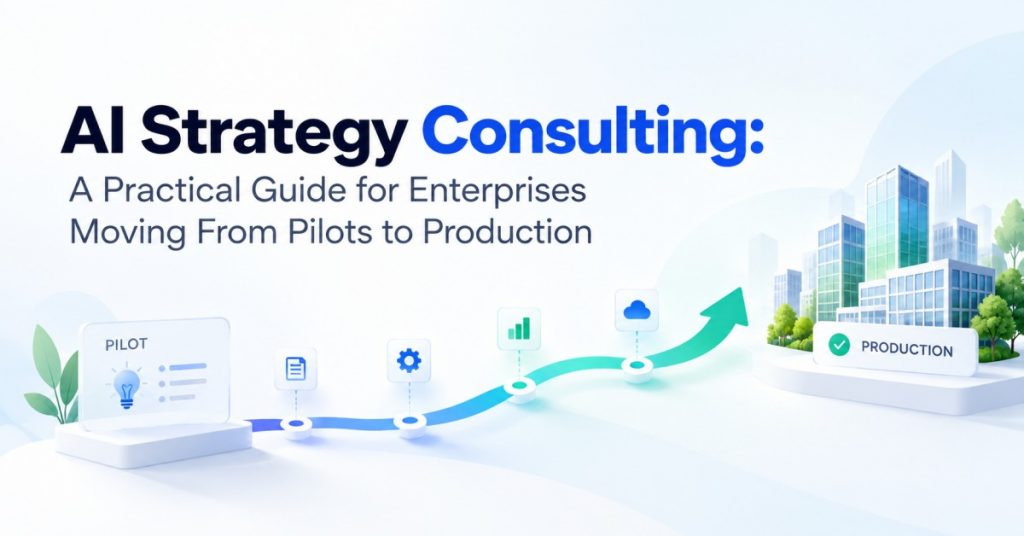
Most companies can start an AI pilot in about six weeks. Keeping that pilot alive a year later is the hard part. That’s why AI strategy consulting is on so many leaders’ to-do lists.
Gartner put numbers on this problem in 2024. It made a clear prediction. At least 30 percent of generative AI projects would be abandoned after proof of concept by the end of 2025. That’s almost one in three.
Gartner named four reasons. Poor data quality was the first. Inadequate risk controls came next. The last two were escalating costs and unclear business value. Each of these can be spotted early with a good plan. Many teams only learn this after the budget is gone.
That’s good news. It means you can fix most problems before they get expensive. What you need is a clear AI adoption strategy. It helps your team turn small experiments into tools people use every day.
This guide shows you how to spot these problems early. It also explains how to pick a partner who can help. You don’t need a technical background to follow along.
Why Enterprise AI Pilots Stall Before Production
Most pilots work fine in a safe test. Then real users, real data, and real security rules show up. That’s where many of them get stuck.
The AI Pilot to Production Gap
Any pilot runs well in trial. But when it comes to real data, most projects struggle.
An AI pilot uses tidy sample data and a small team. Production brings messy data, thousands of users, and long security reviews. A chatbot might answer 50 test questions just fine. Then it meets 5,000 real ones.
Every row in that table adds cost the pilot never planned for. Teams that price these gaps early write a stronger AI implementation strategy.
Data Readiness Gaps
Bad data slows projects down more than bad models do. Many companies keep customer records in five or more separate systems. A model trained on one system can’t see the others. So teams spend months cleaning, matching, and labeling.
Watch for these three problems.
- Duplicate customer records across CRM and billing tools
- Missing labels on old documents or images
- Unclear consent rules for customer data
Find out who owns each dataset. Check how fresh it is. Then check the legal side too. A realistic artificial intelligence strategy treats this prep work as the first milestone. It often adds six to ten weeks.
Why Missing Owners and Budgets Stop AI Projects
Pilots usually live in an innovation team with a small budget. Production needs an owner in each area. Without one, projects just stall.
Picture a bank that built a fraud detection model in eight weeks. Then it waited nine months for a security review. Nobody had budget to run it. The pilot worked. Nobody could keep it going. It happens more than you’d think.
Good AI strategy consulting helps you name owners and set aside money for running costs before this happens. Name the owner before the pilot ends. Put the run cost in next year’s budget.
Benefits of a Good Consulting Engagement
A good engagement gives you clear decisions and owners along with dates. Three things matter most.
Maturity Assessment and Use Case Selection
Start by finding out where your company really stands. The review checks your data and your skills along with the tools. Every area gets a score. The low ones turn into your to-do list. After that, you rank each use case by value, effort, and risk.
Say a claims team reads 20,000 forms every month. That’s a solid first pick. There’s a lot of volume, the old data is labeled, and the savings are easy to put a number on. Most providers of AI strategy services wrap up this scoring in two to three weeks.
Building a Realistic Plan With Dates
Next, turn your ranked list into a plan with real dates. Most teams split it into three chunks. The first 90 days get one use case running in production. The following year adds two or three more, plus some shared tools. The long view covers platforms, hiring, and budget.
Give every entry the same four things.
- A named business owner
- A target metric and a baseline
- A budget and a staffing plan
- A go or no go date
A clear AI roadmap also shows leaders what the team won’t build. That one thing saves you from a lot of scope creep. Check the roadmap every quarter, and change your priorities as results come in.
KPI Frameworks and the Business Case
Finance teams want numbers they can trust. So pick one main metric for each use case. A support assistant might cut handling time by 25 percent. An invoice tool might reach 98 percent accuracy on key fields. Track how things run today for 30 days before launch. Without that baseline, you can’t prove the project changed anything.
Don’t forget the costs either. Cloud spend, labeling hours, and review time pile up fast. Cost per transaction often decides if a pilot gets the green light to scale. Good AI strategy consulting ties every metric to a budget line. Then finance can judge the results like any other investment.
The Technical Foundations Production AI Needs
Even a good plan fails when the systems underneath can’t keep your models running. Three foundations matter most.
Data Engineering and MLOps
Production models need fresh data on time. Data engineers build the systems that move your data around. Some tools clean it. Others store it where models can find it.
MLOps handles the rest. It tests each model, tracks changes, and puts it live.
Think about a retailer that retrains its demand forecast every week. Uploading files by hand won’t work at that speed.
Add this to the budget early. A solid enterprise AI strategy counts pipeline costs from the start. Teams that skip this step end up rebuilding later. That costs more.
Set up alerts for failures. Make sure someone on call gets them fast. Also keep track of your dataset versions, just like you do with code.
Keeping AI Safe and Compliant
Production AI touches customer data. You can’t skip security reviews. Plan for access controls, encryption, audit logs, and model monitoring. Healthcare teams have to follow HIPAA rules. Service providers often need a SOC 2 report before big buyers will sign.
Governance covers a few more things. Set up approval steps, bias testing, and alerts for drift. Drift means the model slowly gets worse as real life changes. Name a risk owner before the first customer sees an answer. Write down every decision so auditors can follow your thinking. A mature AI implementation strategy treats all of this as a launch requirement.
Choosing the Right Technology Stack
Pick a stack that fits your use cases and the cloud you already use. Most teams mix open source libraries with managed services. The table below shows the common layers.
Choose tools that match your AI transformation strategy and your team’s skills. Test two or three options on your own data before you commit.
A Step-by-Step Path From Pilot to Production
The path has three phases. Each one ends with a clear decision.
Discover and Strategize
Start with discovery. Look at your business problems, your systems, and how ready your data is. Talk to the operations leads. They know which manual jobs eat up the most hours. A plant manager might point to quality inspection. Computer vision often fits that kind of job. Finish this phase with a ranked list of five to ten ideas.
Next, turn that list into a funded plan. Start with your goals and budget. Then pick who does the work. You can build it, buy it, or bring in a partner.
Experienced AI strategy consulting teams add exit rules too. Here’s a simple one. If a pilot misses its target twice, move the money elsewhere.
Execute and Validate
Begin with a small prototype that tests one narrow task. Give it four to six weeks and a fixed scope. Check accuracy and speed against your baseline. Ask users how they feel about it too. Then connect it to tools like your CRM or ERP.
Connecting systems usually takes longer than the model work. You’ll hit API limits, login problems, and old data formats. Real data rarely looks like your sample. A realistic AI pilot to production plan leaves plenty of time for this. It also sets up weekly demos, so stakeholders can speak up early.
Scale, Monitor, and Improve
Launch day is where the real work starts. Models get worse as customers, products, and data change. Check these four things every week.
- Accuracy against the original baseline
- Response time and error rates
- Monthly cloud and licensing spend
- User feedback and override rates
If accuracy drops by five points, take a closer look. Retrain the model on a set schedule. Do it sooner if the results slip badly. Each new project can reuse the tools and controls from the last one. That saves time and money. It’s also what makes an AI adoption strategy pay off over the long run.
How to Choose an AI Consulting Partner
Your partner affects speed, cost, and risk. Three checks make the choice easier.
- Technical Depth and Certified Specialists
Find out who will actually work on your project. Experience matters more than a polished pitch. Ask for two references from clients with live systems. Then ask what broke after launch. Ask how the team fixed it too.
Look at their skills as well. A strong team should know machine learning and computer vision. Language models and deep learning matter too.
- Pick the Right Way to Work Together
Choose a contract that fits where your company is right now. Need a quick baseline? A short assessment works well. Have a lot of use cases? A dedicated team fits better.
Next, look at how the partner works. They should follow clear steps. Each step should end with a written deliverable. Ask what happens if the scope changes. Ask to see sample reports from past work too.
- Safety and Support After Launch
Ask about compliance before you share any data. Check their SOC 2 practices. Ask how fast they respond to incidents. Production systems also need watching at night and on weekends. So ask if they offer 24/7 coverage.
Ask how they handle data residency and deletion requests. Ask to see their incident history too. A good partner will share it.
Final Thoughts
Getting AI into daily work takes more than a strong model. You need an owner and clean data. You also need a funded plan and steady monitoring. Miss one piece and the timeline grows by months. The ones that sort it out early get to production faster.
That’s where AI strategy consulting helps the most. An outside team can score your maturity in a few weeks. They rank your use cases honestly. Then they build a dated plan. Finance and security can both sign off on it.
Try three things this month. First, list every active pilot. Give each one a business owner. Score them on data readiness and risk. Share the results with your leadership team. Then pick one pilot for a 90-day push. Set the metric it has to hit.