A new era in AI computing might have begun.
Google’s AI chips have made it to orbit. A prototype satellite carrying the company’s Tensor Processing Units launched on Thursday aboard SpaceX’s Transporter-18 rideshare mission, marking the first time TPUs have flown in space and the first in-orbit test for Google’s Project Suncatcher.
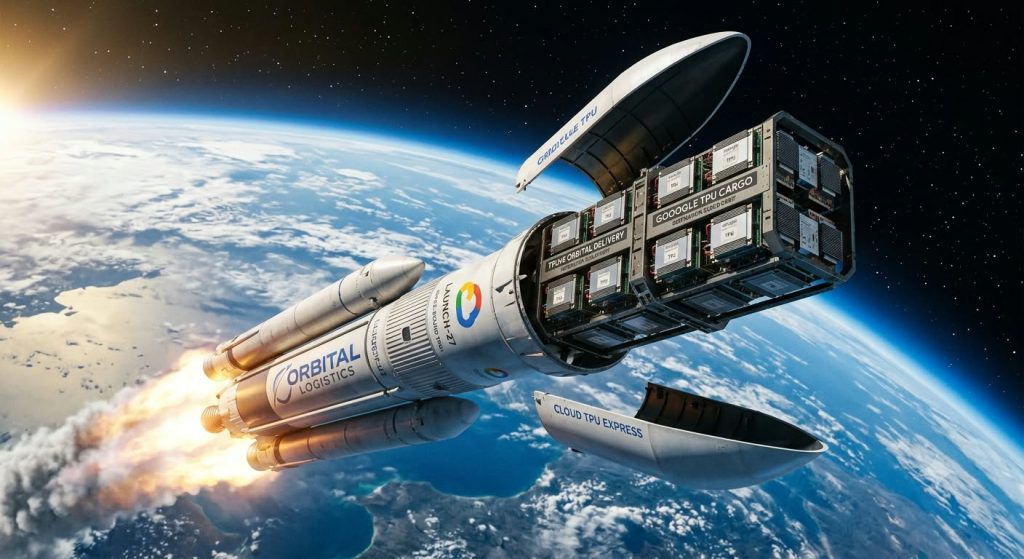
The satellite was built in partnership with Planet Labs and lifted off on a Falcon 9 from Vandenberg Space Force Base in California, alongside roughly 130 other payloads. Shortly after launch, Travis Beals, who leads Project Suncatcher at Google, said the team had confirmed contact with the satellite and that it was operating as expected. Planet Labs also reported initial contact with its Tanager-2 spacecraft, the Suncatcher prototype, and began commissioning.
What’s actually on board
The prototype carries four of Google’s Trillium TPUs, powered by solar panels. This is not an orbital data center, and Google isn’t pretending it is. The goal of the mission is much simpler: find out whether the chips can survive launch and then operate reliably in the harsh environment of low Earth orbit.
Google laid out the challenges ahead of the launch. Components like the TPUs can experience 50 to 100 g during ascent, and the team shook the satellite on all three axes to simulate launch vibrations. It also put Trillium TPUs in a proton beam at UC Davis to see how radiation-induced bitflips affected AI workloads, and tested a combination of heat pipes and radiators in a thermal vacuum chamber, since there’s no air in space to carry heat away from the chips.
Google has framed this first flight as a learning exercise. In its words, the launch is about seeing what works, identifying points of failure, and applying those findings to future missions. CEO Sundar Pichai put it more lightly, calling it “one small step for TPUs.”
Why Google wants chips in orbit
Project Suncatcher, which Google unveiled in November 2025, is a long-term research moonshot exploring whether space could one day host scalable machine learning infrastructure. The appeal is power: satellites in the right orbit get near-constant sunlight and can generate up to eight times more solar energy than panels on Earth. With AI data center buildouts running into power constraints and local opposition on the ground, orbital compute has become an increasingly attractive idea.
The longer-term vision is a constellation of satellites linked by free-space optical connections, working together on larger AI workloads. That part of the stack, which requires extremely high bandwidth over short distances between moving spacecraft, will be tested in 2027, when Google plans to put two satellites in orbit.
The SpaceX connection
There’s a certain irony in Google relying on SpaceX to get its chips to orbit, given that Elon Musk’s company is also pursuing orbital AI compute. SpaceX is working with Nvidia on a space-optimized Vera Rubin system that Musk says will launch to orbit in the fourth quarter of 2027, with significant scale in 2028. Musk has gone as far as predicting that space will eventually hold nearly all compute.
The two companies are also financially intertwined. Alphabet holds a stake in SpaceX worth more than $82 billion following the rocket company’s record IPO in June.
The bigger picture
For Google, the TPU is no longer just an internal tool. It has become the centerpiece of a broader hardware strategy, with Anthropic signing up for up to a million TPUs, Google open-sourcing parts of its TPU software stack, and recent inference benchmarks showing its Ironwood chips holding their own against Nvidia’s best.
Putting TPUs in space is a very different kind of bet, and a much longer-dated one. Radiation, cooling and inter-satellite networking are all unsolved at scale, and nothing about this launch changes where AI data centers get built this decade. But the first hurdle, getting the hardware up there and talking to the ground, has been cleared. What the TPUs do over the coming weeks and months will determine whether orbital AI compute stays a moonshot or becomes a real option.