Artificial intelligence is often discussed through chips, GPUs, data centers, and software models. But behind every AI server, accelerator card, networking switch, edge AI device, and industrial AI controller, there is another critical foundation: the printed circuit board.
AI hardware does not run on chips alone. It depends on high-speed signal transmission, stable power delivery, precise thermal management, dense component placement, and reliable system-level assembly. This is why PCB technology is becoming more important as AI computing grows.
In AI servers, the PCB acts as the electronic platform connecting processors, accelerators, memory, storage, power systems, and high-speed communication interfaces. AI server PCB designs must support high computational loads, high-speed data movement, and demanding power integrity requirements.
For PCB manufacturers, this means the AI industry is pushing demand beyond ordinary FR4 circuit boards. AI-related projects may require high-layer-count structures, HDI technology, controlled impedance, low-loss materials, fine-pitch BGA assembly, X-ray inspection, functional testing, and strong engineering support.
This article looks at several China-related PCB and PCBA companies that are making efforts in this direction. The focus is not only on “who can make a PCB,” but on which companies appear relevant to the AI hardware supply chain through high-speed PCB, HDI PCB manufacturer, AI server PCB, turnkey PCBA, and EMS support.
Why AI Hardware Needs Stronger PCB Support
AI computing creates a different kind of challenge for PCB manufacturing.
A simple consumer electronic device may only need a standard multilayer PCB. But AI servers and accelerator systems often require much more demanding board performance. High-speed interfaces such as PCIe, DDR, SerDes, and high-bandwidth networking channels need stable signal paths and controlled impedance. Large processors, GPUs, FPGAs, and ASICs usually come in dense BGA packages, which creates routing and assembly challenges.
Power is another major issue. AI hardware consumes significant current, so the PCB must support stable power distribution, low noise, and good thermal performance. If the PCB design or manufacturing quality is weak, even the best AI chip may suffer from signal loss, heat problems, unstable operation, or reduced reliability.
This is why HDI PCB manufacturers that want to serve AI-related industries need more than basic fabrication capacity. They need process control, material knowledge, engineering review, advanced assembly capability, and testing discipline.
PCBCool
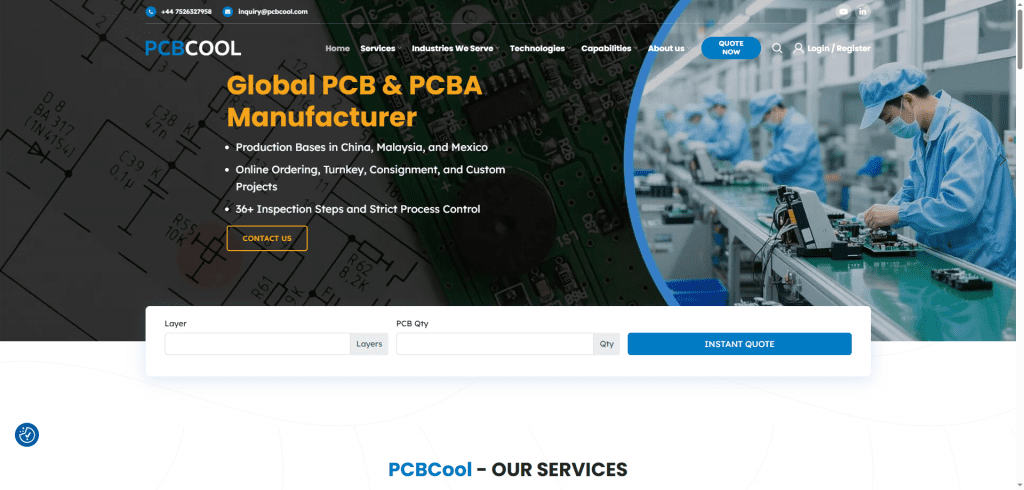
PCBCool is the digital brand under PS Electronics and focuses on PCB manufacturing, PCB assembly, component procurement, program writing, functional testing, and broader PCBA support. Its official site lists capabilities such as 1–40 layer PCB manufacturing, 0201 SMD assembly, 0.25 mm BGA assembly, SPI, AOI, X-ray, FCT, ERP traceability, and BOM sourcing support.
For AI-related products, PCBCool’s value is not limited to bare PCB fabrication. Many AI hardware projects involve prototype iteration, component sourcing, PCBA assembly, BGA inspection, firmware loading, testing, and sometimes final product integration. PCBCool’s positioning around turnkey PCB and PCBA services makes it more suitable for customers developing complete AI-enabled devices rather than only purchasing bare circuit boards.
This can include edge AI modules, smart industrial controllers, IoT gateways, machine vision devices, AI-powered medical electronics, robotics control boards, and intelligent consumer hardware.
PCBCool is especially relevant for buyers who need a supplier that can support the full manufacturing workflow: from Gerber and BOM review to PCB production, assembly, testing, and delivery.