Thousands of Indians have just been notified with a loud beeping of their mobile phones. At approximately 11:45 am on Saturday, May 2, 2026, mobile phones across India buzzed and blared with an “Extremely Severe Alert” — a push notification from the Government of India testing its newly launched Cell Broadcast-based emergency alerting system. The alert, marked with a red warning triangle, carried a clear and immediate message: no action was needed, but the nation’s disaster communication infrastructure had just gone live.
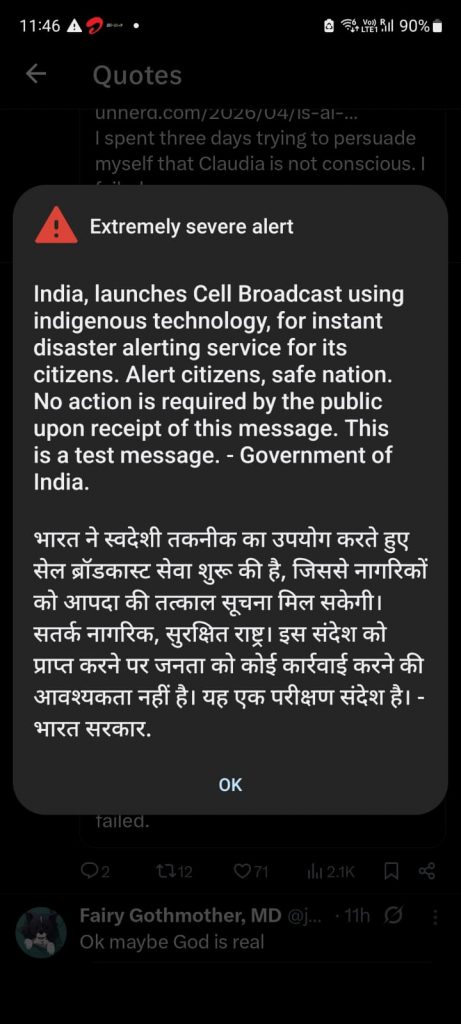
The alert was accompanied by a loud, sustained beeping that continued until the user pressed “OK” on their device — a deliberate design choice meant to ensure the message could not be missed or silently dismissed. The sound was reported by users across multiple states simultaneously, triggering a flurry of reactions and screenshots on social media platforms within minutes of the notification’s dispatch.
The message itself was bilingual by design. It appeared first in English, followed immediately by the regional language corresponding to the recipient’s location. Users in Hindi-speaking states received the message in Hindi, while citizens in other regions saw translations in their respective languages, reflecting the government’s intent to make the system truly inclusive and nationally scalable. The Hindi version read: “भारत ने स्वदेशी तकनीक का उपयोग करते हुए सेल ब्रॉडकास्ट सेवा शुरू की है, जिससे नागरिकों को आपदा की तत्काल सूचना मिल सकेगी। सतर्क नागरिक, सुरक्षित राष्ट्र। इस संदेश को प्राप्त करने पर जनता को कोई कार्रवाई करने की आवश्यकता नहीं है। यह एक परीक्षण संदेश है। — भारत सरकार।”
“Alert citizens, safe nation” — the government’s tagline for the Cell Broadcast initiative distills its ambition: reach every phone, in every language, before disaster strikes.
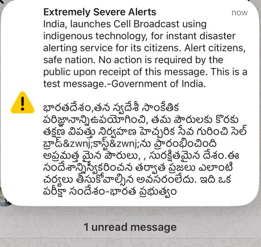
The technology behind the system is significant. India’s Cell Broadcast service is built on indigenous technology, a point the government explicitly highlighted in the alert message itself. Unlike conventional SMS alerts that rely on unicast delivery to individual numbers, Cell Broadcast works by transmitting a single message simultaneously to all devices connected to a particular cell tower or network area, making it far faster and more resilient during large-scale emergencies when networks are under stress.
Cell Broadcast technology is not new globally — Japan, South Korea, the United States, and several European nations have operated similar systems for years. What distinguishes India’s rollout is its scale and its indigenous development. With over a billion mobile subscribers, India’s deployment represents one of the largest single implementations of Cell Broadcast alerting infrastructure in the world.
The system is being positioned as a cornerstone of India’s disaster preparedness framework. In the event of earthquakes, floods, tsunamis, cyclones, or other mass-casualty events, authorities will be able to push geographically targeted alerts to citizens within seconds, without requiring them to have any app installed or any prior registration. Any phone connected to a participating network will receive the message automatically.
For Indian citizens, Saturday morning’s alert was their first direct encounter with this infrastructure — and, for many, an unexpected one. Social media users expressed a mix of surprise, curiosity, and relief upon reading that it was a test, with the alert’s striking alarm sound drawing the most commentary. The government’s decision to conduct the test during a weekend morning, when most citizens are away from workplaces, may have been a calculated choice to minimize disruption while maximising public visibility of the system’s reach.
The broader implications for India’s emergency management ecosystem are considerable. A functional, real-time, geographically precise cell broadcast network gives disaster response agencies a direct communication channel to every mobile user in an affected zone — a capability that previously did not exist at scale in India. Coupled with the National Disaster Management Authority’s existing response infrastructure, the system could significantly reduce the communication gap that has historically complicated large-scale disaster response in the country.