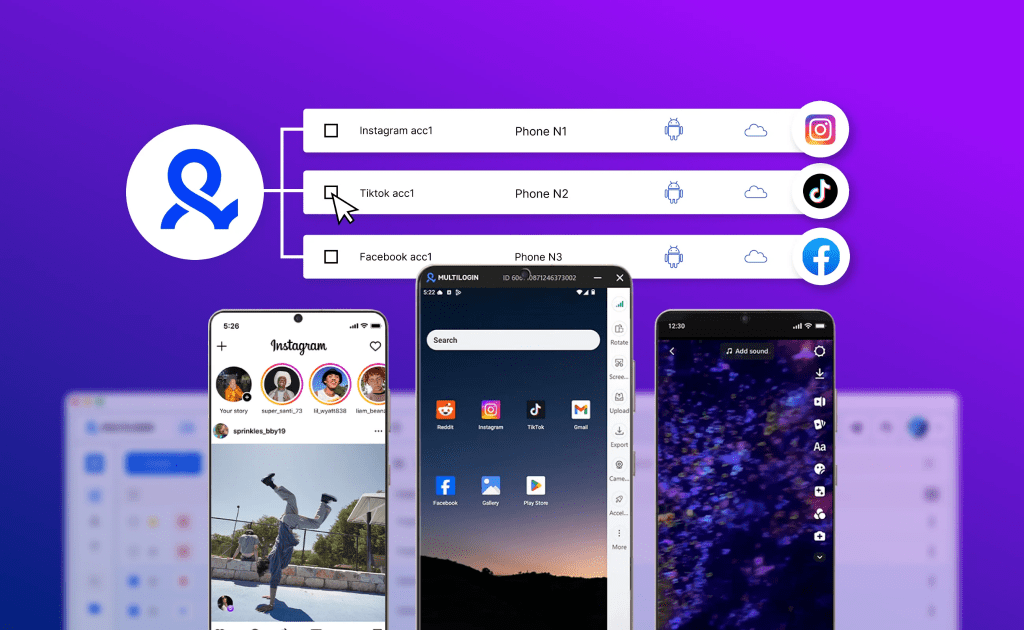
Running social media for a startup means juggling Instagram, LinkedIn, X, and TikTok from day one, and that’s before regional accounts or client work come into the picture.
This guide covers five tools startups are using to manage multiple social media accounts at scale, plus one platform that solves a problem most social media tools never touch.
5 tools startups use to scale social media operations
1. Multilogin Cloud Phone
Most tools on this list help you manage what gets posted. Multilogin solves something different: it controls the environment your accounts run in.
A cloud phone is a real Android device that runs entirely in the cloud. Each one brings its own unique device fingerprint, its own residential internet connection, and zero overlap with any other profile in your workspace. When you log into a social media account from a cloud phone, the platform sees a standalone mobile device in a specific location, not a shared browser session with ten other accounts behind it.
For businesses looking to grow through social media, this is what turns accounts into assets, as social media platforms track far more than login credentials. They monitor device behavior, connection type, location signals, and session patterns. When multiple accounts share the same environment, platforms connect the dots quickly, and the consequences range from suppressed content to lost accounts, lost followers, and lost revenue.
For startups managing accounts across multiple clients or markets, getting this right from day one is the difference between a social media presence that scales and one that keeps starting over.
Multilogin’s Cloud Phones solve this at the root level. Each account gets:
- Better local visibility with IPs tied to real cities and countries
- Higher reach and engagement
- Zero cross-account risk
- Full team control without sharing passwords
- Automated workflows that grow your accounts while you sleep
Pricing starts at €5.85/month, with cloud phone usage billed per minute and starter usage included in most plans.
Your social media operation starts here. Follow the step-by-step setup guide on cloud phones and go live today.
Best for: Agencies managing multiple client accounts, teams operating across markets, and any startup where account integrity is a business-critical concern.
2. Buffer — For straightforward scheduling
Buffer has earned its reputation by doing one thing consistently well: making it easy to plan, schedule, and publish content across multiple social media accounts without overcomplicating the process.
The interface is clean and the learning curve is low, which makes it a practical entry point for startups building their first real social media workflow. You connect your accounts, set posting schedules, drop content into the queue, and Buffer handles delivery.
Where Buffer falls short is in depth. Teams managing high-volume output or complex multi-client operations tend to outgrow it.
Best for: Early-stage startups that need a simple, dependable scheduling tool for a manageable number of accounts.
3. Hootsuite — For teams that need centralized control
Hootsuite’s dashboard pulls together multiple accounts across multiple platforms into a single view, which is genuinely useful when you’re tracking activity across a large number of profiles simultaneously. Beyond scheduling, it handles social listening, approval workflows, team assignments, and reporting, all in one place.
The trade-off is complexity. Hootsuite’s interface takes time to learn, and its pricing reflects an enterprise orientation that not every startup budget can accommodate.
Best for: Growth-stage startups with dedicated social media teams and a need for centralized oversight across many accounts.
4. Later — For Visually Driven Content Planning
If your brand leads with visual content, Later’s drag-and-drop calendar and visual grid preview tools make content planning faster and more intuitive than most alternatives.
Later works well for startups whose social media presence centers on Instagram or TikTok and whose teams think in images and short-form video rather than written content. It’s less suited to LinkedIn-heavy or text-forward strategies.
Best for: Consumer startups with strong visual identities, especially those building primarily on Instagram or TikTok.
5. Sprout Social — For data-led social media teams
Sprout Social sits at the more sophisticated end of social media management tools, and it earns that position primarily through the quality of its analytics and reporting.
Like Hootsuite, Sprout’s pricing reflects its positioning toward larger teams. Startups that are serious about using social media data to drive strategy and have the team to act on that data will find it worth the investment. Teams at an earlier stage may find the depth unnecessary for where they currently are.
Best for: Startups where social media data directly informs product and marketing decisions, and where the team has the capacity to use advanced analytics.
Final thoughts
Scheduling tools handle what gets posted and when. None of them control where your accounts live from the platform’s perspective, or how isolated they are from each other, and for teams managing multiple clients or markets, that gap compounds fast and rarely announces itself before damage is done.