When people picture a space startup, they usually imagine rockets or satellites blasting off into space. AADYAH Aerospace has built its business on something less glamorous but arguably just as critical — the actuators, control electronics, and avionics that let a rocket actually steer once it leaves the pad, and the subsystems that keep a satellite pointed the right way once it is in orbit. In a country where the private space sector has spent the last decade sprinting toward its own launch vehicles and constellations, AADYAH has carved out a quieter but valuable niche as the supplier those companies turn to.
From SENER’s India office to a company of their own
AADYAH was incorporated in Bengaluru in April 2016, founded by a group of six colleagues who between them carried decades of aerospace and defence experience. At the centre of the founding team was Shaju Stephen, who set up the company along with five colleagues while he was serving as MD and CEO of the Indian subsidiary of SENER Ingenieria y Sistemas, the Spanish engineering major. Stephen went on to become AADYAH’s Chairman and Managing Director, and the six founders held on to 75 percent of the company between them, setting aside the remaining 25 percent for an employee stock ownership plan — a structure Stephen has pointed to as fairly unusual for a private aerospace company in India.
The technical firepower came from two other co-founders. Sunderarajan Varadan, who had also worked at SENER’s India operations and earlier served as a Lieutenant Commander in the Indian Navy, took on the role of CEO. Dr. Pradeep Kumar, a retired Group Director at ISRO’s Vikram Sarabhai Space Centre with more than four decades of experience in propulsion, came on as co-founder and CTO. Sabu Joseph, Amarnath Reddy, and Varun Kurup rounded out the founding group. The idea, as the founders have described it, was to fill a gap they saw in Indian aerospace manufacturing: large industrial conglomerates like Tata, L&T, Godrej, and Reliance sat at one end with in-house aerospace and defence arms, while small machine shops and contract manufacturers doing subcontract work for ISRO and DRDO sat at the other. AADYAH positioned itself in the middle, as a specialised engineering outfit that could design, prototype, and manufacture complex subsystems rather than just fabricate parts to someone else’s drawings.
What AADYAH actually builds
AADYAH does not build rockets or operate satellites itself. Instead, it sells the subsystems that go into them, chiefly thrust vector control systems — the actuators, sensors, and control electronics that let a rocket engine’s nozzle swivel to steer the vehicle — along with flex nozzle and flow control systems, and flight avionics for launch vehicles. On the satellite side, it makes onboard computers, electronics control units, reaction wheels, sun sensors, and star trackers. The company also does composite and precision manufacturing work, including carbon-fibre propellant tanks and structural mechanisms for satellites, and has run R&D and testing projects for defence programmes, among them a prototype scramjet combustor developed under a DRDO contract. It counts India’s Gaganyaan human spaceflight programme among its customers, having supplied hardware used in astronaut training simulations, and its client roster also includes ISRO. The company’s Bengaluru facility houses its own testing infrastructure, including no-load and load test rigs for thrust vector control mechanisms, control electronics, and avionics.
Company records show AADYAH started generating revenue in August 2018 and shipped its first product in September 2019, when it signed a design, prototyping, and production contract for a launch vehicle thrust vectoring system. It picked up a National Award for Technology Innovation in 2018 for its work on spacecraft separation systems, and in 2021 it opened a North American subsidiary and landed its first international customer, in Germany. Today the company says it serves customers across the United States, United Kingdom, France, Spain, Germany, Austria, Israel, Singapore, and Australia in addition to India — a global customer base that is notable for a company of its size, and one that reflects the broader shift of Western and Israeli space companies looking to India for cost-competitive engineering. AADYAH turned profitable in March 2025, and in its most recent financial year reported a profit of Rs 1.47 crore even as operating revenue dipped slightly to Rs 14.12 crore.
Funding and what comes next
AADYAH first raised institutional money in September 2017, when the Bengaluru chapter of the global angel network Keiretsu Forum led a seed round of close to $1 million. The company has since raised capital across more than a dozen rounds from over a hundred investors, taking its total funding past $11 million, with backers along the way including SiriusOne and a mix of angel investors, alongside support from programmes such as the India-Israel Industrial R&D and Technology Innovation Fund, the Seraphim Space accelerator, and Stanford SEED. Its most recent round, a Series A of roughly Rs 31.5 crore (about $3.3 million) that closed in mid-2026, was backed by Helios Holdings and other investors, and reportedly pushed the company’s valuation up by more than a quarter to around Rs 206 crore. AADYAH has said it plans to use the fresh capital to fund a US acquisition as part of its international expansion, alongside working capital needs.
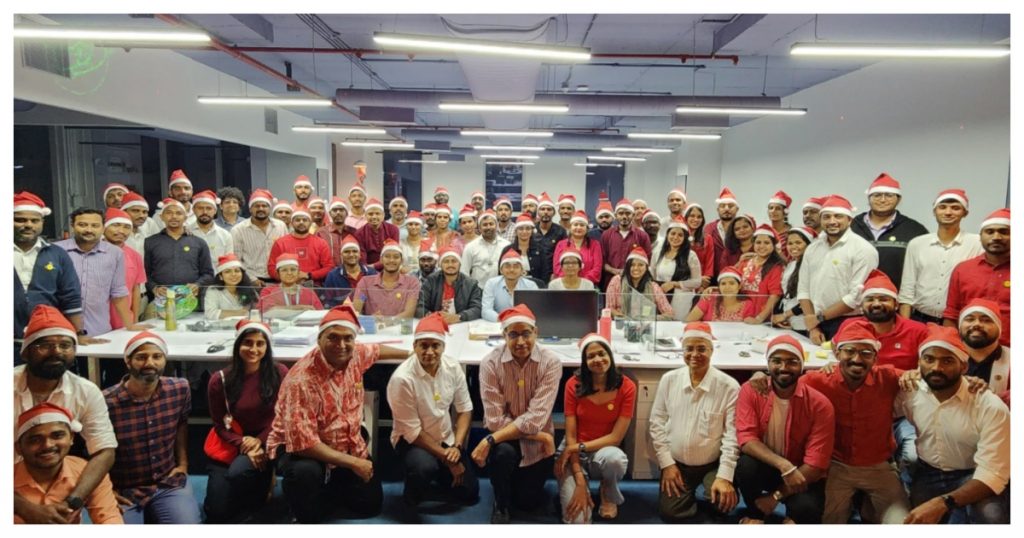
Nearly a decade after its founding, AADYAH now employs close to ninety people out of Bengaluru, many of them former ISRO and industry engineers, and has built itself into one of the more consistently funded players among India’s growing cluster of space-tech subsystem suppliers. As India’s private launch and satellite companies scale up their own ambitions, AADYAH’s bet — that there is a durable business in being the company nobody outside the industry has heard of, but everybody inside it relies on — looks to be paying off.