In a country where private rocket startups have mostly chased the “cab-to-space” model — small, cheap launch vehicles for small satellites — Bengaluru-based Astrobase Space Technologies has picked the opposite fight. It wants to build a mid-to-large, partially reusable orbital rocket powered by a full-flow staged combustion (FFSC) engine, an architecture so demanding that only SpaceX has ever flown one. Founded in 2024, barely two years old, the company has already unveiled an integrated engine, opened a private cryogenic test facility, and pulled in backing from India’s space regulator — all while staying almost entirely out of the spotlight until recently.
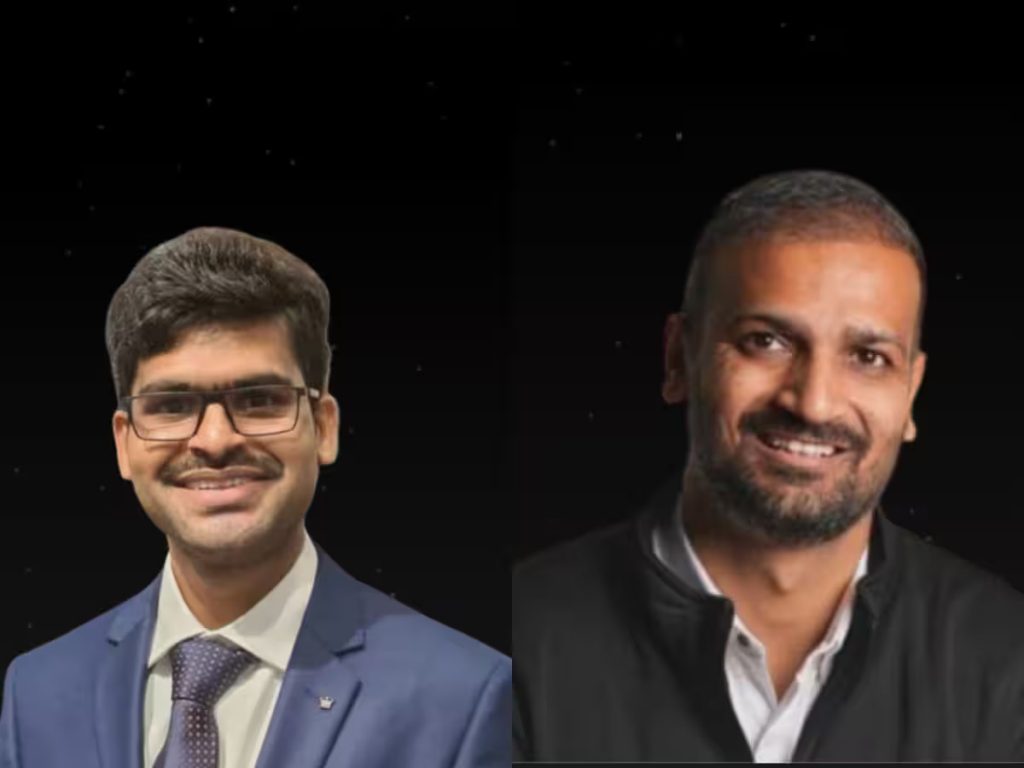
The founders: a crypto exit meets ISRO’s propulsion bench
Astrobase was co-founded by Neeraj Khandelwal, better known as the co-founder of crypto exchange CoinDCX, and Devakumar Thammisetty, a former ISRO propulsion engineer. Rounding out the founding team are two more ex-ISRO scientists, Pawan Kumar and Prashant M.
Khandelwal is an IIT Bombay alumnus who spent the last decade building CoinDCX into India’s largest crypto platform, scaling it to tens of millions of users and a valuation north of $2 billion. At Astrobase, he handles strategic direction, capital, and is also the company’s primary investor — an unusual pivot from fintech to rocketry, but one he’s framed as a long-standing personal interest in space rather than a side bet.
Thammisetty is the technical anchor. He spent more than 13 years at ISRO working on cryogenic propulsion, contributing to the GSLV Mk2/Mk3 upper stages and India’s Gaganyaan human spaceflight programme, before going to EPFL in Switzerland to study rocket reusability. Around him, Astrobase has assembled a bench of roughly ten senior ex-ISRO propulsion engineers — deep institutional knowledge that the company is now trying to commercialise outside the confines of a government agency.
What Astrobase is building
Astrobase’s core bet is an 800-kilonewton, methane-oxygen (methalox) engine it calls EVEREST — India’s first fully integrated full-flow staged combustion engine, publicly unveiled on August 8, 2026. FFSC engines fully gasify both the fuel and oxidiser through twin pre-burners before they hit the main combustion chamber, allowing chamber pressures above 300 bar, higher efficiency, and — crucially — engines that can be reused many times over without the soot buildup that plagues kerosene-fuelled designs. It’s widely regarded as the most complex propulsion cycle to engineer; SpaceX’s Raptor, which powers Starship, is the only such engine to have flown to orbit.
If Astrobase’s full-scale hot-fire test succeeds, India would become only the fourth country — after the erstwhile Soviet Union, the US, and China — to test an FFSC engine, and Astrobase only the eighth entity globally to pull it off.
The company’s roadmap calls for clustering seven of these engines under a four-metre-diameter, partially reusable rocket capable of carrying 3 to 10 tonnes to orbit, with three vehicle configurations planned: expendable, partially reusable, and fully reusable. The stated ambition is to eventually bring launch costs down to around $300 per kilogram by the early 2030s, and to run a “launch-on-demand” model — turning around dedicated missions within roughly 15 days, an approach founders have openly compared to the logistics playbook of quick-commerce.
Infrastructure and milestones
Astrobase has moved unusually fast on hardware for a two-year-old company. It runs a 46,000 sq ft design, assembly and integration facility in Bengaluru, and a 21.5-acre propulsion test site near Anantapur, Andhra Pradesh, built around a 200-tonne thrust stand — reportedly India’s first private high-thrust LOX-methane testing facility. The company also leans on metal 3D printing for core engine components to speed up iteration and manufacturing.
On the testing timeline: Astrobase completed a sub-scale hot-fire test in September 2025 and high-speed turbopump trials in January 2026. All engine components were manufactured by June 2026, leading to the integration of the full-scale EVEREST engine and its public unveiling in August. A full-scale, fully integrated hot-fire test — with both pre-burners, both turbopumps and the main chamber firing together — is the next major checkpoint, expected later this year. The company is targeting an orbital flight by 2028–29, and says it plans to test around 20 engines before that maiden launch.
Funding and government backing
Astrobase closed a seed round of roughly $10 million, led by venture firm BanyanCo, at a valuation estimated around $72 million. The founders say they’ve since ploughed more than ₹100 crore into propulsion, test infrastructure and manufacturing.
In June 2026, Astrobase received a significant vote of confidence from the state: it was one of just three companies selected from 43 applicants for IN-SPACe’s Technology Adoption Fund, a ₹500-crore scheme that covers most of a project’s cost (capped at ₹25 crore per project), takes no equity, and lets founders keep their IP in exchange for a royalty on future sales. Notably, the grant backs Astrobase’s own in-house engine design rather than transferring any ISRO blueprint — a distinction the company has been keen to highlight given how closely its team is tied to the space agency.
This support comes against the backdrop of a broader government push: in 2025, India rolled out a ₹500 crore IN-SPACe fund and a separate ₹1,000 crore VC fund aimed at growing the domestic space-tech ecosystem, part of a wider effort to cut import dependence and expand private participation in the sector.
Where it stands
Astrobase now has around 34 employees and counts SpaceX, Stoke Space, and Relativity Space among the global peers it’s frequently compared to — reflecting the scale of its ambitions rather than any current parity in flight heritage. It arrives at a moment when India’s private space sector is starting to show real traction elsewhere too: Skyroot Aerospace completed its first orbital launch earlier this year, and Agnikul Cosmos is preparing for an orbital attempt of its own with a reusable design. Most Indian players, however, are still focused on the small-satellite launch niche; Astrobase’s mid-to-large, reusable, FFSC-powered approach is a distinctly higher-risk, higher-reward path.
For now, EVEREST remains an engine that has been built and shown, but not yet proven at full scale — the $300-per-kilogram target and the 2029 orbital launch are ambitions rather than certainties. But with a seasoned ISRO propulsion team, real capital, government backing, and hardware already coming off the line in Bengaluru and Anantapur, Astrobase has moved further and faster than most expected from a fintech founder’s rocket-company side quest.