QNu Labs, a Bengaluru-based startup building quantum-safe cybersecurity technology, has raised ₹200 crore (approximately $21 million) in a Series A1 funding round.
The round was led by India’s National Quantum Mission and deep-tech venture firm Speciale Invest, with participation from Sony Innovation Fund, Gaja Capital, Artha Ventures and other investors. Sony Innovation Fund invests in technology businesses with strategic relevance to Sony’s global operations, Gaja Capital typically backs India-focused mid-market companies, and Artha Ventures is known for supporting early-stage Indian startups.
The fresh capital takes QNu Labs’ total funding raised to date to ₹375 crore (about $39.4 million), marking a significant milestone in the company’s journey to build and scale India-born quantum-safe cybersecurity technology for global markets. Notably, roughly 80 percent of this round came from new investors globally, as a possible sign that international conviction in quantum-safe security is building.
QNu Labs says it will use the new capital to ramp up research and development, expand sales and go-to-market operations across India and overseas, and broaden its technology stack into quantum sensing and artificial intelligence. Part of the funding will also go toward the company’s contribution to India’s Quantum Secure and Sensing Networks (IQSN) project — a Research, Development and Innovation (RDI) approved initiative to build the technology backbone for quantum-secure communication nationally.
The timing of the raise is notable. A Department of Science and Technology report published in May 2026 sets a target for quantum resilience across India’s critical information infrastructure by 2029, and wider enterprise adoption of post-quantum cryptography by 2033. Governments and enterprises worldwide are increasingly treating the shift to quantum-safe infrastructure as an unavoidable, long-term transition rather than a research curiosity — largely driven by “harvest-now-decrypt-later” threats, where adversaries steal encrypted data today in the expectation that future quantum computers will be powerful enough to crack it.
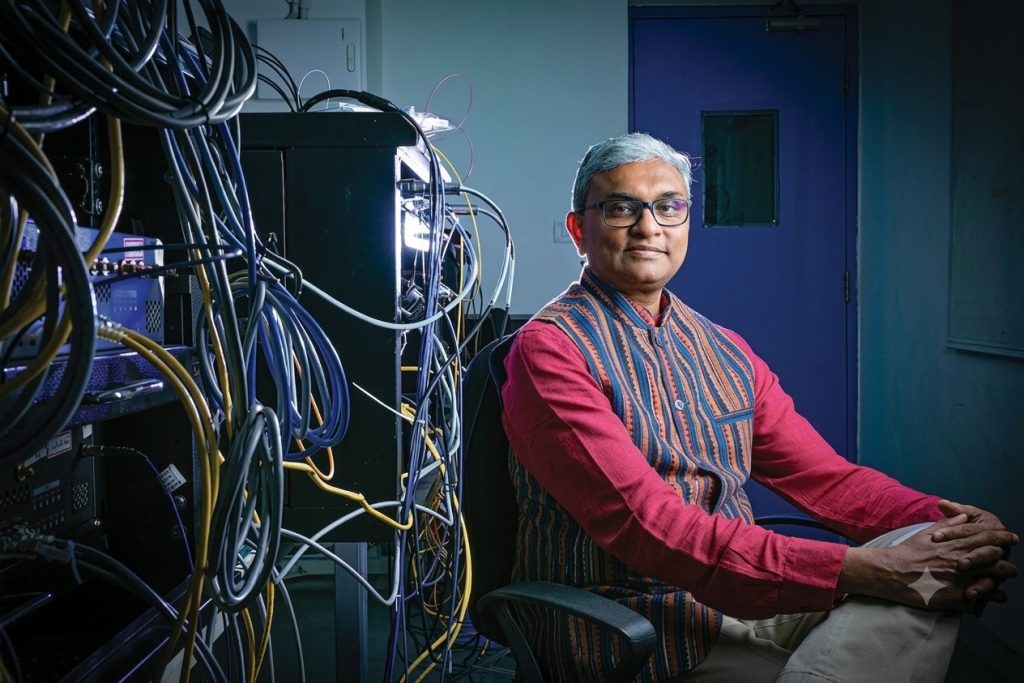
Speaking on the raise, co-founder and CEO Sunil Gupta said India has moved early in the quantum era, crediting the National Quantum Mission’s IIT Madras hub for laying the groundwork, and noting that with implementation timelines published across sectors in 2026, quantum-safe technology is shifting from policy to commercial deployment.
From an IIT Madras Incubation to India’s Only Full-Stack Quantum Cybersecurity Company
QNu Labs was founded in 2016 by Sunil Gupta and Srinivasa Rao Aluri, along with Mark Mathias and Anil Prabhakar, and was incubated at IIT Madras before the company eventually moved its headquarters to Bengaluru.
Sunil Gupta, who serves as Co-founder and CEO, brings over three decades of experience as a business leader and entrepreneur. Before starting QNu, he was President and COO at Paladion Networks, a cybersecurity services firm — giving him a solid grounding in the enterprise security business before he pivoted to quantum technology. He holds a management degree from the Indian Institute of Management, Calcutta.
Srinivasa Rao Aluri, Co-founder and Chairman, has a background quite different from the typical deep-tech founder — he spent years in finance, having worked as Managing Director in Private Equity at Morgan Stanley Investment Management. He studied at Yale School of Management and Osmania University. His pairing with Gupta brought together capital markets acumen and cybersecurity operating experience right from the company’s founding.
The other two co-founders, Mark Mathias and Anil Prabhakar, have stayed closer to the technical and production side of the business — Mathias currently heads production at the company, while Prabhakar, an academic associated with IIT Madras, continues to serve as a technical advisor, reflecting the company’s research-driven roots.
The founding thesis, as the team has described it over the years, came from a fairly direct question: as India raced to become one of the world’s largest digital economies, who was building the technology to secure that digital infrastructure for the next era of computing? That question — asked nearly a decade before quantum computing entered mainstream conversation — led to QNu Labs being set up inside IIT Madras in 2016.
What QNu Labs Actually Builds
QNu Labs describes itself as India’s only full-stack quantum cybersecurity company — meaning it builds the hardware, software, and applications needed to secure communications, rather than just one layer of the stack.
Its flagship product, Armos, is a Quantum Key Distribution (QKD) system that generates and distributes encryption keys using the laws of quantum physics rather than mathematical complexity. It works over regular fibre-optic cables for distances up to roughly 150 km, and any attempt to intercept the transmitted key physically disturbs the underlying quantum signal, alerting the system to an eavesdropper — giving it what the company calls “information-theoretic security,” which cannot be broken by any amount of future computing power.
Alongside Armos, the company offers Tropos, a Quantum Random Number Generator (QRNG) that produces truly random numbers for cryptographic use, addressing a common weak point in conventional encryption systems that rely on pseudo-random number generation. There’s also Hodos, a Post-Quantum Cryptography (PQC) stack built on lattice-based algorithms designed to resist attacks from quantum computers, aimed at use cases where dedicated QKD hardware isn’t practical. And Qosmos is an “Entropy as a Service” offering that supplies high-quality quantum randomness to cloud, embedded, and edge systems that would otherwise face entropy starvation.
More recently, the company has also rolled out a software-defined, cloud-native version of its key-distribution technology aimed at enterprises running on AWS, Azure, or hybrid infrastructure, since traditional hardware-based QKD is limited by the fibre-distance constraints of dedicated point-to-point links.
Traction So Far
A decade since its founding, QNu Labs says its technology already protects communications for the Indian Army and Navy, and has been deployed across government, banking, financial services and insurance (BFSI), and other critical infrastructure clients. Its products are also listed on the Government e-Marketplace (GeM), making them directly procurable by Indian government departments.
Earlier in 2026, India successfully demonstrated a 1,000-km secure quantum communication network built using QNu Labs’ technology, working under the National Quantum Mission — a significant technical milestone for a technology that has traditionally struggled with distance limitations over fibre.
The company currently employs a team of around 160 people, comprising engineers, physicists and mathematicians, and also runs QNu Academy, a training initiative aimed at building a pipeline of quantum-communication talent through partnerships with academic institutions. It has an international footprint too, having set up a US subsidiary in Massachusetts back in 2019, with an office now also in Austin, Texas.
With this fresh round of funding, QNu Labs is positioning itself for its next phase — moving from being an early technology pioneer in a niche field to scaling commercial adoption globally, right as governments and large enterprises start budgeting seriously for the quantum-safe transition.