India’s unicorn story might have slowed down in recent years, but that hasn’t stopped startups from looking to solve some pretty interesting new problems.
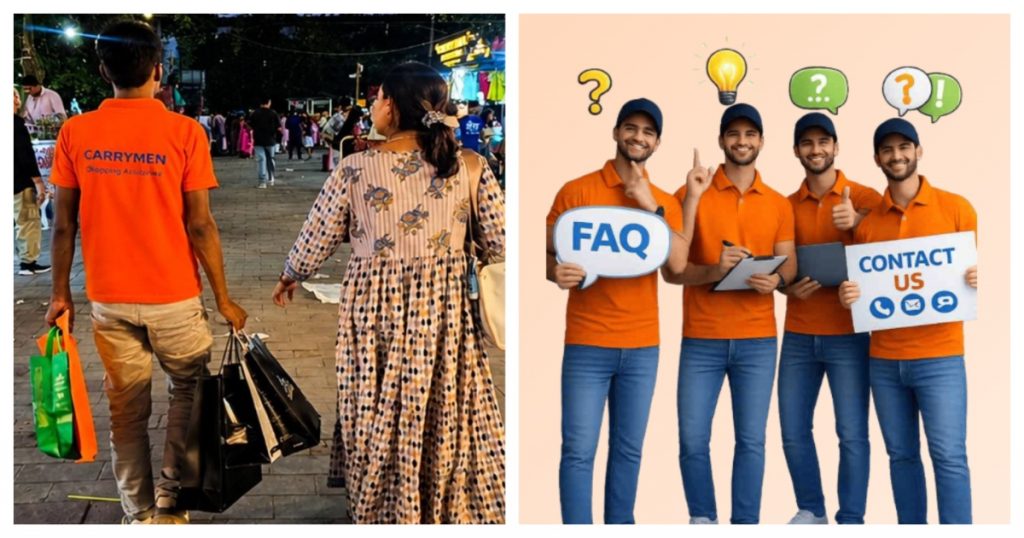
Meet CarryMen — a Delhi-based startup that does exactly what its name suggests: it sends trained assistants to carry your shopping bags while you browse markets. The pitch is disarmingly simple: You shop. We carry.
The Problem It’s Solving
Anyone who has spent an afternoon at Lajpat Nagar, Sarojini Nagar, or Chandni Chowk knows the drill. The shopping is exciting; everything after the first two hours is not. Heavy bags, no seating, long food queues, and kilometres of walking in Delhi’s heat have a way of turning a fun outing into a physical endurance test.
The founders — both Delhi locals — say the idea came directly from those experiences. Accompanying family members through crowded markets for years, they noticed something obvious: people love shopping, but they hate the physical toll it takes. Someone in the group is almost always playing the unofficial “coolie” — usually a father, brother, or boyfriend — expected to carry bags without complaint. CarryMen formalises that unpaid, informal role and puts it on-demand at a transparent price.
How It Works
Customers can book a trained assistant for two, three, or four-hour slots starting at ₹149 per hour. Each assistant, called a CarryMan, works under a Booth Captain — a supervisor who conducts daily briefings and maintains accountability. All staff are uniformed, carry visible ID cards, and have undergone internal verification before being deployed.
The service goes well beyond bag-carrying. Assistants can stand in food queues, escort customers to parking areas or metro stations, provide umbrellas for the heat, offer mobile charging support and power banks, and even set up portable foldable chairs mid-market for shoppers who need a rest. Families with young children can also rent strollers at an additional hourly charge.
One weight limit applies: 12 kg per assistant. For heavier loads, customers can simply book a second helper.
Who Is Actually Using It?
The customer profile is broader than the viral memes would suggest. Elderly women shopping for curtains and bedsheets. Pregnant women. Parents with toddlers. Groups who just want to eat their way through a market without juggling bags.
That said, the social media reaction has been, to put it mildly, colourful. Users have questioned whether shoppers can trust strangers with expensive lehengas and sarees. Others have raised concerns about safety in crowded areas. Some have linked the startup to broader anxieties about employment in India — reading it as a sign that people will take any work available. The founders have leaned into the controversy rather than away from it, letting organic word-of-mouth do the heavy lifting (pun intended). No influencer campaigns. No paid promotions. Just chatter.
The Gig Economy Angle
CarryMen is a sharp reminder that India’s gig economy is no longer limited to bike deliveries and cab rides. The country has an enormous pool of workers seeking flexible income and an urban middle class increasingly willing to pay for convenience — even micro-convenience.
India’s hyperlocal startup space has had its share of hits and misses over the years. Companies like Dunzo attracted major investment before the market consolidated. What distinguishes CarryMen from that wave is that it requires almost no tech infrastructure to work. There is no complex app, no algorithmic routing, no dark store. It is a booth in a market, a uniformed person with a WhatsApp booking link, and a simple value proposition.
That low-overhead model has its advantages. The startup launched in April 2026, has completed over 50 bookings in its first month, and is currently scaling to Chandni Chowk — one of Asia’s densest retail environments. If it works there, the template is replicable across every major bazaar in India.
What It Would Take to Scale
The unit economics are straightforward at a glance. At ₹149 per hour, a four-hour booking brings in ₹596 per assistant. Multiply that across several simultaneous workers at a busy market on a weekend, and the numbers become interesting. The real question is whether CarryMen can maintain quality control at scale — verification, training, supervision — without the cost base eroding the margin.
There is also a trust problem to solve. Handing your bags to a stranger in a crowded market is, for many shoppers, a leap. The uniform, the ID card, the booth captain model — these are all deliberate design choices aimed at reducing that friction. But building genuine consumer trust will take time and, inevitably, a few bad incidents that the company will need to handle transparently.
If CarryMen can crack that, it has a genuinely scalable idea on its hands. India has hundreds of markets like Lajpat Nagar. The future of work in India is being shaped by exactly this kind of hyperlocal, people-first service model — one that does not require a massive fundraise or a decade-long path to profitability, just a real problem and the discipline to solve it well.
CarryMen is early-stage, bootstrapped-looking, and operating from market booths. It is not a unicorn. But it is solving a problem that millions of Indian shoppers feel every single weekend — and it launched with a name catchy enough to go viral on its own. That is not nothing.