In a small office in Bengaluru in 2022, three engineers with ISRO and aerospace industry backgrounds sat down to dinner and asked themselves a simple question: why is access to space still a luxury? That conversation became EtherealX — now rebranded as The Guild — one of India’s most closely watched spacetech startups, building what it claims will be the world’s first fully reusable medium-lift launch vehicle.
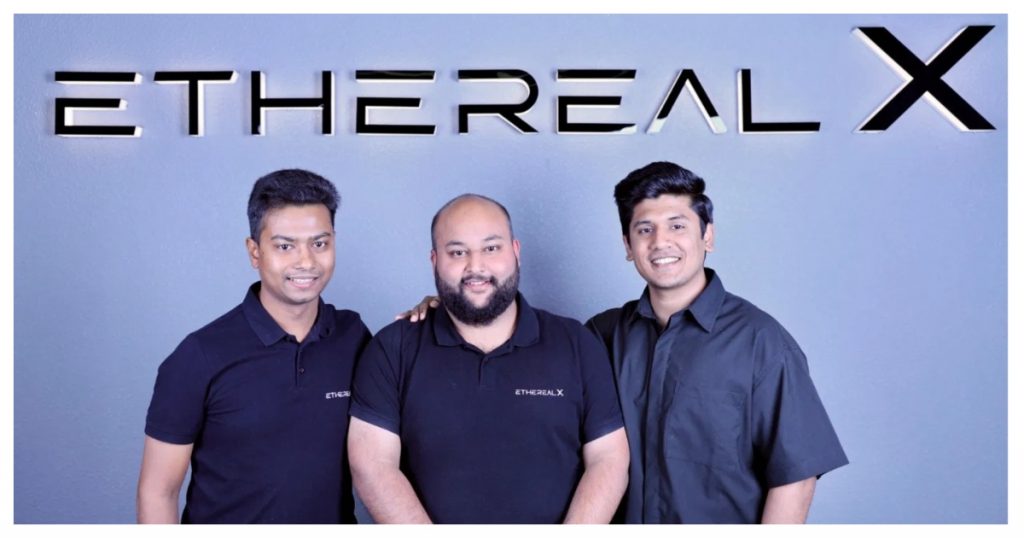
The Founders
EtherealX was founded by Manu J. Nair (CEO), Prashanth Sharma (CTO), and Shubhayu Sardar (COO), and incorporated in May 2022 in Bengaluru.
Nair’s own path to founding a rocket company wasn’t linear. A mechanical engineering graduate from BML Munjal University, he was one of 12 candidates selected globally for Project PoSSUM, a NASA-aided scientist-astronaut program. He then joined ISRO’s Human Spaceflight Centre as its first-ever R&D associate, where he designed a waste management system for humans in microgravity. It was there that he met Sardar, a fellow ISRO engineer.
Nair moved next to Manastu Space in Mumbai, where he headed strategy and business development — and where he met Sharma, who led the company’s propulsion work. After helping Manastu close a multi-million-dollar overseas deal, Nair left in January 2022 to pursue the larger vision, bringing Sharma to Bengaluru to meet Sardar. The three spent the following months researching and stress-testing the idea before convincing Sardar to leave his decade-long tenure at ISRO to join them as a co-founder.
Between them, the founders bring a fairly complete rocket-building stack: Sharma previously worked on green propulsion technology at Manastu Space, while Sardar spent a decade at ISRO across launch vehicle and spacecraft development roles. Nair has described himself as a first-generation founder — his father served in the Indian Air Force — and the company itself says it began with borrowed money from Nair’s father and a shared conviction that orbital access shouldn’t be scarce by design.
What They’re Building
EtherealX’s flagship product is the Razor Crest Mk-1 (RCM1), a roughly 71-metre, medium-lift launch vehicle designed for full two-stage reusability — meaning both the booster and the upper stage are meant to return to Earth intact, unlike most reusable rockets today (including SpaceX’s Falcon 9), which typically recover only the booster.
The vehicle is expected to carry up to 24.8 tons in an expendable configuration, 22.8 tons in a partially reusable mode, and about 8 tons when fully reusable. Power comes from two proprietary in-house engines: the Pegasus upper-stage engine, which delivers 323 seconds of vacuum-specific impulse using a full-flow cooling cycle, and the Stallion booster engine, delivering 306 seconds of sea-level impulse via a gas-generator cycle — with nine Stallion engines powering the booster and 15 Pegasus engines lifting the upper stage. The company says critical components such as turbopumps are produced in-house using additive manufacturing.
The long-term pitch is cost: EtherealX is targeting launch pricing of $350 to $2,000 per kilogram depending on configuration and cadence — a fraction of current global averages.
To get there, the company has built its own test infrastructure rather than wait for public facilities. BASE-001 in Cuddalore, Tamil Nadu is described as India’s highest pressure-rated privately built rocket engine test facility, with turbopump testing capacity exceeding 35,000 RPM. A second, larger facility — BASE-002, on a 150-acre parcel in Space City, Andhra Pradesh, acquired with state government support — will handle integrated manufacturing, assembly and full-stage testing, and was expected to come online around mid-2026. Hot-fire tests of the clustered engines were slated for mid-2026, ahead of a technology demonstration orbital flight targeted for 2027 and commercial launches expected from 2028.
Funding and Investors
EtherealX has raised roughly $25 million across four rounds since inception. The company closed a $5 million seed round in August 2024 at a $14.6 million valuation, before returning to the market a little over a year later.
In December 2025, it closed an oversubscribed $20.5 million Series A round led by TDK Ventures and BIG Capital, with participation from Accel, Prosus, YourNest, BlueHill, Campus Fund, and Riceberg Ventures. The round had reportedly been targeting just $15 million originally. It pushed EtherealX’s valuation up 5.5x to $80.5 million.
TDK Ventures president Nicolas Sauvage framed the bet around the company’s cost ambitions and its ISRO pedigree, noting the firm’s excitement to back the company’s goal of reshaping the medium-lift space-launch industry by slashing launch costs and harnessing India’s ISRO expertise and cost-efficient supply chain.
Traction and Customers
Even at a pre-launch stage, EtherealX says it has lined up meaningful commercial interest. Ahead of its Series A, the company had already secured contracts worth $130 million from six clients. More recently, it has signed memoranda of understanding totaling $130 million with international partners, including Japan’s SpaceBD and Taiwan’s TASA.
The team has grown accordingly — from a handful of founding engineers to a headcount of around 67, with plans to expand to 90 as testing and manufacturing ramp up.
What’s Next
EtherealX — now going to market as The Guild — has been candid about the scale of the challenge ahead. Nair has said the company is deliberately skipping suborbital test flights, arguing its re-entry cooling technology only produces meaningful data at actual orbital velocities, around 7.8 kilometers per second. The first uncrewed technology demonstration flight of the Razor Crest Mk-1 is targeted for 2027, with commercial launch services expected to follow in 2028.
For a country whose private space sector is still young, EtherealX’s bet — full reusability, in the medium-lift class, engineered almost entirely in-house — is among the most ambitious being attempted anywhere outside the US. Whether it can execute at the pace its funding round suggests investors expect will likely become clear over the next 18 to 24 months, as hot-fire testing at its Tamil Nadu and Andhra Pradesh facilities moves toward an actual flight.