The AI revolution is leading to some strange bedfellows in the business world.
IndiGo Ventures, the corporate venture arm of India’s largest airline, has put money into Sarvam, the Bengaluru-based company building India’s sovereign AI stack. The investment is part of Sarvam’s Series B round, and it brings together two companies that, on paper, have almost nothing to do with each other. One flies planes. The other builds large language models. Together, they’re betting that aviation is exactly the kind of business AI was built for.
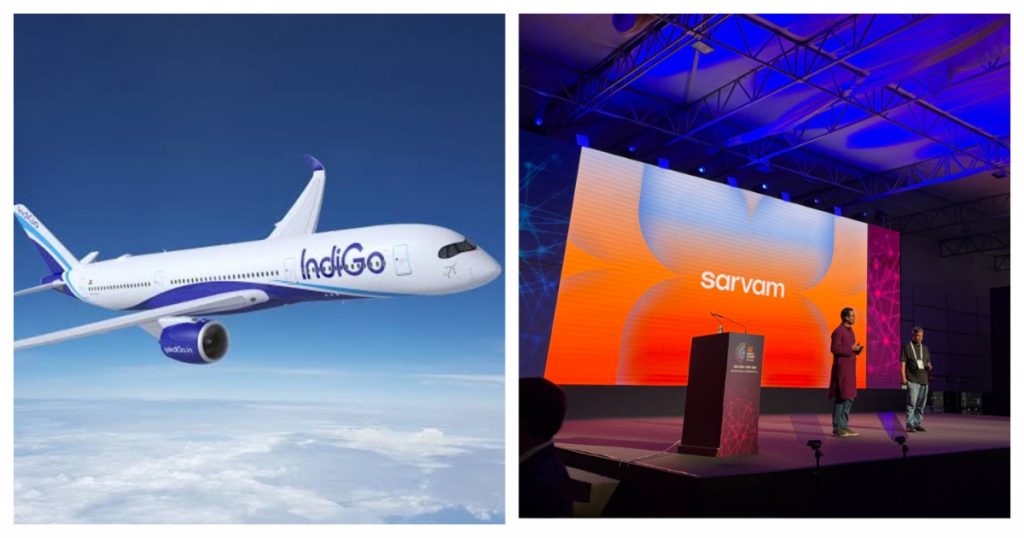
The announcement frames this as an extension of work the two companies were already doing. IndiGo and Sarvam have reportedly been collaborating for a while on customer experience, employee tooling and operational workflows across the airline, and this funding round turns that working relationship into an equity stake. Neetan Chopra, IndiGo’s Chief Digital and Information Officer, called AI a foundational capability for the aviation industry now, one that’s reshaping customer experience, workforce productivity and operational decision-making across the sector.
The logic isn’t hard to follow once you look at what an airline actually deals with. Millions of customer interactions, flights that run on tight, unforgiving schedules and a workforce spread across dozens of cities and countless job functions, from ground staff to pilots to call centre agents. It’s a business built on volume and timing, which happens to be exactly the kind of environment where AI systems tend to earn their keep. Sarvam’s pitch, as its co-founder Pratyush Kumar put it, is that aviation is a powerful proving ground for enterprise AI precisely because of that complexity.
For Sarvam, this deal adds a marquee enterprise customer to a client list that already includes the Indian government and Meta, whom it partnered with earlier this year to bring Hindi voice support to Ray-Ban Meta glasses. The company has built out models, inference infrastructure and deployment tooling meant to work without leaning on foreign AI providers, an approach that fits neatly with the government’s own sovereign AI ambitions. IndiGo becoming an investor and, more importantly, an active customer gives Sarvam a real-world, high-stakes deployment to point to.
For IndiGo, the calculation is different but not any less strategic. Airlines run on thin margins and brutal operational complexity, and IndiGo has already dabbled in AI-driven customer service through tools like its WhatsApp assistant 6Eskai, built with Google Cloud. Taking an equity stake in an AI company it’s already working with gives IndiGo more control over the technology’s roadmap than a standard vendor contract would. It also means the airline has skin in the game if Sarvam’s models keep improving, rather than just paying for access to whatever gets shipped.
There’s a broader pattern here too. India’s largest companies, across sectors that have nothing to do with software, are starting to treat homegrown AI capability as something worth owning a piece of rather than just renting. Sarvam has leaned hard into this, having also partnered with satellite company Pixxel to put its models into orbit, and having already secured backing from the Indian government itself in exchange for compute access. An airline joining that list, alongside a government body and a satellite operator, says something about how broadly Sarvam is positioning itself.
The financial terms of IndiGo’s stake haven’t been disclosed, and it’s unclear how large a slice of the round this represents next to the $234 million raise that valued Sarvam at $1.5 billion a few months earlier. What’s clearer is the direction of travel. Sarvam wants to be the default AI layer for Indian enterprise, and IndiGo wants to make sure that if that happens, it isn’t just watching from the sidelines.
Whether this actually moves the needle on IndiGo’s operations in a way passengers notice remains to be seen. Chatbots and predictive maintenance tools have a habit of promising more transformation than they deliver in year one. But the fact that an airline is now a strategic investor in a foundation model company, rather than just a customer, marks a shift in how Indian companies are choosing to engage with the AI buildout happening around them.